
Chemicals Found in Pregnant Women and Newborns
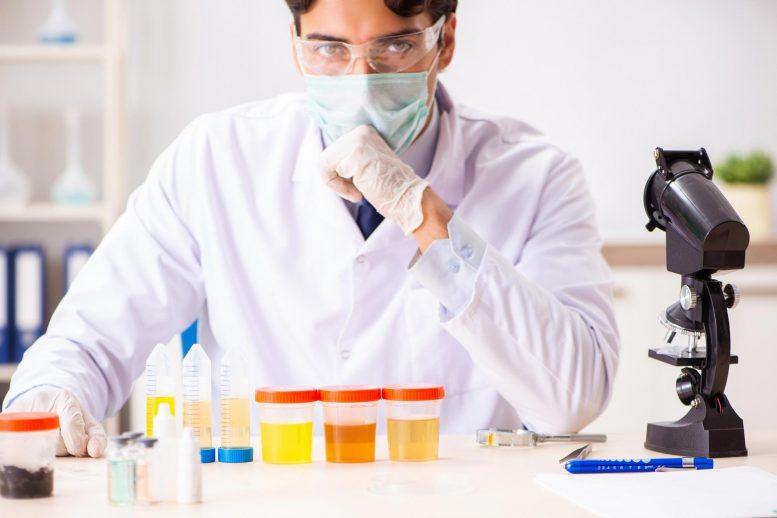
Scientists at University of California San Francisco have detected 109 chemicals in a study of pregnant women, including 55 chemicals never before reported in people and 42 “mystery chemicals,” whose sources and uses are unknown.
The chemicals most likely come from consumer products or other industrial sources. They were found both in the blood of pregnant women, as well as their newborn children, suggesting they are traveling through the mother’s placenta.
The study was published on March 16, 2021, in Environmental Science & Technology.
A Growing Concern Across Generations
“These chemicals have probably been in people for quite some time, but our technology is now helping us to identify more of them,” said Tracey J. Woodruff, PhD, a professor of obstetrics, gynecology and reproductive sciences at UCSF.
A former U.S. Environmental Protection Agency scientist, Woodruff directs the Program on Reproductive Health and the Environment (PRHE) and the Environmental Research and Translation for Health (EaRTH) Center, both at UCSF.
“It is alarming that we keep seeing certain chemicals travel from pregnant women to their children, which means these chemicals can be with us for generations,” she said.
The scientific team used high-resolution mass spectrometry (HRMS) to identify human-made chemicals in people.
But, while these chemicals can be tentatively identified using chemical libraries, they need to be confirmed by comparing them to the pure chemicals produced by manufacturers that are known as “analytical standards.” And manufacturers do not always make these available.
Recently, for example, chemical manufacturer Solvay stopped providing access to a chemical standard for one perfluorooctanoic acid (PFAS) compound that has emerged as a replacement for phased-out PFAS compounds. The researchers have been using this chemical standard to evaluate the presence and the toxicity of the replacement PFAS.
“These new technologies are promising in enabling us to identify more chemicals in people, but our study findings also make clear that chemical manufacturers need to provide analytical standards so that we can confirm the presence of chemicals and evaluate their toxicity,” said co-lead author Dimitri Panagopoulos Abrahamsson, PhD, a postdoctoral fellow with UCSF’s PRHE.
The 109 chemicals researchers found in the blood samples from pregnant women and their newborns are found in many different types of products. For example, 40 are used as plasticizers, 28 in cosmetics, 25 in consumer products, 29 as pharmaceuticals, 23 as pesticides, three as flame retardants, and seven are PFAS compounds, which are used in carpeting, upholstery, and other applications. The researchers say it’s possible there are also other uses for all of these chemicals.
New and Mysterious Compounds Identified
The researchers report that 55 of the 109 chemicals they tentatively identified appear not to have been previously reported in people:
- 1 is used as a pesticide (bis(2,2,6,6-tetramethylpiperidini-4-y) decanedioate)
- 2 are PFASs (methyl perfluoroundecanoate, most likely used in the manufacturing of non-stick cookware and waterproof fabrics; 2-perfluorodecyl ethanoic acid)
- 10 are used as plasticizers (e.g. Sumilizer GA 80 – used in food packaging, paper plates, and small appliances)
- 2 are used in cosmetics
- 4 are high production volume (HPV) chemicals
- 37 have little to no information about their sources or uses (e.g., 1-(1-Acetyl-2,2,6,6-tetramethylpiperidin-4-yl)-3-dodecylpyrrolidine-2,5-dione, used in manufacturing fragrances and paints—this chemical is so little known that there is currently no acronym—and (2R0-7-hydroxy-8-(2-hydroxyethyl)-5-methoxy-2-,3-dihydrochromen-4-one (Acronym: LL-D-253alpha), for which there is limited to no information about its uses or sources
“It’s very concerning that we are unable to identify the uses or sources of so many of these chemicals,” Woodruff said. “EPA must do a better job of requiring the chemical industry to standardize its reporting of chemical compounds and uses. And they need to use their authority to ensure that we have adequate information to evaluate potential health harms and remove chemicals from the market that pose a risk.”
Reference: “Suspect Screening, Prioritization, and Confirmation of Environmental Chemicals in Maternal-Newborn Pairs from San Francisco” by Aolin Wang, Dimitri Panagopoulos Abrahamsson, Ting Jiang, Miaomiao Wang, Rachel Morello-Frosch, June-Soo Park, Marina Sirota and Tracey J. Woodruff, 16 March 2021, Environmental Science & Technology.
DOI: 10.1021/acs.est.0c05984
Authors: Joining Woodruff and Panagopoulos Abrahamsson in the study were Aolin Wang and Marina Sirota, of UCSF; Ting Jiang, Miamiao Wang and June-Soo Park of the California Environmental Protection Agency; and Rachel Morello-Frosch of UC Berkeley.
Funding: This study was funded by NIH/NIEHS grant numbers P30- 870 ES030284, UG3OD023272, UH3OD023272, P01ES022841, 871 R01ES027051 and by the U.S. EPA grant number 872 RD83543301.
Never miss a breakthrough: Join the SciTechDaily newsletter.
Follow us on Google and Google News.
7 Comments
perhaps some of those unknown chemicals are from interactions of other pollutants mixed together and metabolized by people plant and animals?? most labs only test for the pure form of chemicals, not a mixture.
And the Republicans want less regulation and more profits for their big corporate donors. The government, and esp the FDA, has become an embarrassment for the USA around the world. We once relied on such agencies to protect us from unscrupulous chemical companies like Monsanto and Bayer. Now they are in bed together padding each others bank accounts.
Animals fed with Agro Chemicals, Hormones in Red Meat forming more cholesterols, add stress and shake well.
Let’s add a vaccine to it the long-term effects and side-effects of which are completely unknown. What can go wrong? lol
lol….look up in the sky… I know y’all think when people talk like that they cray cray, but this isn’t just about what’s in those forever sky trails.. this is that everything on the ground, ends up in the air, ends up raining/snowing down on us later via clouds..
Republicans want LESS regulation of industry and more profits!? Disgusting,shame on the Republicans
Or why I don’t use cosmetics, air-fresheners or new super-dooper cleaning agents.