
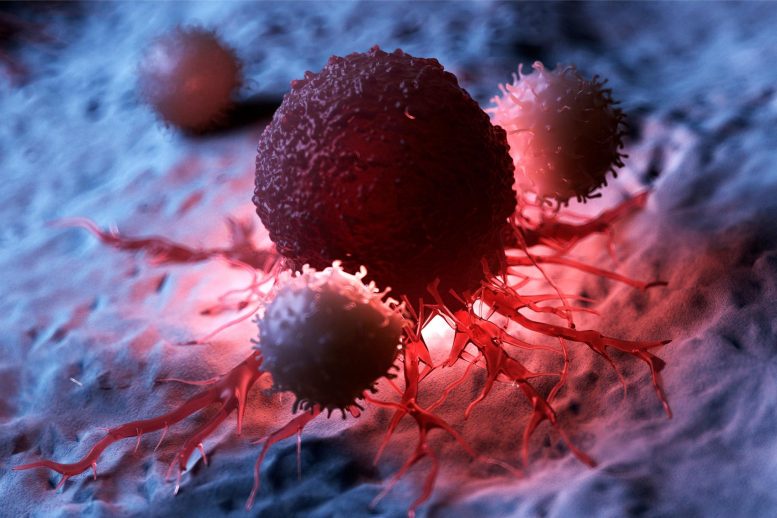
Researchers have created ‘nanomachines’ that use mechanical molecular motions to enter and destroy cells.
Cancer is a condition where some of the body’s cells grow out of control and spread to other bodily regions. Cancer cells divide continually, leading them to invade surrounding tissue and form solid tumors. The majority of cancer treatments involve killing the cancer cells.
According to 2020 estimates, 1.8 million new instances of cancer were diagnosed in the US, and 600,000 people passed away from the condition. Breast cancer, lung cancer, prostate cancer, and colon cancer are the most common cancers. The average age of a cancer patient upon diagnosis is 66, and individuals between the ages of 65 and 74 account for 25% of all new cancer diagnoses.
Proteins are involved in every biological process and use the energy in the body to change their structure via mechanical movements. They are referred to as biological ‘nanomachines’ since even minor structural changes in proteins have a substantial impact on biological processes. To implement movement in the cellular environment, researchers have focused on the development of nanomachines that imitate proteins. However, cells use a variety of mechanisms to defend themselves against the effect of these nanomachines. This restricts any relevant mechanical movement of nanomachines that could be used for medical purposes.
The research team headed by Dr. Youngdo Jeong from the Center for Advanced Biomolecular Recognition at the Korea Institute of Science and Technology (KIST) has reported the development of a novel biochemical nanomachine that penetrates the cell membrane and kills the cell via the molecular movements of folding and unfolding in certain cellular environments, such as cancer cells. They collaborated with the teams of Professor Sang Kyu Kwak from the School of Energy and Chemical Engineering and Professor Ja-Hyoung Ryu from the Department of Chemistry at the Ulsan National Institute of Science and Technology (UNIST), and Dr. Chaekyu Kim of Fusion Biotechnology, Inc.
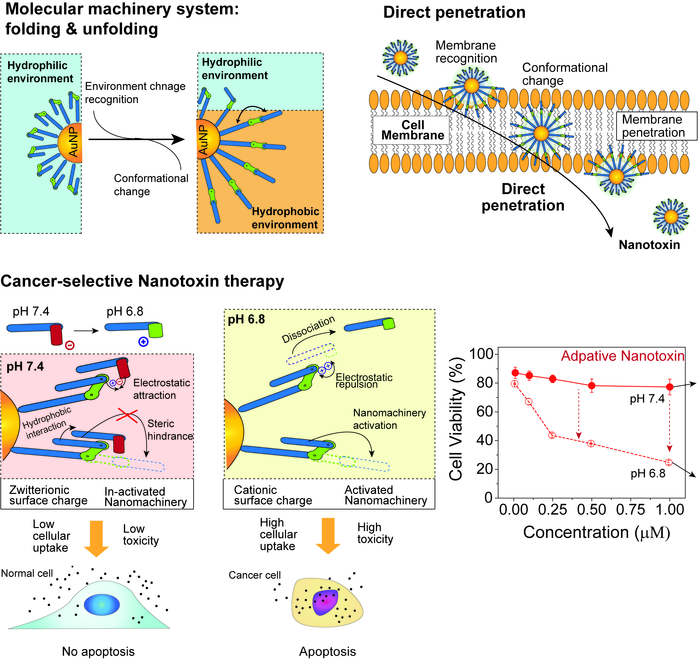
The joint research team focused on the hierarchical structure of proteins, in which the axis of the large structure and the mobile units are hierarchically separated. Therefore, only specific parts can move around the axis. Most existing nanomachines have been designed so that the mobile components and axis of the large structure are present on the same layer. Thus, these components undergo simultaneous movement, which complicates the desired control of a specific part.
A hierarchical nanomachine was fabricated by synthesizing and combining 2 nm-diameter gold nanoparticles with molecules that can be folded and unfolded based on the surrounding environment. This nanomachine was comprised of mobile organic molecules and inorganic nanoparticles to function as large axis structures and defined movement and direction in such a manner that upon reaching the cell membrane, it resulted in a mechanical folding/unfolding movement that led to the nanomachine directly penetrating the cell, destroying the organelles, and inducing apoptosis. This new method directly kills cancer cells via mechanical movements without anticancer medication, in contrast to the capsule-type nanocarriers that deliver therapeutic drugs.
Subsequently, a latch molecule was threaded onto the nanomachine to control the mechanical movement to selectively kill cancer cells. The threaded latch molecule was designed to be released only in a low pH environment. Therefore, in normal cells with a relatively high pH (approximately 7.4), the movements of the nanomachines were restricted and they could not penetrate the cell. However, at the low pH environment around cancer cells (approximately 6.8), the latch molecules were untied, inducing mechanical movement and cell penetration.
Dr. Jeong said, “The developed nanomachine was inspired by proteins that perform biological functions by changing their shape based on their environment. We propose a novel method of directly penetrating cancer cells to kill them via the mechanical movements of molecules attached to nanomachines without drugs. This could be a new alternative to overcome the side effects of existing chemotherapy.”
Reference: “Stimuli-Responsive Adaptive Nanotoxin to Directly Penetrate the Cellular Membrane by Molecular Folding and Unfolding” by Youngdo Jeong, Soyeong Jin, L. Palanikumar, Huyeon Choi, Eunhye Shin, Eun Min Go, Changjoon Keum, Seunghwan Bang, Dongkap Kim, Seungho Lee, Minsoo Kim, Hojun Kim, Kwan Hyi Lee, Batakrishna Jana, Myoung-Hwan Park, Sang Kyu Kwak, Chaekyu Kim and Ja-Hyoung Ryu, 2 March 2022, Journal of the American Chemical Society.
DOI: 10.1021/jacs.2c00084
Never miss a breakthrough: Join the SciTechDaily newsletter.
Follow us on Google and Google News.
45 Comments
Nanomachines, son.
making the mother of all omelettes here, can’t fret over every egg
You can’t hurt me Jack
… if one can bring enough atoms of gold around one could cook the cancer too!
I think what you’re doing is absolutely miraculous and brilliant.. I just want to know how in the heck do you insert the nano machines?
Through the bottom hole.
So how fast does each machine require to render a cancer cell incapacitated? And can they destroy them at a sufficient rate vs. Reproduction? And how many can be introduced at any given time and still effectively do the required task?
How soon can this be implemented for cancer treatment? Are we looking at months or years before we see this come to fruition? We’ve been using chemo for far too long; it is such an inhumane and destructive way to treat people with cancer.
It will be great a relief as chemotherapy is unbearable, expensive and after four to five months it becomes ineffective. Then you shift to the next line of treatment and same story. Kindly advise how does on qualify for nano- machine treatment as all therapeutic options have
been tried.
Reply to the comments I posted before. Thanks
Nanomachine therapy for cancer has a long way to go to get to the clinic and will be expensive. Today we have a non-toxic method of debulking the tumor which I believe should be done first and then the last thing you do is one or two rounds of chemo. If you look it up chemo only can eradicate a tumor that is less than one centimeter in diameter. So if it is a large mass, all you do with chem is knock off one centimeter of the mass and then repeat it over and over whild the tumor continues to grow. Better to use high dose vitamin C, hyperthermia, catalase inhibitors, ultrasound, vibration (destroys the blood vessels), radiation, etc. and then when you have the tumor down to one centimeter, wipe it out totally with the chemo since the cancer will still be sensitive to the chemo at that point.
Let’s do it!
Hmm, so this is how we get to see the Lyndsay Sands Immortal Vampire series become reality? Sign me up as a tester! 😁
Science, science, science…we thank God for it!
Yes!
Thank him for the Covid too !!
Standing here, I realize
Nanomachines, son. They harden in response to physical trauma. You can’t hurt me Jack.
Why won’t you Die!
There are methods to raise ph levels so that cancer cells die out. Why those inexpensive methods aren’t used or promoted?
Different topic with nanoparticles but im desperate. Is it possible to have individual weapon uding Hydrogen Sulphate/Methylmercury and conveyences? Cause it happenung here in Woodstock ontario Canada
[email protected]
This is in response to post that chemo can only kill one centimeter of the tumor. I’m confused because I had a 3×8 cm tumor in my lung and chemo shrunk the tumor to less than 1 cmx 3cm. Immunotherapy continued to shrink the tumor to barely visible particles.
HIV ki vaccion be bna da plz
Metal gear solid In full effect
good new for cancer pacient.
And I am also proud on behealf of researcher.
good new for cancer pacient.and I am also great on behealf of the researcher.
You Slippery Little Bastard!
Can it help endometriosis patients also?
Ivermectin is useful in curing cancer.
Snake? SNAKEEEEE
You really mean, penetrates and kills. Period
*Looks at cancer* DIE YOU PIECE OF S***!
all right… I think we’re about done here.
They harden in response to physical trauma!
Standing here
I realize
You were just like me trying to make history
But who’s to judge
The right from wrong
Nanomachines, son
Nanomachines, son. They harden in response to physical trauma. YOU CAN’T HURT ME JACK!
…
What did I just say?
Time to end this.
DIE! DIE!
Die you piece of |garbage|!
This is pretty cool, Of course it probably still has a long way to go, but im glad, Ive been trying to get some closure since one of my Favorite youtubers just died from stage 4 cancer, stupid, yes, But oh well, thats the cycle of life sometimes, moving on im excited for the future and hope a cure for cancer that can efficently kill it would be invented, in or far away from the future.
NANOMACHINES SON
Nice to hear, but after helping 2 family members get standard treatment and die even though there were advanced treatments being used, I don’t have much hope this will see general use. For myself, I will seek no treatment if it hits me.
An advanced technology to cure a disease caused by advanced technology… What could go wrong?
thank you