
Close Menu
    Facebook X (Twitter) Instagram
    SciTechDaily
    • Biology
    • Chemistry
    • Earth
    • Health
    • Physics
    • Science
    • Space
    • Technology
    Facebook X (Twitter) Pinterest YouTube RSS
    SciTechDaily
    Home»Space»Scientists Develop New Space Weather Model to Help Simulate Magnetic Structure of Solar Storms
    Space

    Scientists Develop New Space Weather Model to Help Simulate Magnetic Structure of Solar Storms

    By Lina Tran, NASA’s Goddard Space Flight CenterJanuary 26, 2017No Comments3 Mins Read
    Facebook Twitter Pinterest Telegram LinkedIn WhatsApp Email Reddit
    Share
    Facebook Twitter LinkedIn Pinterest Telegram Email Reddit
    New Space Weather Model Helps Simulate Magnetic Structure of Solar Storms
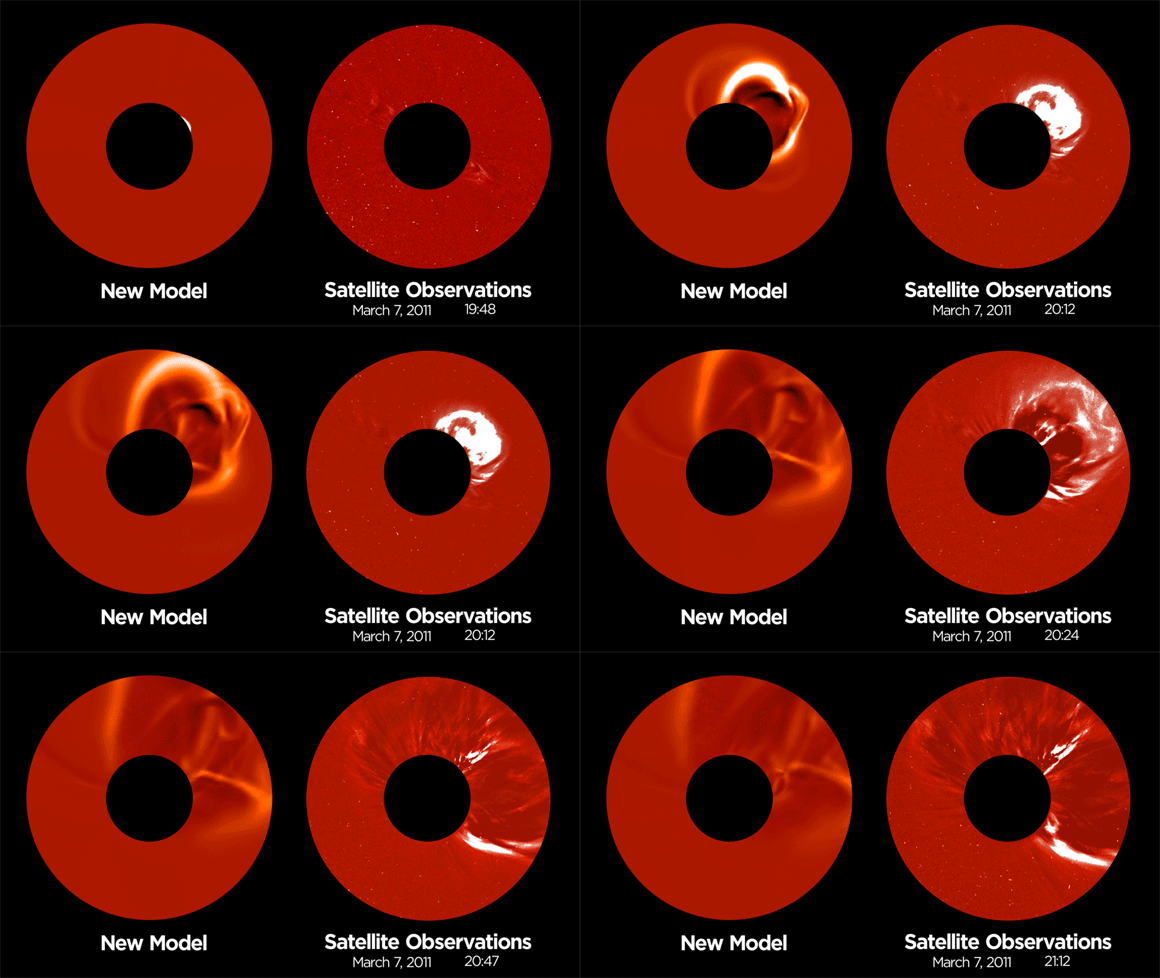
    These animated images show the propagation of a CME as it erupts from the sun and travels through space, comparing actual NASA and ESA’s SOHO satellite observations on the right to the simulation from the new CME-modeling tool at the Community Coordinated Modeling Center on the left. SOHO observed this CME on March 7, 2011.

    Engineers developed the model as part of its Space Weather Modeling Framework, which is the first “first principles” model to simulate CMEs including their magnetic structure open to the public.

    The dynamic space environment that surrounds Earth – the space our astronauts and spacecraft travel through – can be rattled by huge solar eruptions from the sun, which spew giant clouds of magnetic energy and plasma, a hot gas of electrically charged particles, out into space. The magnetic field of these solar eruptions are difficult to predict and can interact with Earth’s magnetic fields, causing space weather effects.

    A new tool called EEGGL – short for the Eruptive Event Generator (Gibson and Low) and pronounced “eagle” – helps map out the paths of these magnetically structured clouds, called coronal mass ejections or CMEs, before they reach Earth. EEGGL is part of a much larger new model of the corona, the sun’s outer atmosphere, and interplanetary space, developed by a team at the University of Michigan. Built to simulate solar storms, EEGGL helps NASA study how a CME might travel through space to Earth and what magnetic configuration it will have when it arrives. The model is hosted by the Community Coordinated Modeling Center, or CCMC, at NASA’s Goddard Space Flight Center in Greenbelt, Maryland.

    The new model is known as a “first principles” model because its calculations are based on the fundamental physics theory that describes the event – in this case, the plasma properties and magnetic free energy, or electromagnetics, guiding a CME’s movement through space.

    Such computer models can help researchers better understand how the sun will affect near-Earth space, and potentially improve our ability to predict space weather, as is done by the U.S. National Oceanic and Atmospheric Administration.

    Taking into account the magnetic structure of a CME from its initiation at the sun could mark a big step in CME modeling; various other models initiate CMEs solely based on the kinematic properties, that is, the mass and initial velocity inferred from spacecraft observations. Incorporating the magnetic properties at CME initiation may give scientists a better idea of a CME’s magnetic structure and ultimately, how this structure influences the CME’s path through space and interaction with Earth’s magnetic fields – an important piece to the puzzle of the sun’s dynamic behavior.

    The model begins with real spacecraft observations of a CME, including the eruption’s initial speed and location on the sun, and then projects how the CME could travel based on the fundamental laws of electromagnetics. Ultimately, it returns a series of synthetic images, which look similar to those produced of actual observations from NASA and ESA’s SOHO or NASA’s STEREO, simulating the CME’s propagation through space.

    A team led by Tamas Gombosi at the University of Michigan’s Department of Climate and Space Sciences and Engineering developed the model as part of its Space Weather Modeling Framework, which is also hosted at the CCMC. All of the CCMC’s space weather models are available for use and study by researchers and the public through runs on request. In addition, EEGGL, and the model it supports, is the first “first principles” model to simulate CMEs including their magnetic structure open to the public.

    Never miss a breakthrough: Join the SciTechDaily newsletter.
    Follow us on Google and Google News.

    Astronomy Coronal Mass Ejections Earth Science NASA Goddard Space Flight Center Planetary Science Space Weather
    Share. Facebook Twitter Pinterest LinkedIn Email Reddit

    Related Articles

    NASA’s Van Allen Probes Uncover Relativistic Electrons

    NASA’s TWINS Provide Continuous Coverage of the Ring Current

    Study Reveals How Saturn’s Magnetosphere Changes With the Seasons

    Cassini Views a Spinning Vortex at Saturn’s North Pole

    NASA Captures Image of an M6.5 Class Flare

    NASA’s Solar Dynamics Observatory Captures Filament Explosion

    Two Coronal Mass Ejections Strongly Compressed the Magnetopause

    New Image of an M7.9 Flare from Active Region 1429

    NASA Continues to Monitor Solar Flares

    Leave A Reply Cancel Reply

    • Facebook
    • Twitter
    • Pinterest
    • YouTube

    Don't Miss a Discovery

    Subscribe for the Latest in Science & Tech!

    Trending News

    Millions Take These IBS Drugs, But a New Study Finds Serious Risks

    Scientists Unlock Hidden Secrets of 2,300-Year-Old Mummies Using Cutting-Edge CT Scanner

    Bread Might Be Making You Gain Weight Even Without Eating More Calories

    Scientists Discover Massive Magma Reservoir Beneath Tuscany

    Europe’s Most Active Volcano Just Got Stranger – Here’s Why Scientists Are Rethinking It

    Alzheimer’s Symptoms May Start Outside the Brain, Study Finds

    Millions Take This Popular Supplement – Scientists Discover a Concerning Link to Heart Failure

    The Universe Is Expanding Too Fast and Scientists Can’t Explain Why

    Follow SciTechDaily
    • Facebook
    • Twitter
    • YouTube
    • Pinterest
    • Newsletter
    • RSS
    SciTech News
    • Biology News
    • Chemistry News
    • Earth News
    • Health News
    • Physics News
    • Science News
    • Space News
    • Technology News
    Recent Posts
    • Doctors Surprised by the Power of a Simple Drug Against Colon Cancer
    • Why Popular Diabetes Drugs Like Ozempic Don’t Work for Everyone: The “Genetic Glitch”
    • Scientists Create Improved Insulin Cells That Reverse Diabetes in Mice
    • Scientists Stunned After Finding Plant Thought Extinct for 60 Years
    • A Common Diabetes Drug May Hold the Key to Stopping HIV From Coming Back
    Copyright © 1998 - 2026 SciTechDaily. All Rights Reserved.
    • Science News
    • About
    • Contact
    • Editorial Board
    • Privacy Policy
    • Terms of Use

    Type above and press Enter to search. Press Esc to cancel.