
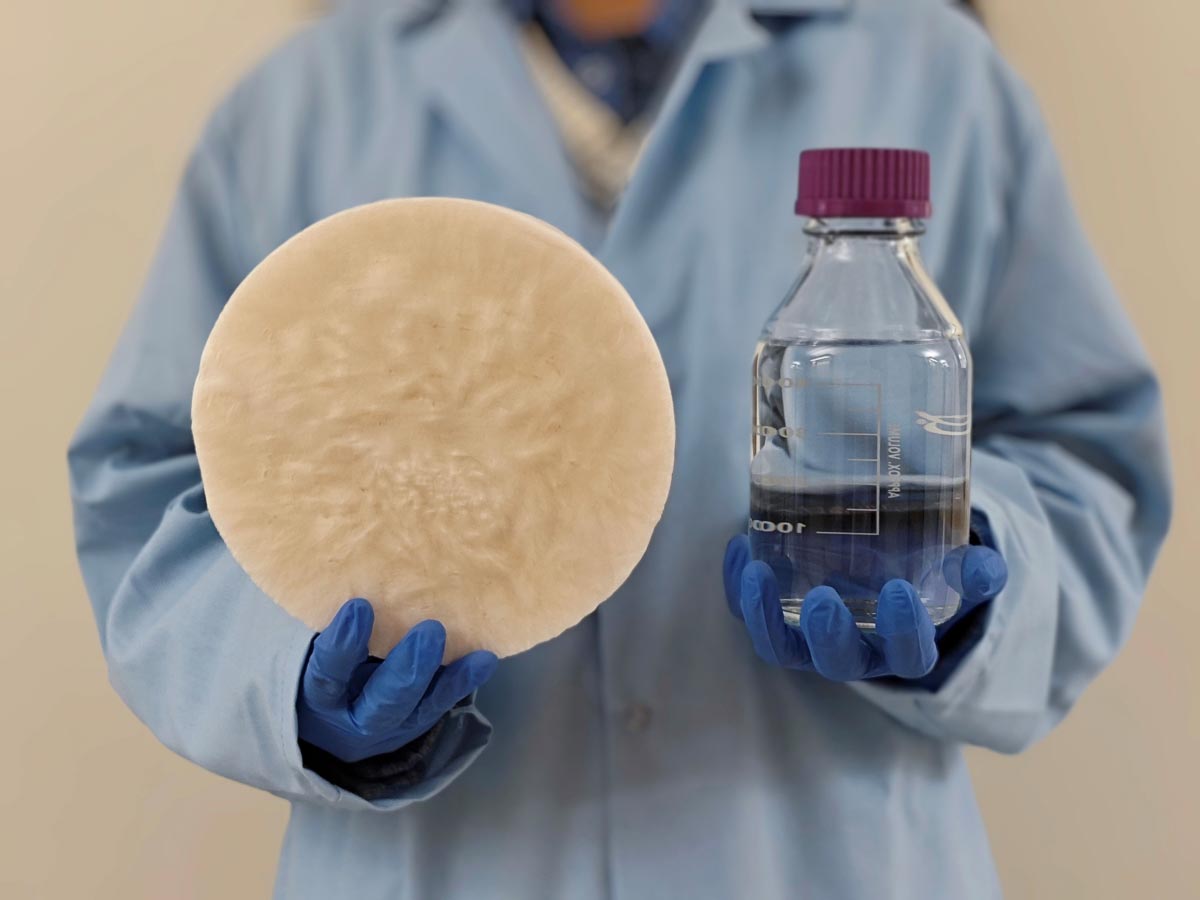
UT Austin researchers have developed a biodegradable, biomass-based hydrogel that efficiently extracts drinkable water from the air, offering a scalable, sustainable solution for water access in off-grid communities, emergency relief, and agriculture.
Discarded food scraps, stray branches, seashells, and other natural materials serve as key ingredients in a new system developed by researchers at The University of Texas at Austin that can extract drinkable water from thin air.
This innovative system, called “molecularly functionalized biomass hydrogels,” transforms a wide range of natural products into sorbents—materials that absorb liquids. By pairing these sorbents with mild heat, the researchers can extract gallons of drinkable water from the atmosphere, even in arid conditions.
“With this breakthrough, we’ve created a universal molecular engineering strategy that allows diverse natural materials to be transformed into high-efficiency sorbents,” said Guihua Yu, a professor of materials science and mechanical engineering and Texas Materials Institute at UT Austin. “This opens up an entirely new way to think about sustainable water collection, marking a big step towards practical water harvesting systems for households and small community scale.”
In field tests, the researchers generated 14.19 liters (3.75 gallons) of clean water per kilogram of sorbent daily. Most sorbents can generate between 1 and 5 liters per kilogram per day.
The new research was published in Advanced Materials.
Turning Biomass into High-Efficiency Sorbents
This system represents a new way of designing sorbents, the researchers say. Instead of the traditional “select-and-combine” approach, which requires picking specific materials for specific functions, this general molecular strategy makes it possible to turn almost any biomass into an efficient water harvester.
Unlike existing synthetic sorbents, which use petrochemicals and generally require high energy inputs, the UT Austin team’s biomass-based hydrogel is biodegradable, scalable, and requires minimal energy to release water. The secret lies in a two-step molecular engineering process that imparts hygroscopic properties and thermoresponsive behavior to any biomass-based polysaccharide, such as cellulose, starch, or chitosan.
“At the end of the day, clean water access should be simple, sustainable, and scalable,” said Weixin Guan, a senior doctoral student and the study’s lead researcher. “This material gives us a way to tap into nature’s most abundant resources and make water from air—anytime, anywhere.”
The latest innovation is part of Yu’s years-long quest to develop solutions for people lacking access to clean drinking water. He’s developed water-generating hydrogels throughout his career, adapting them for the driest conditions. He recently created an injectable water filtration system, and he has applied his hydrogel technology to farming.
The research team is now working on scaling production and designing real-world device systems for commercialization, including portable water harvesters, self-sustaining irrigation systems, and emergency drinking water devices. Since the beginning, the researchers have focused on scalability and the ability to translate this research into solutions that can help people around the world.
“The biggest challenge in sustainable water harvesting is developing a solution that scales up efficiently and remains practical outside the lab,” said Yaxuan Zhao, a graduate researcher in Yu’s lab. “Since this hydrogel can be fabricated from widely available biomass and operates with minimal energy input, it has strong potential for large-scale production and deployment in off-grid communities, emergency relief efforts, and decentralized water systems.”
Reference: “Molecularly Functionalized Biomass Hydrogels for Sustainable Atmospheric Water Harvesting” by Weixin Guan, Yaxuan Zhao, Chuxin Lei, Yuyang Wang, Kai Wu and Guihua Yu, 13 February 2025, Advanced Materials.
DOI: 10.1002/adma.202420319
Never miss a breakthrough: Join the SciTechDaily newsletter.
Follow us on Google and Google News.
10 Comments
This sounds like it would dry the air out, no? Removing moisture from the air, is it a risk to increase wild fires at scale? Will trees bend to grow towards where this is deployed?
Along this train of thought, an additional point to think about is the rate of ocean evaporation is dependant on the current moisture content in the atmosphere. Have more water particles in the air will disperse and attenuate light rays before reaching the surface of the ocean. If we condense water on a large scale this will cause a localized lower pressure which will draw moisture. This will allow the locallized atmosphere above the water to be clear of previously evaporated water. I think you are right in thinking the immediate affect will cause dryer air, but after the requisite transit time equilibrium conditions should trend to a near pre-transient state.
I STILL don’t know how it works.
Do you put it in your window with a carafe under it?
These are always non realistic applications. They are basically dehumidifiers and the energy cost far exceeds the benefit…. and they always omit this in their announcement articles. There have been hundreds of this type of story over the years.
If it’s like the other systems out there then it works like a filtration system -the sorbet in this case, it’s put out in the open where the air is absorbed by the sorbet in a very slow process, condenses into water into an attached reservoir/tank.
Interesting concept as there are many. But the cost to deploy where needed is always too expensive for locals to afford. The needy will keep on needing.
Thermodynamics still says no
Dehumidifiers exist and have always been flawed for water from air, for the simple reason that it’s inefficient and the materials often collect bacteria and can’t be cleaned due to their porous nature.
This is just another bs claim by a dehumidifier team wanting to hyperbole about their new sorbent discovery.
You’d probly get a few (maybe dozens) cycles of clean water from this before it became too dirty to use, and you’d probably have to use steam distillation just to extract the water this sorbent sucked from the air.
Thunderf00t has dozens of videos debunking this sort of thing as well. It’s just a nonsense set of claims to be making after all those Kickstarter scams, but humans just looooove free water from air I guess.
And let’s not forget where there’s less water in the air, in an ARID region. They always forget that and do their testing with high humidity air so they can get a nice jar of water.
If it’s like the other systems out there then it works like a filtration system -the sorbet in this case, it’s put out in the open where the air is absorbed by the sorbet in a very slow process, condenses into water into an attached reservoir/tank.
Think of it as a dehumidifier condensing the humidity into water. It wouldn’t work in very low humidity or desert areas as there is little to no moisture to extract.
Similarly, these versatile atmospheric water makers’ production & maintenance costs vary with the amount of humidity in the air. A small system would produce water for a small family. A bigger and more expensive system could supply more water.
Literally a dehumidifier. If you want the water from mine, I empty it every 3 days. About a gallon of water each time. I love how Gen Zs are always amazed by basic technology invented decades ago.