
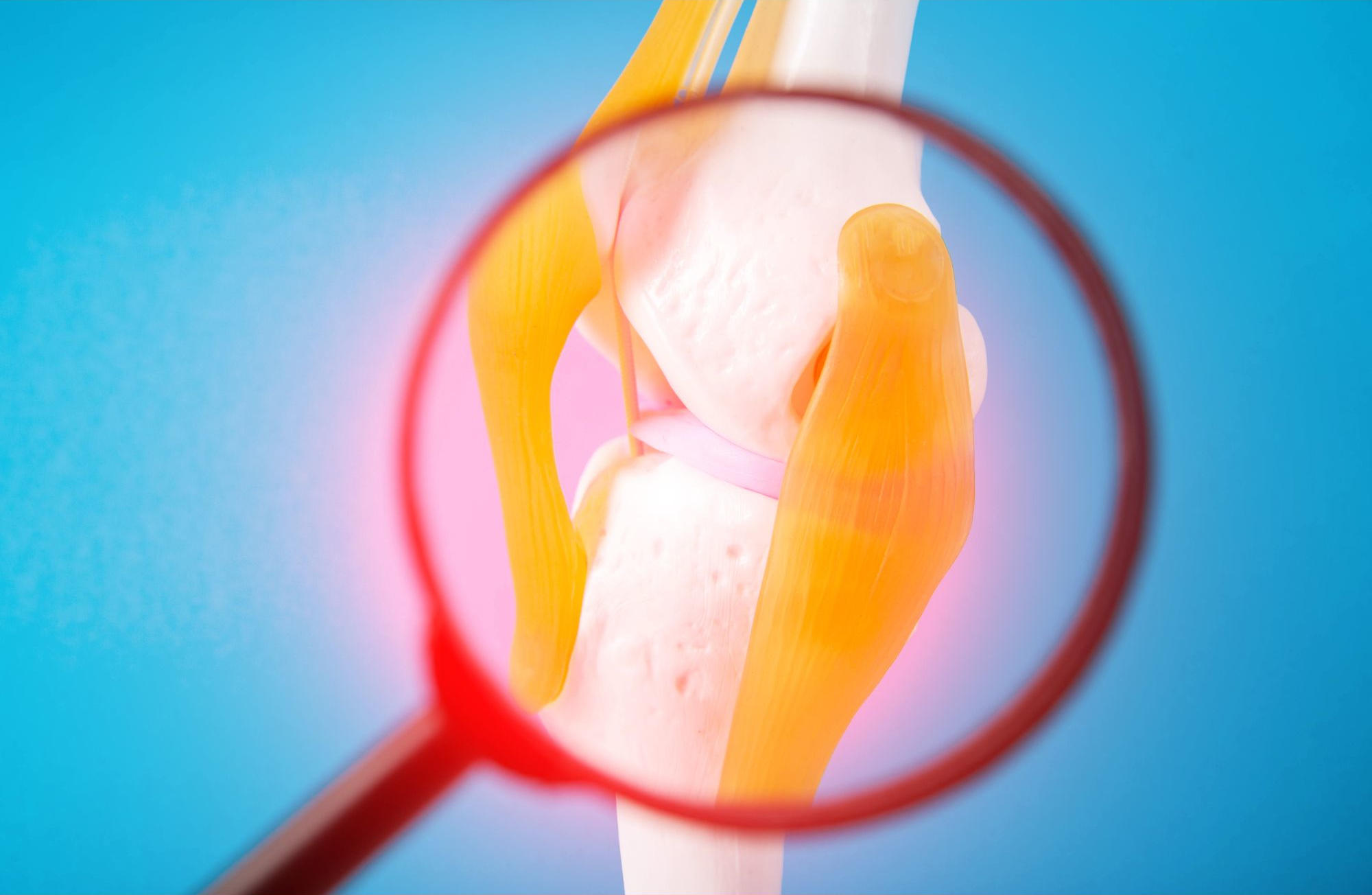
TU Wien has pioneered a novel method for generating artificial tissue: Cells are grown in microstructures created in a 3D printer.
Is it possible to grow tissue in the laboratory, for example, to replace injured cartilage? At TU Wien (Vienna), an important step has now been taken towards creating replacement tissue in the lab – using a technique that differs significantly from other methods used around the world.
A special high-resolution 3D printing process is used to create tiny, porous spheres made of biocompatible and degradable plastic, which are then colonized with cells. These spheroids can then be arranged in any geometry, and the cells of the different units combine seamlessly to form a uniform, living tissue. Cartilage tissue, with which the concept has now been demonstrated at TU Wien, was previously considered particularly challenging in this respect.
Tiny spherical cages as a scaffold for the cells
“Cultivating cartilage cells from stem cells is not the biggest challenge. The main problem is that you usually have little control over the shape of the resulting tissue,” says Oliver Kopinski-Grünwald from the Institute of Materials Science and Technology at TU Wien, one of the authors of the current study. “This is also due to the fact that such stem cell clumps change their shape over time and often shrink.”
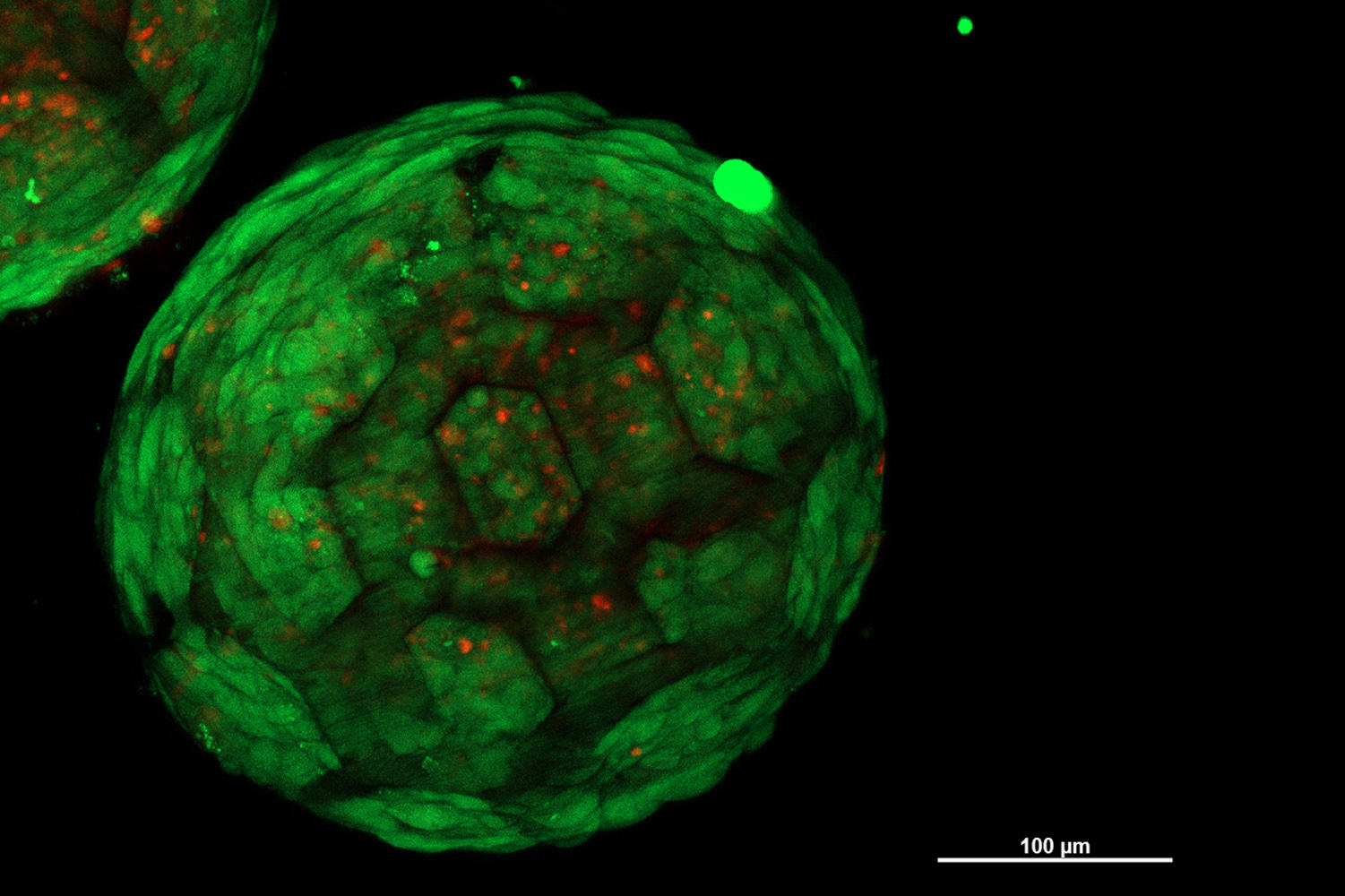
To prevent this, the research team at TU Wien is working with a new approach: specially developed laser-based high-resolution 3D printing systems are used to create tiny cage-like structures that look like mini footballs and have a diameter of just a third of a millimeter. They serve as a support structure and form compact building blocks that can then be assembled into any shape.
Stem cells are first introduced into these football-shaped mini-cages, which quickly fill the tiny volume completely. “In this way, we can reliably produce tissue elements in which the cells are evenly distributed and the cell density is very high. This would not have been possible with previous approaches,” explains Prof. Aleksandr Ovsianikov, head of the 3D Printing and Biofabrication research group at TU Wien.
Growing together perfectly
The team used differentiated stem cells – i.e. stem cells that can no longer develop into any type of tissue, but are already predetermined to form a specific type of tissue, in this case cartilage tissue. Such cells are particularly interesting for medical applications, but the construction of larger tissue is challenging when it comes to cartilage cells. In cartilage tissue, the cells form a very pronounced extracellular matrix, a mesh-like structure between the cells that often prevents different cell spheroids from growing together in the desired way.
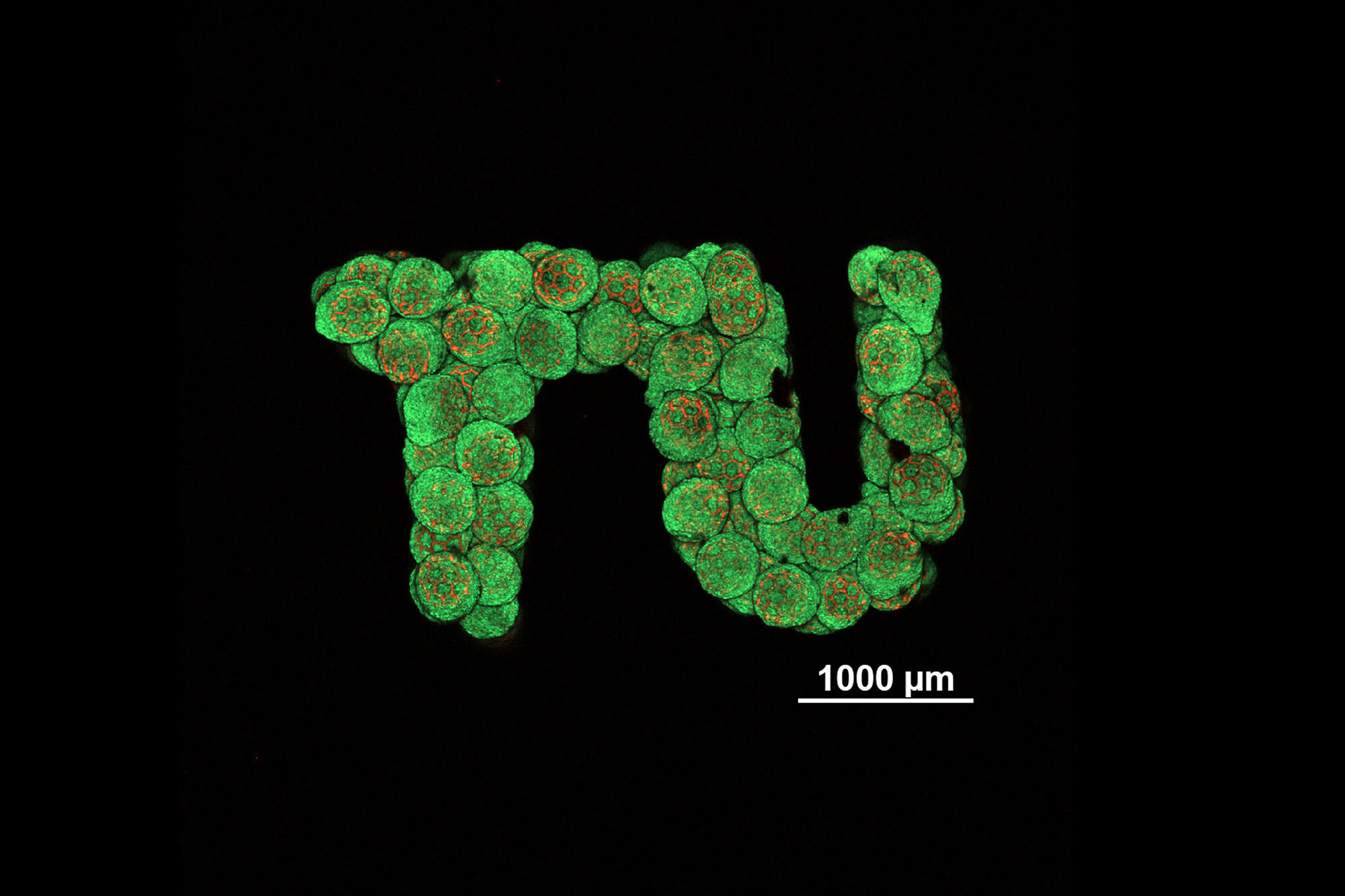
If the 3D-printed porous spheres are colonized with cells in the desired way, the spheres can be arranged in any desired shape. The crucial question is now: do the cells of different spheroids also combine to form a uniform, homogeneous tissue?
“This is exactly what we have now been able to show for the first time,” says Kopinski-Grünwald. “Under the microscope, you can see very clearly: neighboring spheroids grow together, the cells migrate from one spheroid to the other and vice versa, they connect seamlessly and result in a closed structure without any cavities – in contrast to other methods that have been used so far, in which visible interfaces remain between neighboring cell clumps.”
The tiny 3D-printed scaffolds give the overall structure mechanical stability while the tissue continues to mature. Over a period of a few months, the plastic structures degrade, they simply disappear, leaving behind the finished tissue in the desired shape.
First step towards medical application
In principle, the new approach is not limited to cartilage tissue, it could also be used to tailor different kinds of larger tissues such as bone tissue. However, there are still a few tasks to be solved along the way – after all, unlike in cartilage tissue, blood vessels would also have to be incorporated for these tissues above a certain size.
“An initial goal would be to produce small, tailor-made pieces of cartilage tissue that can be inserted into existing cartilage material after an injury,” says Oliver Kopinski-Grünwald. “In any case, we have now been able to show that our method for producing cartilage tissue using spherical micro-scaffolds works in principle and has decisive advantages over other technologies.”
Is it possible to grow tissue in the laboratory, for example, to replace injured cartilage? At TU Wien (Vienna), an important step has now been taken towards creating replacement tissue in the lab – using a technique that differs significantly from other methods used around the world.
A special high-resolution 3D printing process is used to create tiny, porous spheres made of biocompatible and degradable plastic, which are then colonized with cells. These spheroids can then be arranged in any geometry, and the cells of the different units combine seamlessly to form a uniform, living tissue. Cartilage tissue, with which the concept has now been demonstrated at TU Wien, was previously considered particularly challenging in this respect.
Tiny spherical cages as a scaffold for the cells
“Cultivating cartilage cells from stem cells is not the biggest challenge. The main problem is that you usually have little control over the shape of the resulting tissue,” says Oliver Kopinski-Grünwald from the Institute of Materials Science and Technology at TU Wien, one of the authors of the current study. “This is also due to the fact that such stem cell clumps change their shape over time and often shrink.”
To prevent this, the research team at TU Wien is working with a new approach: specially developed laser-based high-resolution 3D printing systems are used to create tiny cage-like structures that look like mini footballs and have a diameter of just a third of a millimeter. They serve as a support structure and form compact building blocks that can then be assembled into any shape.
Stem cells are first introduced into these football-shaped mini-cages, which quickly fill the tiny volume completely. “In this way, we can reliably produce tissue elements in which the cells are evenly distributed and the cell density is very high. This would not have been possible with previous approaches,” explains Prof. Aleksandr Ovsianikov, head of the 3D Printing and Biofabrication research group at TU Wien.
Growing together perfectly
The team used differentiated stem cells – i.e. stem cells that can no longer develop into any type of tissue, but are already predetermined to form a specific type of tissue, in this case cartilage tissue. Such cells are particularly interesting for medical applications, but the construction of larger tissue is challenging when it comes to cartilage cells. In cartilage tissue, the cells form a very pronounced extracellular matrix, a mesh-like structure between the cells that often prevents different cell spheroids from growing together in the desired way.
If the 3D-printed porous spheres are colonized with cells in the desired way, the spheres can be arranged in any desired shape. The crucial question is now: do the cells of different spheroids also combine to form a uniform, homogeneous tissue?
“This is exactly what we have now been able to show for the first time,” says Kopinski-Grünwald. “Under the microscope, you can see very clearly: neighboring spheroids grow together, the cells migrate from one spheroid to the other and vice versa, they connect seamlessly and result in a closed structure without any cavities – in contrast to other methods that have been used so far, in which visible interfaces remain between neighboring cell clumps.”
The tiny 3D-printed scaffolds give the overall structure mechanical stability while the tissue continues to mature. Over a period of a few months, the plastic structures degrade, they simply disappear, leaving behind the finished tissue in the desired shape.
First step towards medical application
In principle, the new approach is not limited to cartilage tissue, it could also be used to tailor different kinds of larger tissues such as bone tissue. However, there are still a few tasks to be solved along the way – after all, unlike in cartilage tissue, blood vessels would also have to be incorporated for these tissues above a certain size.
“An initial goal would be to produce small, tailor-made pieces of cartilage tissue that can be inserted into existing cartilage material after an injury,” says Oliver Kopinski-Grünwald. “In any case, we have now been able to show that our method for producing cartilage tissue using spherical micro-scaffolds works in principle and has decisive advantages over other technologies.”
Reference: “Scaffolded spheroids as building blocks for bottom-up cartilage tissue engineering show enhanced bioassembly dynamics” by Oliver Kopinski-Grünwald, Olivier Guillaume, Tamara Ferner, Barbara Schädl and Aleksandr Ovsianikov, 7 December 2023, Acta Biomaterialia.
DOI: 10.1016/j.actbio.2023.12.001
Never miss a breakthrough: Join the SciTechDaily newsletter.
Follow us on Google and Google News.
1 Comment
More advancements are expected