
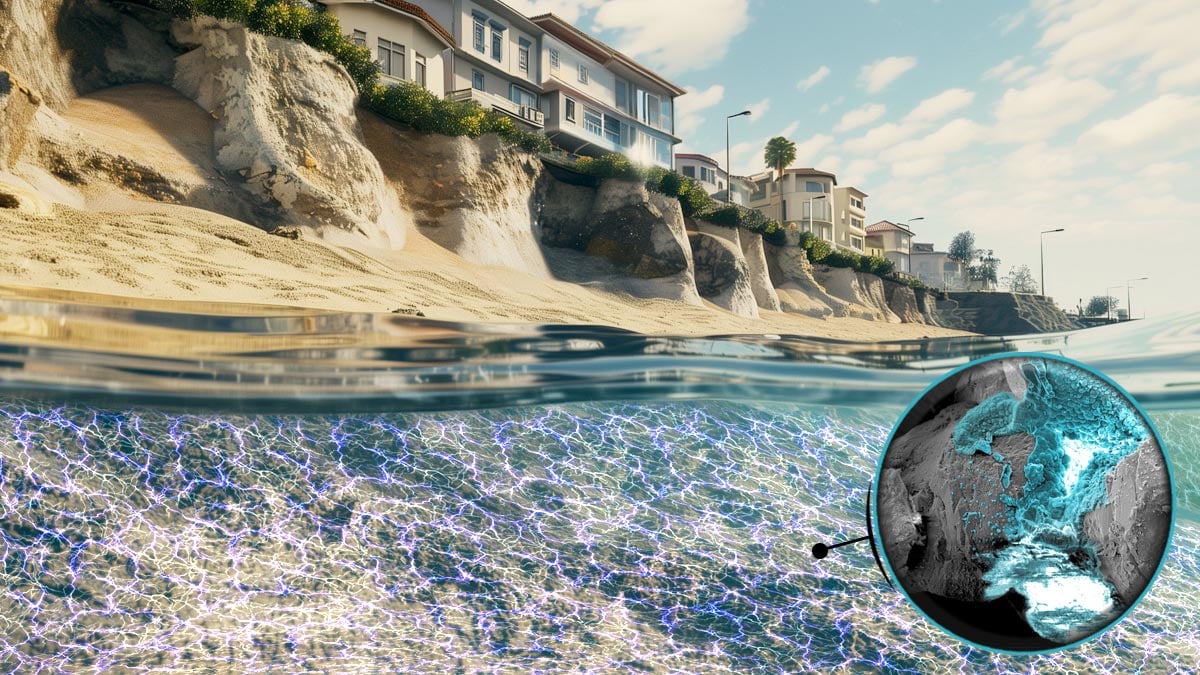
A new method developed by Northwestern University uses electrical currents to solidify marine sand, creating durable, rock-like structures that could replace costly traditional coastal defenses like sea walls.
Researchers from Northwestern University have demonstrated that a zap of electricity can strengthen a marine coastline for generations, mitigating the rising threat of erosion in the face of rising sea levels and climate change.
In their study, recently published in Communications Earth and the Environment, the researchers took inspiration from clams, mussels, and other shell-dwelling sea life, which use dissolved minerals in seawater to build their shells. Similarly, the researchers leveraged the same naturally occurring, dissolved minerals to form a natural cement between sea-soaked grains of sand. But, instead of using metabolic energy like mollusks do, the researchers used electrical energy to spur the chemical reaction.
In laboratory experiments, a mild electrical current instantaneously changed the structure of marine sand, transforming it into a rock-like, immovable solid. The researchers are hopeful this strategy could offer a lasting, inexpensive, and sustainable solution for strengthening global coastlines.
“Over 40% of the world’s population lives in coastal areas. Because of climate change and sea-level rise, erosion is an enormous threat to these communities. Through the disintegration of infrastructure and loss of land, erosion causes billions of dollars in damage per year worldwide. Current approaches to mitigate erosion involve building protection structures or injecting external binders into the subsurface,” said Alessandro Rotta Loria, Louis Berger Assistant Professor of Civil and Environmental Engineering at Northwestern’s McCormick School of Engineering, who led the study.
“My aim was to develop an approach capable of changing the status quo in coastal protection — one that didn’t require the construction of protection structures and could cement marine substrates without using actual cement. By applying a mild electric stimulation to marine soils, we systematically and mechanistically proved that it is possible to cement them by turning naturally dissolved minerals in seawater into solid mineral binders — a natural cement.”

Challenges in Current Coastal Defense Strategies
From intensifying rainstorms to rising sea levels, climate change has created conditions that are gradually eroding coastlines. According to a 2020 study by the European Commission’s Joint Research Centre, nearly 26% of the Earth’s beaches will be washed away by the end of this century.
To mitigate this issue, communities have implemented two main approaches: building protection structures and barriers, such as sea walls, or injecting cement into the ground to strengthen marine substrates, widely consisting of sand. However, multiple problems accompany these strategies. Not only are these conventional methods extremely expensive, but they also do not last.
“Sea walls, too, suffer from erosion,” Rotta Loria said. “So, over time, the sand beneath these walls erodes, and the walls can eventually collapse. Oftentimes, protection structures are made of big stones, which cost millions of dollars per mile. However, the sand beneath them can essentially liquify because of a number of environmental stressors, and these big rocks are swallowed by the ground beneath them.
“Injecting cement and other binders into the ground has a number of irreversible environmental drawbacks. It also typically requires high pressures and significant interconnected amounts of energy.”
Eco-Friendly Electrocementation Process
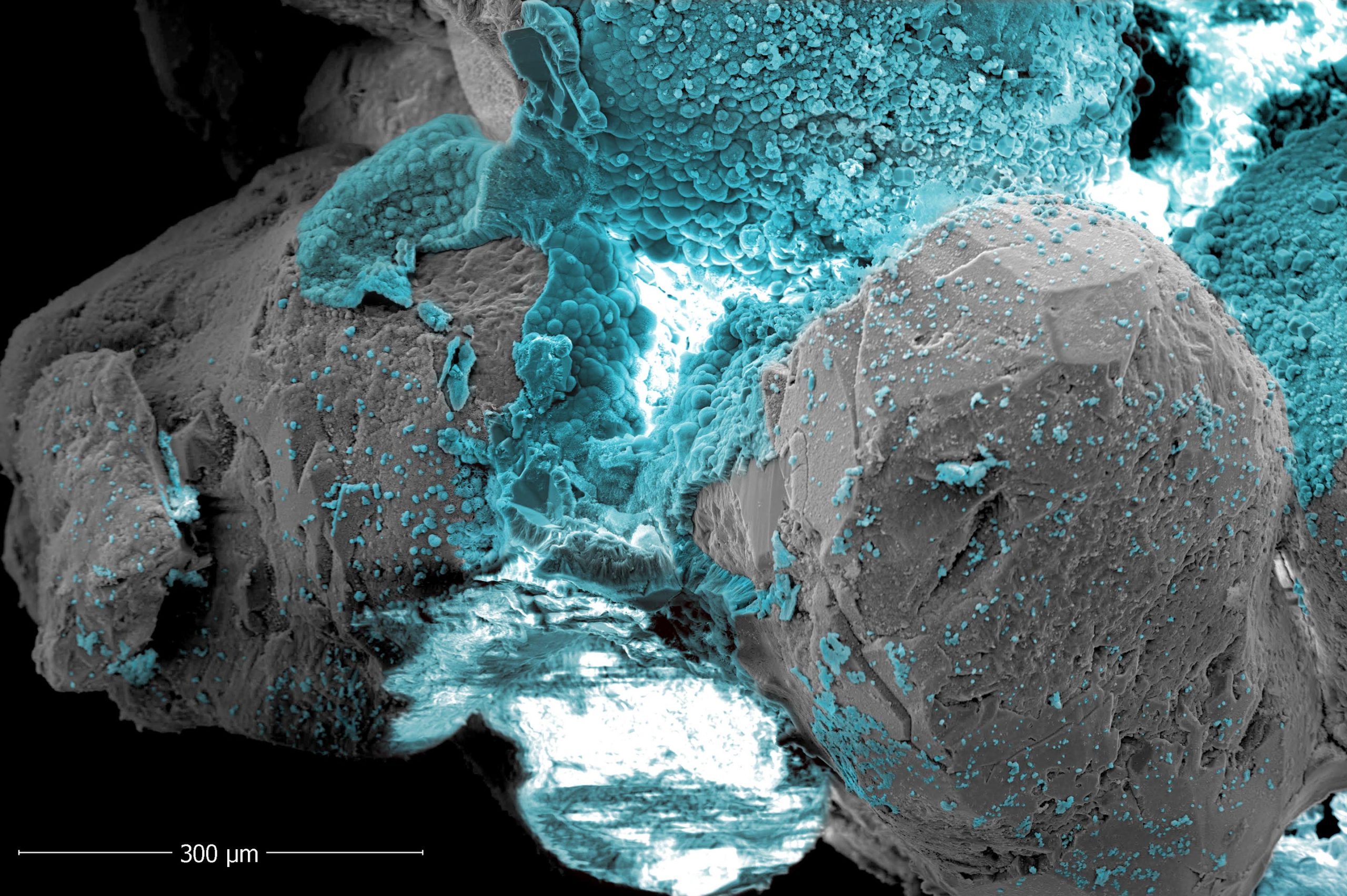
To bypass these issues, Rotta Loria and his team developed a simpler technique, inspired by coral and mollusks. Seawater naturally contains a myriad of ions and dissolved minerals. When a mild electrical current (2 to 3 volts) is applied to the water, it triggers chemical reactions. This converts some of these constituents into solid calcium carbonate — the same mineral mollusks use to build their shells. Likewise, with a slightly higher voltage (4 volts), these constituents can be predominantly converted into magnesium hydroxide and hydromagnesite, a ubiquitous mineral found in various stones.
When these minerals coalesce in the presence of sand, they act like glue, binding the sand particles together. In the laboratory, the process also worked with all types of sands — from common silica and calcareous sands to iron sands, which are often found near volcanoes.
“After being treated, the sand looks like a rock,” Rotta Loria said. “It is still and solid, instead of granular and incohesive. The minerals themselves are much stronger than concrete, so the resulting sand could become as strong and solid as a sea wall.”
While the minerals form instantaneously after the current is applied, longer electric stimulations garner more substantial results. “We have noticed remarkable outcomes from just a few days of stimulations,” Rotta Loria said. “Then, the treated sand should stay in place, without needing further interventions.”

Sustainable Applications and Future Prospects
Rotta Loria predicts the treated sand should keep its durability, protecting coastlines and property for decades. He also says there is no need to worry about negative effects on sea life. The voltages used in the process are too mild to feel. Other researchers have used similar processes to strengthen undersea structures or even restore coral reefs. In those scenarios, no sea critters were harmed.
If communities decide they no longer want the solidified sand, Rotta Loria has a solution for that, too, as the process is completely reversible. When the battery’s anode and cathode electrodes are switched, the electricity dissolves the minerals — effectively undoing the process.
“The minerals form because we are locally raising the pH of the seawater around cathodic interfaces,” Rotta Loria said. “If you switch the anode with the cathode, then localized reductions in pH are involved, which dissolve the previously precipitated minerals.”
The process offers an inexpensive alternative to conventional methods. After crunching the numbers, Rotta Loria’s team estimates that his process costs just $3 to $6 per cubic meter of electrically cemented ground. More established, comparable methods, which use binders to adhere and strengthen sand, cost up to $70 for the same unit volume.
Research in Rotta Loria’s lab shows this approach can also heal cracked reinforced concrete structures. Much of the existing shoreside infrastructure is made of reinforced concrete, which disintegrates due to complex effects caused by sea-level rise, erosion, and extreme weather. If these structures crack, the new approach bypasses the need to rebuild the infrastructure fully. Instead, one pulse of electricity can heal potentially destructive cracks.
“The applications of this approach are countless,” Rotta Loria said. “We can use it to strengthen the seabed beneath sea walls or stabilize sand dunes and retain unstable soil slopes. We could also use it to strengthen protection structures, marine foundations, and so many other things. There are many ways to apply this to protect coastal areas.”
Next, Rotta Loria’s team plans to test the technique outside of the laboratory and on the beach.
Reference: “Electrodeposition of calcareous cement from seawater in marine silica sands” by Andony Landivar Macias, Steven D. Jacobsen and Alessandro F. Rotta Loria, 22 August 2024, Communications Earth & Environment.
DOI: 10.1038/s43247-024-01604-3
The study was supported by the Army Research Office (grant number W911NF2210291) and Northwestern’s Center for Engineering Sustainability and Resilience.
Never miss a breakthrough: Join the SciTechDaily newsletter.
Follow us on Google and Google News.
57 Comments
“He also says there is no need to worry about negative effects on sea life.”
That is a very naive assessment. There are many organisms that require loose sand in which to burrow for food and shelter. They will either be entombed in place or driven to seek shelter elsewhere, which will not be accessible to creatures without the ability to move long distances quickly. This is basically a method to sterilize and extirpate an ecosystem very quickly!
When there is a long-shore transport current moving sand along the coast, which is usually the case, erosion will accelerate down stream of where the beach has been treated because the area is deprived of new sand. Thus, the focus of erosion will just be moved.
This is basically a problem of people with more dollars than ‘cents,’ who don’t realize that cliffs made of unconsolidated materials are ephemeral, and that it is unwise to build on them close to the shoreline. Once again, a myopic technologist has come up with a ‘solution’ that doesn’t look at the big picture.
I like his idea! It sounds like it could have great benefits in many areas. Don’t be such a wet blanket.
The Sierra Club has a former slogan of “Not unthinking opposition to change, but opposition to unthinking change.” I’m pointing out that in most situations people have built expensive homes without consideration of the suitability of the location, and are now looking for quick fixes for their shortsightedness. If it works as touted, it will give people a quick and cheap method to protect their homes at the cost of the extirpation of the ecosystem that is a part of the scenic view they so appreciate. Personally, I don’t share the idea that it is a fair or good tradeoff. Is being concerned about the environment really being a “wet blanket?”
Why not apply this method to make more durable — but completely recyclable adobe walls?
I was thinking of similar applications which could be extended to general housing maybe roads going through national parks I think this approach has endless potential never mind the wet blankets of some other people here the question they need to consider is what will happen if we do nothing all the critters will suffer including people
Are you thinking of building an adobe house under the ocean?
No Clyde, you don’t sound like a wet blanket, more like a solidified oppositionist. Obviously, the suggested method needs to be carefully tested in fragile environments. But there is no need to focus on “expensive homes without consideration”, and there is no need to label it a quick fix. Coastal environments around the world are in dire need of practical solutions, not only for accelerating erosion, but also for the problem of liquefaction of the soil during earthquakes or heavy rainfall. So this potentially simple solution deserves wider scrutiny into possible side effects, but it seems to offer a feasible alternative to the traditional (and more environmentally destructive) methods of strengthening coastlines.
Moral. Only a damn fool builds a house on sand-dunes by the sea-side. Electrifyingly shocking behaviour, but typically human.
Greg, what you’re calling a “wet blanket” is merely considering outcomes other than the intended. It’s what all good scientists, and humans, should do.
+10
I think you’re taking quite a myopic view yourself, my friend. I see vast applications to mitigate the effects of sea level rise and stabilize lagoon wetlands, such as those in the Gulf Coast, and on island nations of the Pacific. I agree and don’t really care about cliffside houses or luxury homes built on barrier islands, but protecting shoreline infrastructure and repairing reef damage seem like good uses of this tech.
I’m reminded of the infamous quote,”It became necessary to destroy the town to save it,” used to rationalize razing a village in Vietnam.
What good does it do to save the land if the bottom of the food chain is destroyed by the method used? The reason that the words “food chain” have become synonymous with an ecosystem, is that if the food chain is broken, then the entire system will fail. A chain is no stronger than its weakest link. Indeed, the bottom of the food chain is probably the most critical because it supports everything above it. If the muds that support burrowing creatures becomes too hard to allow animals, or the roots of plants adapted to soft organic muds, to penetrate, they will die. The important thing is to save the ecosystem, not just the physical edifice that serves to support the ecosystem. Not looking at the big picture will lead to a situation analogous to the infamous Potemkin Villages (look it up) of Czarist Russia. Besides that, I don’t think that the organic muds of wetlands or mangrove swamps will be amenable to this ‘electrifying’ technique.
I know coastal homeowners who are ready to riprap as soon as the state of Oregon tells them the ocean has come close enough to their house to do so. If there’s a way to avoid riprapping an existing property, it seems sensible to try.
This has potential in many parts of the globe. Good work. Keep experimenting!
There is a long history of failures to effectively, address beach erosion, usually because the engineers contracted to do so don’t understand the dynamics of beaches, and build things that have unintended consequences.
The fundamental problem is that incoming waves, particularly Winter storm waves, carry a lot of energy. Some of that energy is dissipated in removing the wide, high Summer beaches. The energy that is left is available to undercut cliffs and remove the unconsolidated sediment. This proposed approach may well exacerbate the problem because the artificially-created shelf will be resistant to being broken up, and the waves will arrive at the cliff with nearly all their original energy, and higher amplitude than on natural beaches. What may well determine the success of this approach is the reaction of insurance companies, particularly if some of the early-adopters lose their homes and it can be demonstrated that it was because the attempt to armor the beach actually made the problem worse.
We don’t have enough electric to keep our city’s and new electric vehicles running with out blackout how will this work
The voltage required is so low that this could be done with solar power, which is readily available in the locations where this treatment would be needed. They can probably outfit a few boats with the panels and other equipment required to do the job, and those boats could move along the coastline as needed.
I’m afraid that the voltage will have to be stepped up. Two to four volts is fine for tests in a Petri dish, but to treat a beach, say 100 meters long, you will have to increase the voltage to equal 2-4X the number of Petri dishes that can be placed edge to edge along the length of the beach being treated.
As George Kyrala points out below, the article doesn’t provide detailed information on the voltage gradient or current necessary to carry this out on a realistic scale. The amperage required will go up with the volume of beach sand necessary to be treated, and the volume goes up with the cube of the linear dimensions.
Maybe don’t build a house on a cliff that’s been eroding for thousands of years. When will we learn we can’t stop nature? We need to learn to live with it and stop this arrogant minded approach of “fixing” things for just humans. Life is bigger and more encompassing than the human agenda.
2-4 volts is half the capacity of the battery in a smoke detector. Hardly a burden on the power grid.
Do you really think that you can get something for nothing? Two to 4 volts at negligible current works in a Petri dish, not on an industrial scale!
This scheme is More harm than good. It is time for climate migration.
Coming from a fishing village on a sandy coast, where dunes are constantly threatened in some areas, I certainly think this method sounds interesting. It’s not just about wealthy people’s holiday homes.
Every method of coastal protection has large effects on the environment — the usual methods are to build large barriers or piers, or sand-feeding which means pumping up sand from somewhere and delivering it at the needed places. It’s very expensive, energy-intensive, doesn’t last long and is possibly changing the submarine biology a lot.
It’s also well-known that if you stop the unhindered sand flow along a coast, it can harm areas where this sand would normally settle. It’s always a choice.
My home village (Vorupør at the North Sea coast of Jutland) is a living study of that. The current and sand flow come from the south since southwestern winds dominate. The village emerged at a slight natural coastal protusion, maybe caused by a stony seabed area slightly to the southwest. (A solid seabed is exactly what the electrolysis method would create, if it works.) The protrusions gave a little protection for landing the fishing boats. There is no real harbour, boats are dragged on to the beach.
A large pier was built in 1908 , to give better protection for the fishery. The innermost 50 m of the pier was a bridge, allowing the sea to flow under it. In this way, they wanted to avoid that sand would build up south of the pier. In the 1980s, the fishermen convinced the coastal authority to close the hole in the pier. Thus, when the sand flow was stopped, the boat landing area improved, with deeper water. But the area on the sand delivering side of the pier got a surplus amount of sand, and the beach has grown to almost the end of the pier (which is several hundred meters long). The side that would formerly receive the sand, the bay north of the village, is now suffering and the dunes are being broken down year by year, maybe 3-5 m per year.
You should find it on Google Map; it’s easy for somebody with hydrological or geological insight to see what’s going on. The sea currents are virtually visible on satellite photos due to the sand patterns.
However, it’s a choice between harming inhabited areas or societal infrastructure vs. an uninhabited or less valuable coast stretch. Since Denmark is a small country with an enormous coast line, almost exclusively “soft” coasts, we have a lot of discussion about this. I don’t see why a new method would harm nature more than older methods. It’s good to have tools.
You are the first person to demonstrate that you actually have some knowledge about, and experience with, the dynamics of waves and beach sand movement.
It is important to remember that NASA has discovered that there is no such thing as a free launch. There are always costs, sometimes in the form of unintended consequences. However, someone looking at the big picture should anticipate at least some of the more obvious potential problems. Pollyannas don’t make good dam or bridge builders.
Just what I was thinking tho’ I didn’t know about the transport. Surely, at least here in California, the Environmental Impact process should limit or adjust the use of such ossifications. Another reason to protect and improve the EPA and related agencies.
Right, of course. Whenever I hear about some laboratory model that sounds too good to be true, I figure the next thing to look for is a free lunch. TANSTAAFL.
Clyde, I agree with your viewpoints, as a biologist. However, this is an interdisciplinary problem, as you obviously know but other casual readers may be unaware. We just need to incorporate everybody to get a novel approach to work. If you’ve ever done an EIS, you know that it takes several dimensions of science in order to accomplish a sound resolution. For example: perhaps engineers could come up with a staggered brick method that would allow interstitial areas for the substrate microbiota to flourish, expwrimwnt with angled striations or some kind of 3D stacked patchwork or lattice that would facilitate multiple requirements. At the very least, we could buy the lifetimes of the property, refuse further development, and develop more lasting techniques.
Or, frankly, we just humbly accept the consequences of arrogance. Everyone has to get insurance; a buyer may be ignorant but the insurance companies are not and they’ll premium-up the premium for sure.
Interesting, but you need two poles when applying a voltage. Where is the other pole and what is the field in volts per cm, and what current. A poorly documented write up that can not easily be reproduced. The reference DOU has the same issue.
Inasmuch as beaches vary in depth and width, and change with the seasons, there probably isn’t a simple answer to the voltage and current necessary to do what is proposed. Furthermore, the field will not be uniform, so the effect will probably be non-uniform. Many a proposal has failed field tests when taken out of the lab and an attempt was make to scale it up.
One pole is always the ground. It does seem that our energy infrastructure has started to become saturated. Are we already running current through a lot of soils we are not considering? Every high voltage power line has current traveling above and below. What effect does alternating current have, as opposed to direct current?
“One pole is always the ground.”
And the other pole then?
“What effect does alternating current have, as opposed to direct current?”
Every half-cycle the cement created in the previous half-cycle is dissolved. That is why they claim the process is completely reversible — “When the battery’s anode and cathode electrodes are switched, the electricity dissolves the minerals — effectively undoing the process.” However, that is not quite true. It may be “completely reversible” in a Petri dish, but the completed ‘sandcrete’ will have less porosity and permeability and therefore have reduced volume of ocean water, to act as an electrolyte to carry the current. That, means, the electrical conductivity will be much lower than the loose, porous sands were to begin with. So, undoing the process will undoubtedly take longer, and therefore cost more money, should it be decided that it was a mistake to “mess with Mother Nature.”
Wrong: electricity with 4 volts of power/pressure Can Not magically convert Calcium atoms or ions into Magnesium atoms or ions, as claimed in this story. Calcium nuclei are not fissile, so neither fast nor slow neutrons can split them and create Magnesium nuclei!!! Hire 1 “Proof-Thinker” to correct your stories
Why do we resist nature?
Obviously, to stop their house from falling down. It happens all the time in the UK.
It’s referring to the “constituents” which includes both calcium and magnesium ions
“When a mild electrical current (2 to 3 volts)”
Sorry, what you mention is the Voltage, not the Current. Correct it to: “When a mild electrical current (using source of 2 to 3 volts)
Of course, both materials come from the sea water, so that is an irrelevant point. It’s not even erroneously described in the article, just a little ambiguous.
It appears that you misunderstand. They are proposing that sea water, which already contains calcium and magnesium ions, be used. They are NOT proposing some sort of electrical alchemy.
If an area does anything to protect itself from erosion, they have only moved the problem somewhere else.
Right on!
I can’t wait for an article to be written in 10 years saying that “experts” are finding that this solution has somehow caused irreparable damage to the local ecosystem.
I doubt that it will make it to commercial trials.
I quit reading when the quote from Northwestern University stated due to climate change and sea level rise.
Comparing 150 year old pictures of the Statue of Liberty shows absolutely zero sea levell rise. Ocean levels balance themselves globally and are affected by Moon tide only.
All the climate science is flawed just like the covid science was flawed and I’m tired of being lied to.
And shame on sci tech daily for allowing this kind of thinking to creep into a published article.
Is your eraser h simply comparing pictures? At what tides were the pictures taken?
Don’t you think you need REAL measurements? You think climate scientists compare
Seascapes by artists over the centuries to measure sea level changes?
Methinks you need to rethink your thinking! Cheers!
If you’re “tired of being lied to “, try doing some actual research instead of using an opinion.
Like, “the COVID science wasn’t real.”
Tell that to the families of the millions in this country and around the world who lost loved ones during the pandemic. Like my sister, like my best friend….
Many people were professing falsehoods like you, until they were choking on their own fluids begging for that vaccine. Have some compassion.
I’m no geologist, but I like the idea of fortifying kelp beds to weaken the ocean currents. Along that line, twenty years ago I read an article about beach erosion threatening cliffs in NY. Talking with my boss, he said there are millions of tires in junk yards in this country and scrap metal to make the chains to connect the tires together lying flat like a huge carpet. He thought that might slow erosion and also give small marine life stabile sand and protection in the areas where sand didn’t fully fill the tires and gaps between. I don’t know how the tire carpets would need to be anchored. Thoughts anyone?
I’ve never been comfortable with disposing of waste materials under the guise of building artificial reefs or some such thing. Tires are not natural. Do we know what will leach out of them over time, or what will happen if they are consumed by organisms at the bottom of the food chain that in turn are eaten by other creatures higher up the food chain and concentrate low-level toxins?
We do such things at our peril without thoroughly understanding what is in tires and what chemical reactions will take place after long immersion in salt water. That is, let’s use the approach of the Scientific Method on a small-scale before engaging in a large-scale experiment whose results we will have to live with if it turns out that tires are not as chemically benign as they appear to be on short time scales. Too often science is ignored and people with money, or politicians with other people’s money, use the approach of throwing different things at a wall to see what sticks and what doesn’t. If one owns the wall, and it is a small wall, that serves as a crude experiment. However, committing to an approach of ‘trial and error’ on a large-scale is a recipe for at least some disasters.
They clearly didnt see, are ignoring, or are hoping one of the two is true of us, that this is exactly how gene transfer occurs.
How do they claim it’s safe for the ecosystem while altering the genetics of all those organisms so carelessly?
If they’re headed to the beach to test this I recommend DNA tests both before and after, of the humans as well as the surrounding organisms.
Back in the 1970’s Wolf Hilbertz developed a system to grow low cost structures in the ocean using an electric current to precipitate minerals on a wire framework. He later utilized this process to create electrified reefs. His process is now called biorock.
It was interesting to read about this NEW development by Northwestern University, 50 years after it was first invented. It seems Dr. Hilbert was half a century too early with his initial development.
Whoever we give the credit to, it. is a process that can truly benefit our planet with the environmental changes we are experiencing.
Absolutely true Robert!
Dr. Tom Goreau and Prof. Wolf Hilbertz developed the concept decades ago and eventually named it Biorock. Previous names were SeaCrete and Seament. Goreau still applies it to marine habitat / coral reef restoration and shoreline protection applications via http://www.globalcoral.org
Although yes a wonderful idea for stabilisation, I think the research team has forgotten about all the molluscs, sandstorms, and other sea life that lives in the sand on beaches, both above and below the tide line, and that stabilisation of extensive areas is going to have a massive effect on the biodiversity and ecosystem of those areas.
Also this would, to be stable enough not to erode exactly like a retaining wall, have to extend down to bedrock, essentially creating a sandstone platform.
The simplest and most environmentally friendly way to approach the situation is don’t build on a beach in the first place.
I too innovated a method to avoid coastal erosion, it’s called not building directly on the coast.
Pros: no harm to the environment, no private ownership of the coasts, we keep our coasts and beaches
cons: entitled wealthy people hate common sense approaches such as this.
Yet another thing that has thus far only worked in the lab. So, let’s not break out the champagne just yet.
This is sadly how our tax dollars are wasted on grants to fund nonsensical experiments that have no real world validation. Virginia Beach currently has some real zingers in the works at 500
Million dollars of our taxes. Rube Goldberg all the way!
When it is all said and done, the cost of the electrical treatment would probably be more effective if the money were spent instead to encourage the growth of kelp beds off the coast to absorb the energy of the waves. Sometimes ‘low-tech’ is a better approach.
Best Option, Don’t build your home next to a cliff.
Could this method be used in a multi-step process to make young, sharp, angular sand from old, rounded sand?