
Close Menu
    Facebook X (Twitter) Instagram
    SciTechDaily
    • Biology
    • Chemistry
    • Earth
    • Health
    • Physics
    • Science
    • Space
    • Technology
    Facebook X (Twitter) Pinterest YouTube RSS
    SciTechDaily
    Home»Technology»Scientists Develop the World’s First Transistor Made of Wood
    Technology

    Scientists Develop the World’s First Transistor Made of Wood

    By Linköping UniversityMay 5, 20231 Comment3 Mins Read
    Facebook Twitter Pinterest Telegram LinkedIn WhatsApp Email Reddit
    Share
    Facebook Twitter LinkedIn Pinterest Telegram Email Reddit
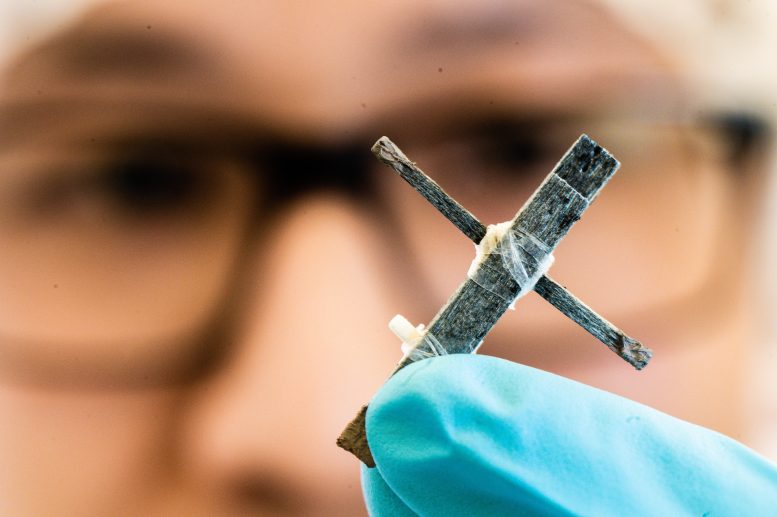
    Transistor Made of Wood
    Researchers at Linköping University, together with colleagues from the KTH Royal Institute of Technology, have now developed the world’s first electrical transistor made of wood. Credit: Thor Balkhed

    Modulation of Electrical Current in a Wood-Based Electrochemical Transistor

    A team of researchers from Linköping University and the KTH Royal Institute of Technology have created the world’s first transistor made from wood. Their findings, published in the journal PNAS, open up new opportunities for the advancement of wood-based electronics and the control of electronic plants.

    Transistors, a revolutionary invention that dates back nearly a century, are often regarded as one of the most significant innovations in human history, on par with the telephone, the light bulb, and the bicycle. Today, they play a crucial role in modern electronic devices and are manufactured at a nanoscale level. A transistor acts as a control device, regulating the flow of current, and can also serve as a power switch.

    Researchers at Linköping University, together with colleagues from the KTH Royal Institute of Technology, have now developed the world’s first electrical transistor made of wood.

    “We’ve come up with an unprecedented principle. Yes, the wood transistor is slow and bulky, but it does work, and has huge development potential,” says Isak Engquist, senior associate professor at the Laboratory for Organic Electronics at Linköping University.

    Isak Engquist
    Isak Engquist, senior associate professor at the Laboratory for Organic Electronics at Linköping University. Credit: Thor Balkhed

    In previous trials, transistors made of wood have been able to regulate ion transport only. And when the ions run out, the transistor stops functioning. The transistor developed by the Linköping researchers, however, can function continuously and regulate electricity flow without deteriorating.

    Innovative Use of Balsa Wood

    The researchers used balsa wood to create their transistor, as the technology involved requires a grainless wood that is evenly structured throughout. They removed the lignin, leaving only long cellulose fibers with channels where the lignin had been.

    These channels were then filled with a conductive plastic, or polymer, called PEDOT:PSS, resulting in an electrically conductive wood material.
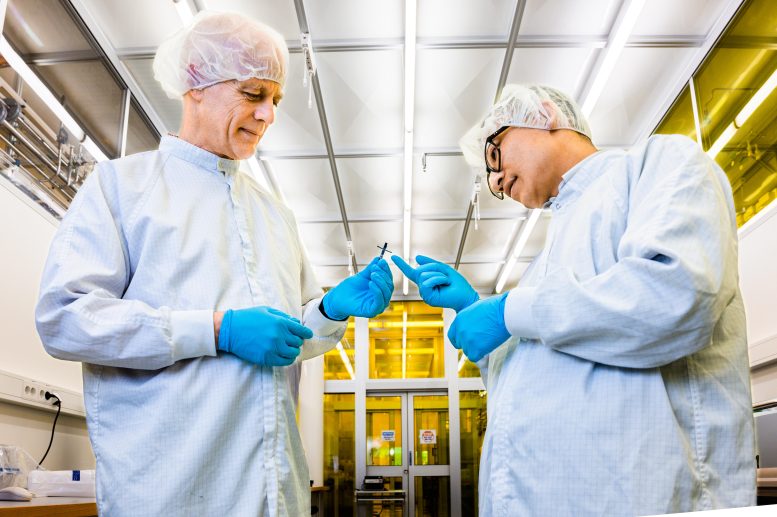
    Isak Engquist and Van Chinh Tran
    Isak Engquist, senior associate professor, and Van Chinh Tran, a Ph.D. student at Linköping University. Credit: Thor Balkhed

    The researchers used this to build the wood transistor and could show that it is able to regulate electric current and provide continuous function at a selected output level. It could also switch the power on and off, albeit with a certain delay – switching it off took about a second; on, about five seconds.

    Possible applications could include regulating electronic plants, which is another strong research area at Linköping University. One advantage of the transistor channel being so large is that it could potentially tolerate a higher current than regular organic transistors, which could be important for certain future applications. But Isak Engquist wants to stress something:

    “We didn’t create the wood transistor with any specific application in mind. We did it because we could. This is basic research, showing that it’s possible, and we hope it will inspire further research that can lead to applications in the future,” says Isak Engquist.

    Reference: “Electrical current modulation in wood electrochemical transistor” by Van Chinh Tran, Gabriella G. Mastantuoni, Marzieh Zabihipour, Lengwan Li, Lars Berglund, Magnus Berggren, Qi Zhou and Isak Engquist, 24 April 2023, Proceedings of the National Academy of Sciences.
    DOI: 10.1073/pnas.2218380120

    The study was funded by the Knut and Alice Wallenberg Foundation through the Wallenberg Wood Science Center.

    Never miss a breakthrough: Join the SciTechDaily newsletter.
    Follow us on Google and Google News.

    Electronics Linkoping University Materials Science Transistors
    Share. Facebook Twitter Pinterest LinkedIn Email Reddit

    Related Articles

    The Hidden Material Breakthrough That Could Supercharge AI and Save Energy

    Chance Discovery Results in New Type of Transistor for High-Power Electronic Devices

    Large Scale Integrated Circuits Produced in Printing Press Based on Organic Electrochemical Transistors

    New Nanotechnology Aids in Electron Cooling Without External Sources

    Researchers Create World’s Fastest Organic Transistor

    Graphene Provides Cooling for Electronics

    Researchers Develop Transistors without Semiconductors

    Liquid Metal Used in Ultra-Stretchable Conducting Wires

    First Integrated Chemical Circuits Developed Using Ion Transistors

    1 Comment

    1. mike on May 8, 2023 5:45 am

      Gee, its not even April 1st!

      Reply
    Leave A Reply Cancel Reply

    • Facebook
    • Twitter
    • Pinterest
    • YouTube

    Don't Miss a Discovery

    Subscribe for the Latest in Science & Tech!

    Trending News

    Scientists Reversed Autism-Like Symptoms in Adult Mice Within Two Hours

    30-Year-Old Museum Rock May Hide a New Mosasaur Species

    Unzipping the Code of Life: Scientists Pinpoint Where DNA First Opens

    American Heart Association Reveals How Much Coffee Is Safe for Your Heart

    Earth May Be Twice As Vulnerable to Extreme Solar Storms As Scientists Thought

    New Compound Could Help Aging Muscles Repair Themselves

    Scientists Tested an 8-Hour Eating Window and Found a Surprising Brain Benefit

    Killer Whales Filmed Smashing Giant Sunfish Into Thousands of Pieces, Possibly for Fun

    Follow SciTechDaily
    • Facebook
    • Twitter
    • YouTube
    • Pinterest
    • Newsletter
    • RSS
    SciTech News
    • Biology News
    • Chemistry News
    • Earth News
    • Health News
    • Physics News
    • Science News
    • Space News
    • Technology News
    Recent Posts
    • Coffee’s Most Destructive Pest Is Accidentally Helping the Ants That Hunt It
    • Cells Join Forces To Survive Prolonged Mechanical Strain
    • When Gut Bacteria Run Out of Fiber, They May Start Eating You
    • Scientists Discover the Brain May Enter a New Biological Phase Between 50 and 75
    • New Research Reveals Autistic Brains Process Faces Differently
    Copyright © 1998 - 2026 SciTechDaily. All Rights Reserved.
    • Science News
    • About
    • Contact
    • Editorial Board
    • Privacy Policy
    • Terms of Use

    Type above and press Enter to search. Press Esc to cancel.