
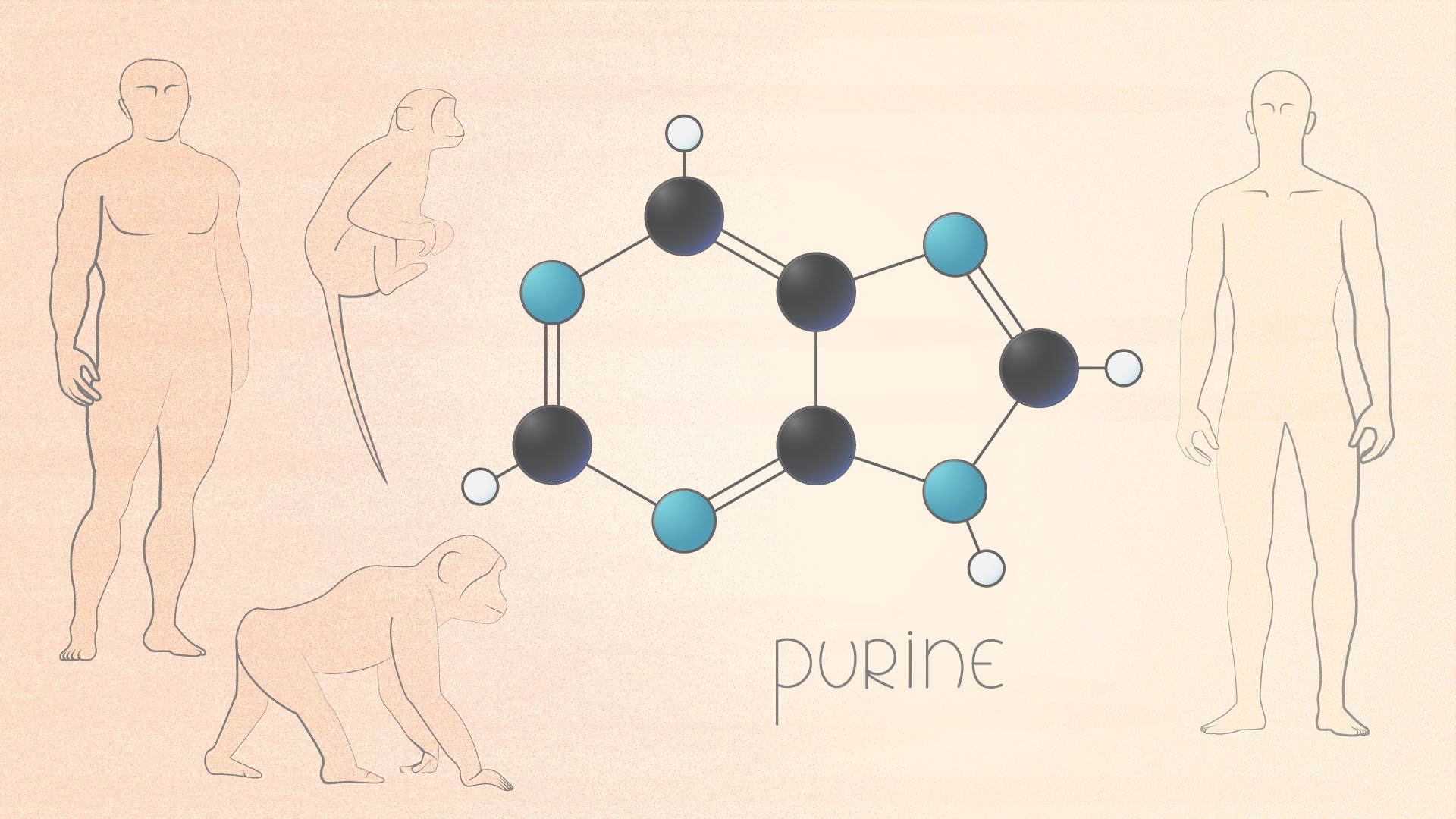
A human-only mutation lowers brain purine levels, offering insights into metabolic changes that may have shaped human evolution.
Skoltech scientists and their colleagues from Germany and the United States have analyzed the metabolomes of humans, chimpanzees, and macaques in muscle, kidney, and three different brain regions. The team discovered that the modern human genome undergoes mutation which makes the adenylosuccinate lyase enzyme less stable, leading to a decrease in purine synthesis. This mutation did not occur in Neanderthals, so the scientists believe that it affected metabolism in brain tissues and thereby strongly contributed to modern humans evolving into a separate species. The research was published in the journal eLife.
The predecessors of modern humans split from their closest evolutionary relatives, Neanderthals, and Denisovans, about 600,000 years ago, while the evolutionary divergence between our ancestors and those of modern chimpanzees dates as far back as 65 million years ago. Evolutionary biologists are after the particular genetic features that distinguish modern humans from their ancestors and may give a clue as to why humans are what they are.
Researchers from the Skoltech Center for Neurobiology and Brain Restoration (CNBR) led by Professor Philipp Khaitovich and their colleagues from the Max Planck Institutes in Leipzig, Dresden, and Cologne and the University of Denver studied metabolic differences in the brain, kidney, and muscle of humans, chimpanzees, and macaques.
The research supervisor was a renowned evolutionary biologist, Professor Svante Pääbo, who earlier on had discovered the Denisovan and led the Neanderthal Genome Project.
A Key Mutation in the Adenylosuccinate Lyase Enzyme
The team looked at an interesting human mutation that leads to amino acid substitution in adenylosuccinate lyase, an enzyme involved in the synthesis of purine inside DNA. This substitution reduces the enzyme’s activity and stability, which results in a lower concentration of purines in the human brain. The team showed that the new mutation is typical for humans only and does not appear in other primates or Neanderthals. The researchers proved that this mutation is indeed the reason for the metabolic peculiarities in humans by introducing it into the mouse genome. The mice subjected to mutation produced fewer purines, whereas an ancestral gene, when introduced into human cells, led to apparent metabolic changes.
“Although a powerful tool for scientists, the decoded human genome, unfortunately, cannot account for all the phenotypic differences between humans. The study of the metabolic composition of tissues can give clues about why functional changes occur in humans. I am delighted that we have succeeded in predicting the metabolic characteristics of modern humans and validated our hypotheses on mouse and cell models, even though we did not have ‘live Neanderthals’ to work on,” says lead author and Skoltech PhD student Vita Stepanova.
Reference: “Reduced purine biosynthesis in humans after their divergence from Neandertals” by Vita Stepanova, Kaja Ewa Moczulska, Guido N Vacano, Ilia Kurochkin, Xiangchun Ju, Stephan Riesenberg, Dominik Macak, Tomislav Maricic, Linda Dombrowski, Maria Schörnig, Konstantinos Anastassiadis, Oliver Baker, Ronald Naumann, Ekaterina Khrameeva, Anna Vanushkina, Elena Stekolshchikova, Alina Egorova, Anna Tkachev, Randall Mazzarino, Nathan Duval, Dmitri Zubkov, Patrick Giavalisco, Terry G Wilkinson, David Patterson, Philipp Khaitovich and Svante Pääbo, 4 May 2021, eLife.
DOI: 10.7554/eLife.58741
Never miss a breakthrough: Join the SciTechDaily newsletter.
Follow us on Google and Google News.
10 Comments
This is a possible phenomena as seen in di-hexa-cyclic ringss of benzenes,exceptionĺ to any known pròcess but by the nature.
Evolutionary divergence humans-chimpanzees 65 million years ago? When dinosaurs roamed the earth? Really? LOL
One . can make a lot of difference … 😉
Haven’t you ever heard of a syntax error? Without a proofreading and a corruption editing? There is another one:humans have same gene variants as Neanderthal responsible for augmenting a severe response to COVID-19. In another sentence this word increase transform in an opposite – decrease. 😊
My mistake, excuse me. I’m not a native English speaking person …
Correct form of the word transform is transforms.
I think you’ve got a typo, there’s no way the split between chimps and modern apes happened sixty-five million years ago when the dinos were wiped out. Think you missed a decimal point and it should be 6.5 million years ago.
Lol will you be my friend? [email protected]
He must have meant 6.5 million years ago not 65 million years ago. Really, I don’t need this.
How do these chemicals know what to produce or how to produce the end product in a living, functioning human being? In our world we use building plans, laborers, concrete and machinery for any substantial changes in a project as well as for the initial project before modification. To put it another way : how does a chemical, or a change in a chemical, produce changes in the morphology of a living organism?
So, what I hear you saying is, we’re purile?
Disappointing. But it explains a lot.
“… while the evolutionary divergence between our ancestors and those of modern chimpanzees dates as far back as 65 million years ago.”
Typo, 6.5 million.