
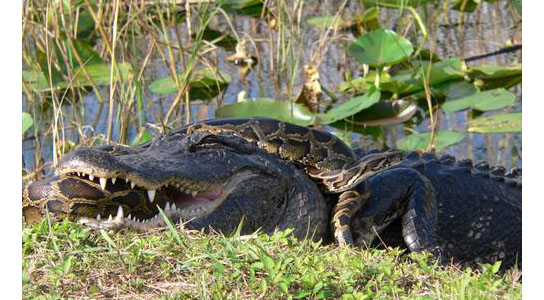
According to new study that was co-authored by USGS and published today in the Proceedings of the National Academy of Sciences, scientists found that the mid-sized mammal population living in the Everglades National Park has declined dramatically. The researchers believe this is due to a large number of Burmese pythons living in southern Florida and that these mammals are not used to being preyed upon since pythons are not native to the area.
Mid-sized mammals in Everglades National Park are getting a big squeeze from invasive Burmese pythons, according to a United States Geological Survey (USGS) co-authored study published today in the Proceedings of the National Academy of Sciences. These pythons, large constricting snakes native to Asia that can reach more than 20 feet (6 meters) in length and upwards of 200 pounds (90 kilograms), are now found throughout much of southern Florida, including all of Everglades National Park. Since the recognition 11 years ago that these invasive, exotic snakes were breeding in the park, formerly common mammals there have declined dramatically.
The status of species that are rare, patchily distributed, active during the day, or that don’t cross roads was not assessed in this new study.
The university and federal scientists who conducted the study found that the most severe declines in mammals appear to have occurred in the remote southernmost regions of the park, where pythons have been established the longest. In this area, observations of raccoons dropped 99.3 percent, opossums 98.9 percent, and bobcats 87.5 percent. Marsh and cottontail rabbits, as well as foxes, were not seen at all in recent years, despite having been present in the 1990s.
The authors suggested that one reason for such dramatic declines in such a short time is that these prey species may be “naïve” to large constrictor snakes — that is, they are not used to being preyed upon by pythons since such large snakes have not existed in the eastern United States for millions of years. In addition, some of the declining species could be both victims of being eaten by pythons and of having to compete with pythons for food.
Pythons have increased dramatically in both abundance and geographic range in South Florida since 2000. Based on the geographic extent of the Burmese python population in Florida and knowledge of detection rates for other snakes, experts estimate that a population of at least tens of thousands now live in the wild in Florida, but stress that this estimate is extremely rough. Population size may have dropped somewhat as a result of the severe cold snap of early 2010, but the population is expected to quickly recover from this unusual event.
Burmese pythons have traits that increase their risk of establishment and that make their eradication difficult. Specifically, Burmese pythons:
- grow rapidly to a large size (one over 16-feet or 5-meter long was captured in the Everglades in January 2012);
- are habitat generalists (they can live in many kinds of habitats);
- are dietary generalists (can eat a variety of mammals, birds, and reptiles);
- may be arboreal (tree-living) when young, which puts birds and arboreal mammals such as squirrels and bats at risk and provides another avenue for quick dispersal of the snakes;
- are tolerant of urbanization (can live in urban/suburban areas);
- are well-concealed “sit-and-wait” predators (difficult to detect and difficult to trap due to their infrequent movements between hiding places);
- mature rapidly and produce many offspring (females can store sperm and fertilize their eggs —which can number more than 100 — when conditions are favorable for bearing young);
- achieve high population densities (resulting in a greater impact on native wildlife); and
- serve as potential hosts for parasites and diseases of economic and human health significance.
As a result, Burmese pythons pose considerable challenges for the ecosystems of South Florida and many of the animals that live there, including threatened and endangered species. Federal and state agencies or institutions are working hard to deal with the serious threats caused by this invasive species. USGS research aims to help managers preserve and restore the Everglades’ ecosystems.
Everglades Restoration Includes the Management of Invasive Species
Invasive species are plants or animals that are non-native to a given ecosystem and which pose economic or ecological threats to native plants, animals, ecosystems, and sometimes people. In the case of the Burmese python, the new study shows that pythons appear to have begun to markedly alter the Everglades ecosystem by changing food webs through depleting or eliminating vulnerable native species. If enough animals are lost, entire ecosystem processes could be disrupted.
Scientists found little support for alternative explanations for the mammals’ decline, such as disease or changes in habitat. Scientists also ruled out predation by black bears and Florida panthers as the cause, since these populations have not grown in size during the past 15 years. Additionally, researchers ruled out mid-sized predators, such as foxes and bobcats, as the cause of these mammal declines since these two species have also experienced significant declines.
Can the Everglades be Rid of These Pythons?
The odds of eradicating an introduced population of reptiles once it has spread across a large area are very low, pointing to the importance of prevention, early detection, and rapid response. And with the Burmese python now distributed across more than a thousand square miles of southern Florida, including all of Everglades National Park and areas to the north such as Big Cypress National Preserve, the chances of eliminating the snake completely from the region is low. However, controlling their numbers and preventing their spread are critical goals for South Florida land managers. For example, a number of Burmese pythons have been found in the Florida Keys, but there is no confirmation yet that a breeding population exists in the Keys. Given a recent USGS study that showed the python’s apparent ability to disperse via salt water, island residents and resource managers need to stay vigilant so as to be able to detect and eliminate arriving pythons before they become established.
On January 23, 2012, the U.S. Fish and Wildlife Service published a rule in the Federal Register that will restrict the importation and interstate transportation of four non-native constrictor snakes (Burmese python, northern and southern African pythons, and the yellow anaconda) that threaten the Everglades and other sensitive ecosystems. These snakes are being listed as injurious species under the Lacey Act. In addition, the FWS will continue to consider listing as injurious five other species of nonnative snakes: the reticulated python, boa constrictor, DeSchauensee’s anaconda, green anaconda, and Beni anaconda. For more information about the Lacey Act and the listing of these four constrictors as injurious, please visit this FWS News and Resources site.
How does USGS Research Help Managers Deal with Invasive Species?
According to the USGS Invasive Species Program, the U.S. is under an economic and ecological siege by having to deal with more than 6,500 harmful non-native species estimated to cause more than a hundred billion dollars in damage each year to the U.S. economy. These costs are borne by farmers, ranchers, businesses, and local, state, tribal and federal governments battling to control the economic, health, and environmental threats these invaders pose. Invasive species adversely affect every state in the country, in both urban centers and wilderness areas. Increased global travel and trade provide pathways for both intentional and unintentional introductions of invasive species.
Experts note that Florida has the largest number of established non-indigenous reptile and amphibian species in the entire world. Fifty-six are established including three frogs, four turtles, one crocodilian, 43 lizards, and five snakes.
Reference: “Severe mammal declines coincide with proliferation of invasive Burmese pythons in Everglades National Park” by Michael E. Dorcas, John D. Willson, Robert N. Reed, Ray W. Snow, Michael R. Rochford, Melissa A. Miller, Walter E. Meshaka, Jr., Paul T. Andreadis, Frank J. Mazzotti, Christina M. Romagosa and Kristen M. Hart, 30 January 2012, Proceedings of the National Academy of Sciences.
DOI: 10.1073/pnas.1115226109
Researchers with the USGS Invasive Species Program work collaboratively on all significant groups of invasive organisms in terrestrial and aquatic ecosystems in all regions of the United States. USGS plays an important role in Federal efforts to combat invasive species by providing tools, technology and information to assess, prevent, contain, control, and manage invasive species nationwide. Key components of invasive species activities include prevention, monitoring and forecasting threats, and control and management of established invaders.
Never miss a breakthrough: Join the SciTechDaily newsletter.
Follow us on Google and Google News.