
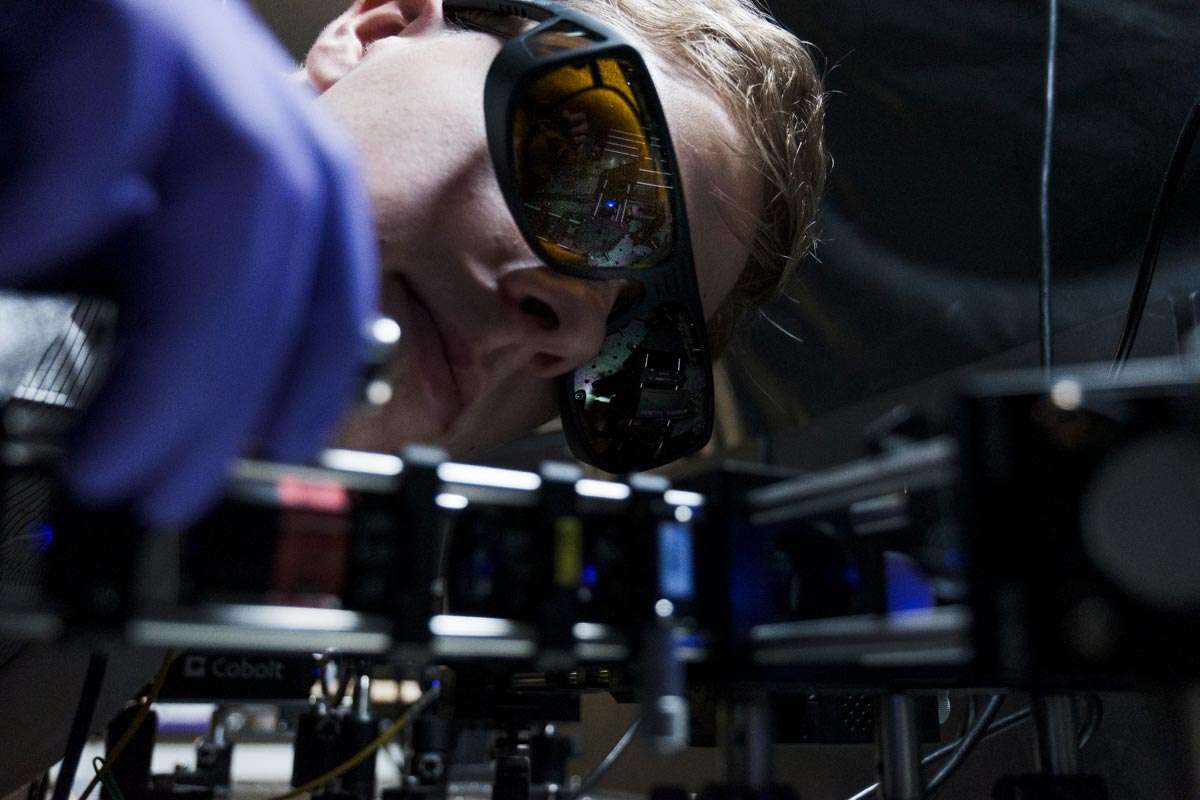
Researchers have developed a revolutionary method to produce entangled photon pairs using much thinner materials, drastically reducing the size of quantum computing components.
This breakthrough enables simpler, more compact setups for quantum technologies, potentially transforming fields from climate science to pharmaceuticals.
Breakthrough in Quantum Computing
Researchers have made a discovery that could make quantum computing more compact, potentially shrinking essential components 1,000 times while also requiring less equipment.
A class of quantum computers being developed now relies on light particles, or photons, created in pairs linked or “entangled” in quantum physics parlance. One way to produce these photons is to shine a laser on millimeter-thick crystals and use optical equipment to ensure the photons become linked. A drawback to this approach is that it is too big to integrate into a computer chip.
Now, Nanyang Technological University, Singapore (NTU Singapore) scientists have found a way to address this approach’s problem by producing linked pairs of photons using much thinner materials that are just 1.2 micrometers thick, or about 80 times thinner than a strand of hair. And they did so without needing additional optical gear to maintain the link between the photon pairs, making the overall setup simpler.

Innovative Methods
“Our novel method to create entangled photon pairs paves the way for making quantum optical entanglement sources much smaller, which will be critical for applications in quantum information and photonic quantum computing,” said NTU’s Prof Gao Weibo who led the researchers.
He added that the method could scale down the size of devices for quantum applications because many of these devices currently need large and bulky optical equipment, which are cumbersome to align, before they can work.
Quantum Computing Revolution
Quantum computers are expected to revolutionize the approach to many challenges, from helping us better understand climate change to finding new drugs faster by completing complex computations and quickly finding patterns in large data sets. For instance, calculations that would take supercomputers today millions of years to resolve could be done within minutes by quantum computers.
This is expected to happen because quantum computers perform many computations simultaneously instead of doing them one at a time like standard computers.

Photon-Based Quantum Bits
Quantum computers can do so as they perform calculations using tiny switches called quantum bits, or qubits, that can be in both the on and off position simultaneously. It is akin to flipping a coin in the air, with the spinning coin in a state between heads and tails. In contrast, standard computers use switches that can be on or off at any time, but not both.
Photons can be used as qubits for quantum computers to perform faster calculations as they can have on and off states at the same time. But being in two states simultaneously only happens if the photons are produced in a pair, with one photon linked, or entangled, to the other. An important condition for entanglement is that the paired photons need to vibrate in sync.
One advantage of using photons as qubits is that they can be produced and entangled at room temperature. Relying on photons can thus be easier, cheaper, and more practical than using other particles like electrons that need ultra-low temperatures close to the coldness of outer space before they can be used for quantum computing.

Overcoming Material Limitations
Researchers have been trying to find thinner materials to produce linked pairs of photons so that they can be worked into computer chips. However, one challenge is that when materials get thinner, they produce photons at a much lower rate, which is impractical for computing.
Recent advances showed that a promising new crystalline material called niobium oxide dichloride, which has unique optical and electronic properties, can produce pairs of photons efficiently despite its thinness. But these photon pairs are useless for quantum computers because they are not entangled when produced.
A solution was found by NTU scientists led by Prof Gao, from the University’s School of Electrical & Electronic Engineering and School of Physical & Mathematical Sciences, in collaboration with Prof Liu Zheng from the School of Materials Science & Engineering.
A Quantum Leap Inspired by Tradition
Prof Gao’s solution was inspired by an established method to create entangled pairs of photons with thicker and bulkier crystalline materials, which was published in 1999. It involves stacking two flakes of thick crystals together and positioning the crystalline grains of each flake perpendicularly to each other.
However, the vibrations of photons produced in a pair can still be out of sync due to how they travel within the thick crystals after they are created. Additional optical equipment is therefore needed to synchronize the photon pairs to maintain the link between the light particles.
Prof Gao theorized that a similar two-crystal set-up could be used with two thin crystal flakes of niobium oxide dichloride, with a combined thickness of 1.2 micrometers, to produce the linked photons without requiring extra optical instruments.
He expected this to happen because the flakes used are much thinner than the bulkier crystals from earlier studies. As a result, the pairs of photons produced travel a smaller distance within the niobium oxide dichloride flakes, so the light particles remain in sync with each other. Experiments by the NTU Singapore team proved that his hunch was correct.
Quantum Computing’s Future Enhanced
Prof Sun Zhipei from Finland’s Aalto University, who specializes in photonics and was not involved in NTU’s research, said that entangled photons are like synchronized clocks that show the same time no matter how far apart they are and can thus enable instant communication.
He added the NTU team’s method to generate quantum entangled photons “is a major advancement, potentially enabling the miniaturization and integration of quantum technologies”.
“This development has potential in advancing quantum computing and secure communication, as it allows for more compact, scalable, and efficient quantum systems,” said Prof Sun, a co-principal investigator at the Research Council of Finland’s Center of Excellence in Quantum Technology.
The NTU team plans to further optimize the design of their set-up to generate even more linked pairs of photons than possible now.
Some ideas include exploring whether introducing tiny patterns and grooves on the surface of niobium oxide dichloride flakes can increase the number of photon pairs produced. Another one will examine whether stacking the niobium oxide dichloride flakes with other materials can boost photon production.
Reference: “Van der Waals engineering for quantum-entangled photon generation” by Leevi Kallioniemi, Xiaodan Lyu, Ruihua He, Abdullah Rasmita, Ruihuan Duan, Zheng Liu and Weibo Gao, 14 October 2024, Nature Photonics.
DOI: 10.1038/s41566-024-01545-5
Never miss a breakthrough: Join the SciTechDaily newsletter.
Follow us on Google and Google News.
3 Comments
No, entangled photons do NOT “… enable instant communication.” They respond equally to testing even when widely separated, but the separation speed never exceeds the speed of light,
Yes the result of the wavefunction collapse of the entangled particle is random hence it can not be used for instant communication
Those people are touting the possible future ability of quantum computing, as if nothing could ever go wrong there.
Seriously, why do we even need that monstrosity? I understand why the governments would want it, though.