
Close Menu
    Facebook X (Twitter) Instagram
    SciTechDaily
    • Biology
    • Chemistry
    • Earth
    • Health
    • Physics
    • Science
    • Space
    • Technology
    Facebook X (Twitter) Pinterest YouTube RSS
    SciTechDaily
    Home»Biology»Scientists Discover Ancient Fossilized Crustaceans Entombed with Eggs and Embryos
    Biology

    Scientists Discover Ancient Fossilized Crustaceans Entombed with Eggs and Embryos

    By Eric Gershon, Yale UniversityMarch 18, 2014No Comments3 Mins Read
    Facebook Twitter Pinterest Telegram LinkedIn WhatsApp Email Reddit
    Share
    Facebook Twitter LinkedIn Pinterest Telegram Email Reddit
    Researchers Discover Ancient Crustaceans Buried Alive with Eggs and Embryos
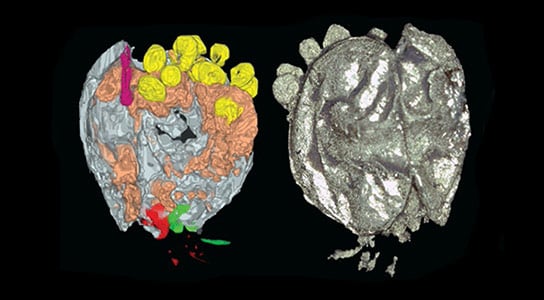
    This X-ray image of the ostracod Luprisca incubi, found in 450 million-year-old rocks in New York State, shows eggs and possibly hatched offspring (in yellow) protruding from the rear of the shell. Credit: Yale University

    A team of biologists has discovered 450-million-year-old fossilized crustaceans entombed with their eggs and newly hatched offspring, extending the knowledge of ostracods and confirming their presence in the Ordovician period.

    Scientists have found 450-million-year-old fossilized crustaceans entombed with their eggs and newly hatched offspring. At least one of the animals is a newly identified species.

    The tiny ostracods — arthropods related to shrimps, lobsters, and crabs — were buried by a mudslide in an area of upstate New York, near Rome, at a time when the entire region was deep underwater. In one specimen, both eggs and early embryos are present with the adult female.

    “This kind of detail is rarely preserved in the fossil record,” said Derek E.G. Briggs, an author of a research paper on the crustaceans published March 13 in Current Biology and director of the Yale Peabody Museum of Natural History, which supported the research. David Siveter of the University of Leicester in England, a specialist on fossil ostracods, is the first author.

    The discoveries extend knowledge of ostracods, the most abundant group of fossil arthropods, by about 25 million years and confirm their presence in the Ordovician period (485 million to 443 million years ago), when most of the Earth north of the tropics was ocean. These new specimens show that this kind of brood care has persisted for at least 450 million years, researchers said.

    The brooding crustaceans were found in and around a fossil deposit first excavated in the early 1890s by Charles Emerson Beecher of Yale and known since as Beecher’s Trilobite Bed. The site, which was rediscovered in 1984, is celebrated for the remarkable preservation of its fossils, particularly the trilobite Triarthrus. In many cases, these fossils include evidence of soft tissues as well as shells; the soft anatomy is preserved by the mineral pyrite. The ostracods came to light during a new major excavation as part of research on pyritization of the Beecher’s Bed fossils by Yale graduate student Una Farrell, now at the University of Kansas.

    “Only a handful of examples are known where eggs are fossilized and associated with the parent,” Siveter said. “This discovery tells us that these ancient tiny marine crustaceans took particular care of their brood in exactly the same way as their living relatives.”

    The recent discoveries yielded more than 100 specimens of ostracods frozen in time, a small number of them with eggs and/or newly hatched offspring. The adult animals are tiny — two or three millimeters long, the embryos the size of a grain of sand.

    “These new discoveries show how important exceptional preservations are in revealing the history of life,” said Briggs, who leads the Yale project on the Beecher’s Bed fossils.

    At least one of the ostracods is a new species and the researchers named it Luprisca incuba after Lucina, the Roman goddess of childbirth.

    Co-authors are Gengo Tanaka, Úna C. Farrell, Markus J. Martin, and Derek J. Siveter.

    Reference: “Exceptionally Preserved 450-Million-Year-Old Ordovician Ostracods with Brood Care” by David J. Siveter, Gengo Tanaka, Úna C. Farrell, Markus J. Martin, Derek J. Siveter and Derek E.G. Briggs, 31 March 2014, Current Biology.
    DOI:10.1016/j.cub.2014.02.040


    Never miss a breakthrough: Join the SciTechDaily newsletter.
    Follow us on Google and Google News.

    Fossils University of Leicester Yale University
    Share. Facebook Twitter Pinterest LinkedIn Email Reddit

    Related Articles

    Hail to the Squid – New Species of Extinct Vampire-Squid-Like Cephalopod With 10 Arms Named After Biden

    Researchers Discover Fossils of Cthulhu-Like Creature

    Burnt Toast and Dinosaur Bones Have a Common Trait

    Finding the ‘Breath of Life’ in a Silurian Ostracod

    Scientists Reveal the First Bird Beak, 3D Skull of Ichthyornis Dispar

    Ancient Fossil Reveals New Details About How Brittle Stars Functioned

    Drepanosaurus – A Small Reptile with a Rearsome Finger

    Pentecopterus – A Giant Sea Scorpion from the Prehistoric Seas

    Fossil Discovery Captures a Previously Unseen Stage in the Evolution of Ancient Arthropods

    Leave A Reply Cancel Reply

    • Facebook
    • Twitter
    • Pinterest
    • YouTube

    Don't Miss a Discovery

    Subscribe for the Latest in Science & Tech!

    Trending News

    The Universe Is Expanding Too Fast and Scientists Can’t Explain Why

    “Like Liquid Metal”: Scientists Create Strange Shape-Shifting Material

    Early Warning Signals of Esophageal Cancer May Be Hiding in Plain Sight

    Common Blood Pressure Drug Shows Surprising Power Against Deadly Antibiotic-Resistant Superbug

    Scientists Uncover Dangerous Connection Between Serotonin and Heart Valve Disease

    Scientists Discover a “Protector” Protein That Could Help Reverse Hair Loss

    Bone-Strengthening Discovery Could Reverse Osteoporosis

    Scientists Uncover Hidden Trigger Behind Stem Cell Aging

    Follow SciTechDaily
    • Facebook
    • Twitter
    • YouTube
    • Pinterest
    • Newsletter
    • RSS
    SciTech News
    • Biology News
    • Chemistry News
    • Earth News
    • Health News
    • Physics News
    • Science News
    • Space News
    • Technology News
    Recent Posts
    • Scientists Overcome Major Quantum Bottleneck, Potentially Transforming Teleportation and Computing
    • Quantum Physics’ Strangest Problem May Hold the Key to Time Itself
    • Scientists Create “Liquid Gears” That Spin Without Touching
    • The Simple Habit That Could Help Prevent Cancer
    • Forgotten Medicinal Plant Shows Promise in Fighting Dangerous Superbugs
    Copyright © 1998 - 2026 SciTechDaily. All Rights Reserved.
    • Science News
    • About
    • Contact
    • Editorial Board
    • Privacy Policy
    • Terms of Use

    Type above and press Enter to search. Press Esc to cancel.