
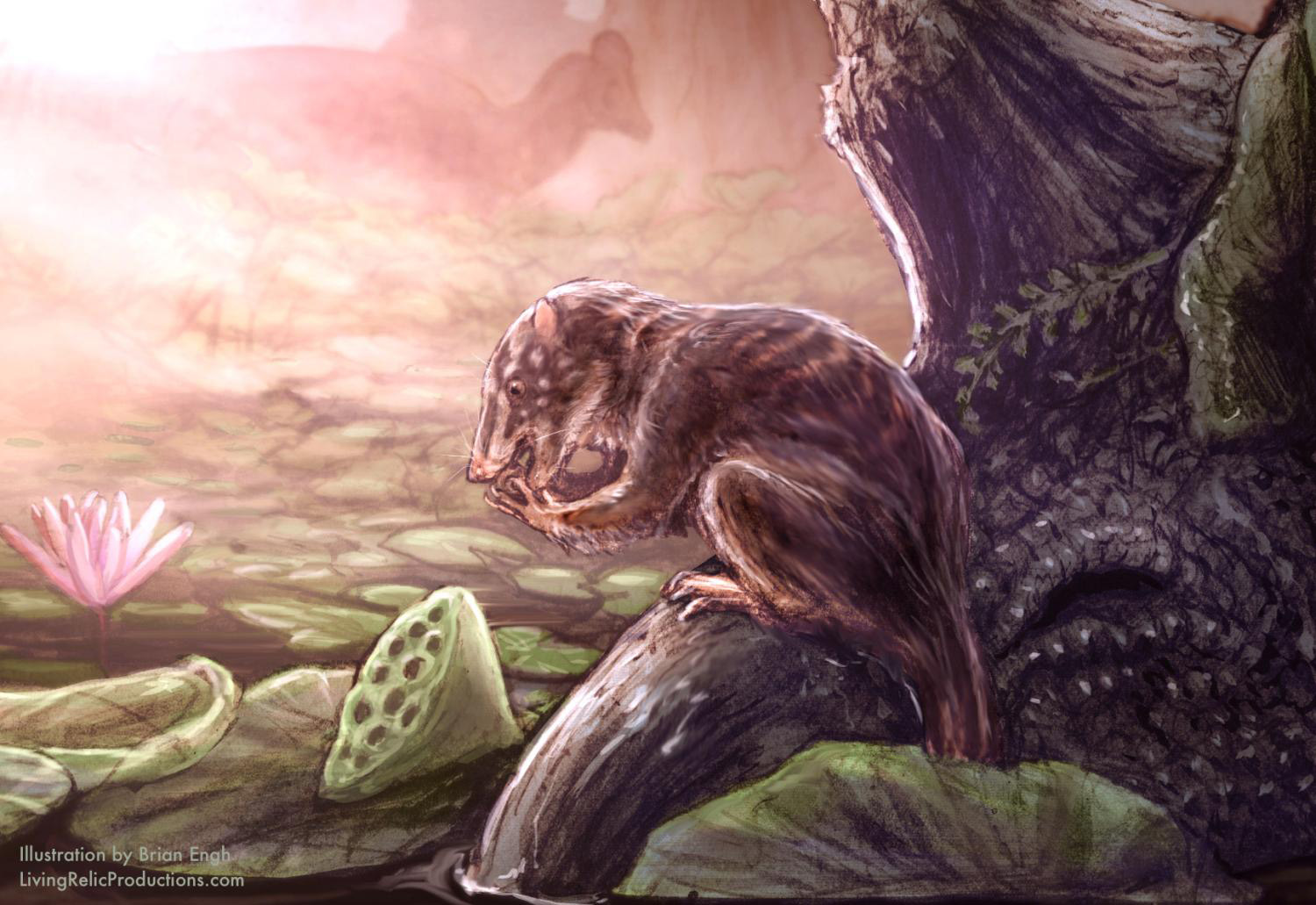
Colorado paleontologists found a rare fossil mammal, Heleocola piceanus, from 70-75 million years ago. The discovery shows some ancient mammals were larger than previously thought.
A team of paleontologists near Rangely, Colorado, has discovered a new (or rather, ancient) state resident—a fossilized mammal roughly the size of a muskrat, which likely scurried through swamps during the Age of Dinosaurs.
The researchers, led by the University of Colorado Boulder’s Jaelyn Eberle, published their findings in the journal PLOS ONE.
Eberle and her colleagues named their discovery, which they identified from a piece of jawbone and three molar teeth, Heleocola piceanus. The animal lived in Colorado roughly 70 to 75 million years ago—a time when a vast inland sea covered large portions of the American West. (Fittingly, “Heleocola” roughly translates to “swamp dweller” in Latin).

“Colorado is a great place to find fossils, but mammals from this time period tend to be pretty rare,” said Eberle, curator of fossil vertebrates at the CU Museum of Natural History and professor in the Department of Geological Sciences. “So it’s really neat to see this slice of time preserved in Colorado.”
Compared to much larger dinosaurs living at the time like tyrannosaurs or the horned ancestors of Triceratops, the new fossil addition to Colorado might seem tiny and insignificant. But it was surprisingly large for mammals at the time, Eberle said.
She’s also glad to see Rangely, which sits in the northwest corner of the state not far from Dinosaur National Monument, get its due.
“It’s a small town, but, in my experience as a paleontologist, a lot of cool things come out of rural environments,” Eberle said. “It’s nice to see western Colorado have an exciting discovery.”
Land meets water
That cool discovery helps to paint a more complete picture of a Colorado that would be all but unrecognizable to residents today.
Paleontologists John Foster and ReBecca Hunt-Foster, co-authors of the new study, have been coming to this part of the state to dig up fossils every summer for about 15 years. Seventy million years ago, it was a place where land met water. Here, creatures like turtles, duck-billed dinosaurs, and giant crocodiles may have flourished in and around marshes and estuaries, gorging themselves on wetland vegetation, fish, and more.

“The region might have looked kind of like Louisiana,” said ReBecca Hunt-Foster, a paleontologist at Dinosaur National Monument in Utah and western Colorado. “We see a lot of animals that were living in the water quite happily like sharks, rays, and guitarfish.”
John Foster first remembers seeing the bit of mammal jaw emerge from a slab of sandstone that he collected from the site in 2016. The fossil measured about an inch long.
“I said, ‘Holy cow, that’s huge,” said Foster, a scientist at the Utah Field House of Natural History State Park Museum in Vernal, Utah.
One big mammal
Eberle explained that before an asteroid killed off the non-avian dinosaurs 66 million years ago, mammals tended to be small—most were about the size of today’s mice or rats. She largely identifies them from the tiny teeth they left behind.
H. piceanus, in comparison, was positively huge. Eberle estimates that the animal, a cousin to modern-day marsupials, weighed 2 pounds or more, larger than most Late Cretaceous mammals. (It’s not quite a record—another fossil mammal from the same period, known as Didelphodon, may have weighed as much as 11 pounds). Based on H. piceanus’ teeth, the mammal likely dined on plants with a few insects or other small animals mixed in.
While dinosaurs get all the glory, the new find is another reason why paleontologists shouldn’t overlook ancient mammals. Small or not, they played an important role in Colorado’s ecosystems in the Late Cretaceous.
“They’re not all tiny,” Eberle said. “There are a few animals emerging from the Late Cretaceous that are bigger than what we anticipated 20 years ago.”
Hunt-Foster said that the Mountain West is a special place for anyone who loves fossils. She also urged people visiting public lands not to collect vertebrate fossils, such as dinosaurs, they may come across while hiking to avoid disturbing important scientific information. Instead, they should note the location, take a photo and alert a representative from a nearby museum or public land agency.
“We have scientists that come from all over the world specifically to study our fossils,” she said. “We really are lucky.”
Reference: “A new Late Cretaceous metatherian from the Williams Fork Formation, Colorado” by Jaelyn Eberle, Joshua Cohen, John Foster, ReBecca Hunt-Foster and Andrew Heckert, 23 October 2024, PLOS ONE.
DOI: 10.1371/journal.pone.0310948
Never miss a breakthrough: Join the SciTechDaily newsletter.
Follow us on Google and Google News.
1 Comment
We still in age of dinosaur the raise of mesoeucrocodylia dinosaur .spinosauridae got more powerful through the the years and turn into modern crocodilian .they are no links between gator and birds .the dinosaur was allways primitive they have palate teeth like the primitive tuatara the early dinosaur .not found in pseudosuchus The scapula was not fuse to Coracoid in early dinosaur the early tetanuran the basipterygoid was not fuse .all those feature are fuse in modern crocodilian .dinosaur did not have pseudorotunda like the tuatara the only dinosaur has it is spinosauridae that why king of dinosaur has it the great modern crocodilian