
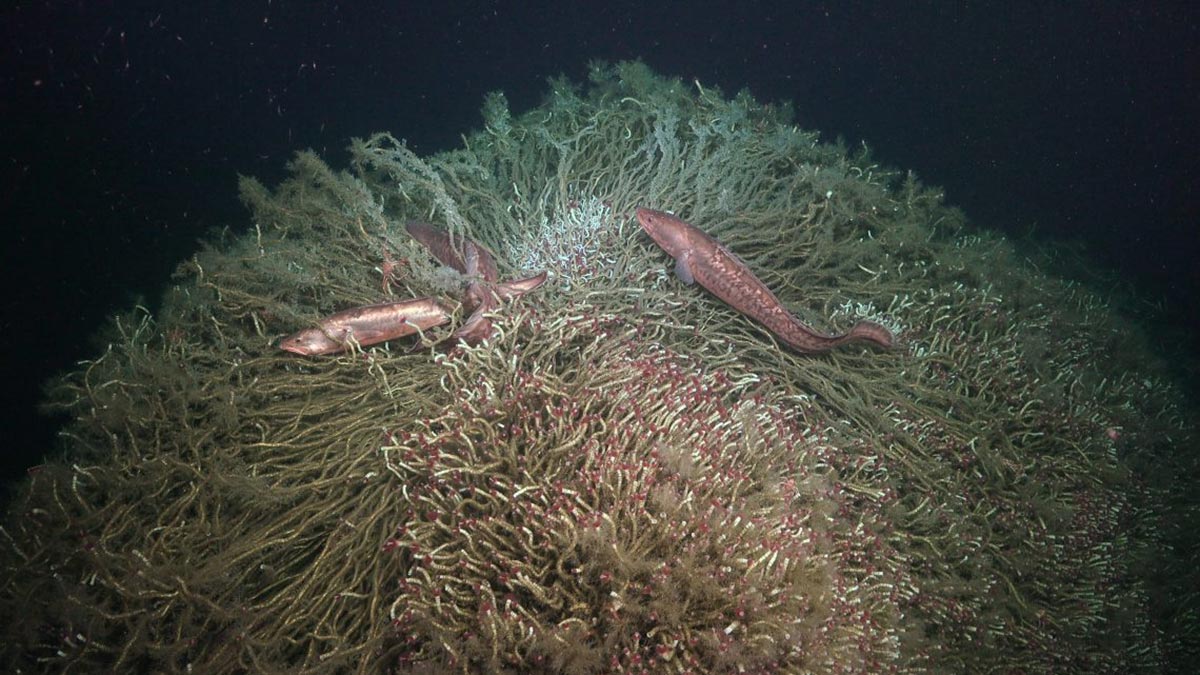
An international team charts four previously unnamed underwater canyons, investigates nearly 20 methane seep ecosystems thriving in complete darkness, and discovers a stunning array of otherworldly creatures, including potential new species.
An international team of scientists aboard the Schmidt Ocean Institute’s research vessel R/V Falkor (too) recently surveyed nearly 20 methane seeps, including several newly discovered sites, and explored four submarine canyon systems that had never before been seen by humans. Their findings revealed a rich abundance of marine life off the Chilean coast, including approximately 60 potentially new species thriving in diverse ecosystems. Among the discoveries were commercially valuable fish swimming in methane seep areas. The 55-day expedition traversed the Chilean coastline, from Valparaíso to Punta Arenas, exploring ocean habitats from central to southern Chile.
This groundbreaking cruise was the first in the region to employ a remotely operated vehicle (ROV) to transmit real-time imagery. It was co-led by Dr. Jeffrey Marlow of Boston University (USA), Dr. Patricia Esquete of the University of Aveiro (Portugal), and Dr. Eulogio Soto of the University of Valparaíso (Chile). The team utilized advanced techniques, including sonar-based bubble mapping, bathymetric mapping, and in situ methane concentration measurements, to map the canyons and locate methane seeps. The expedition featured researchers from Chile, the United States, Portugal, Norway, Germany, the Netherlands, Spain, and Italy, marking a highly collaborative international effort.
The Importance of Methane Seeps
Methane seeps are chemosynthetic environments where methane bubbles up from the seafloor, feeding microbes that, in turn, support an array of life. While clues from water chemistry measurements and images from camera tows taken on previous expeditions to the region suggested the presence of some seeps off of Chile, many sites had not been fully surveyed and sampled before. In addition, several seep sites were entirely new to science. Some were in shallow waters, others in deep waters; some were in rocky areas, others were in sediment.
“I was most impressed by how different the methane seeps in this area are from those we’ve studied in North America — and how distinct the sites we visited were from one day to the next,” said Marlow, a microbial ecologist who served as the expedition’s chief scientist. “The fact that we came across so many seeps in such a relatively small area suggests that they’re pervasive along the Chilean coast, serving as hubs for biodiversity and elemental cycling on a vast scale.”
One observation the team was particularly impressed by was abundant red cusk-eels called congrio colorado (Genypterus chilensus) — a commercially important fish that is highly valued in Chile — swimming in and around an 892-square-meter (9600-square-foot) tubeworm mound near a methane seep. Poet and Nobel Laureate Pablo Neruda celebrated this iconic Chilean fish; upon returning to the country from exile in 1954, he wrote an ode to the eel as a celebration of his home country and life.
While these fish have been observed around reefs and soft-bottom mangrove ecosystems, there has been little documentation of their behavior swimming near methane seeps. Scientists require further research to understand the species’ relationship with methane seeps and to determine if these environments are essential to sustaining their populations.
“These exploratory expeditions are incredible — and essential — opportunities for the science community to improve our understanding of the planet,” said Esquete. “After extensive sampling, we suspect our team has found at least 60 species new to science and will be working over the next few years to confirm this.”
Unveiling Submarine Canyons and Extraordinary Discoveries
The team explored four unnamed submarine canyons in southern Chile for the first time, mapping them to a high resolution. The largest of the canyons is approximately 2000 square kilometers (770 square miles) and the deepest is over 3000 meters deep (1.86 miles). Submarine canyons are critical ecosystems that connect land to the open ocean. The rocky canyon walls provide structures for habitat-building animals like glass sponges and deep-sea corals, which support species from tiny bristle stars to octopuses.
An additional methane seep was discovered in one of the canyons near Chile’s triple junction, a place on the seafloor where three tectonic plates meet.
Other notable observations included large congregations of Humboldt Squid feeding near the seeps, a sighting of a glowing anglerfish scientists are still working to identify, massive chemosynthetic clam beds, and a shimmering polychaete worm that garnered the attention of millions on social media during the expedition.
“This expedition is yet another example of the tremendous value of bringing together cross-disciplinary science teams and cutting-edge technology to little-known regions of our global Ocean,” said Dr. Jyotika Virmani, executive director of Schmidt Ocean Institute. “The diverse marine life swimming contentedly in this geologically interesting ecosystem was beautiful to watch — a strong reminder that what is out of sight should perhaps not be out of mind.”
Never miss a breakthrough: Join the SciTechDaily newsletter.
Follow us on Google and Google News.