

Researchers at the University of Basel in Switzerland have discovered that certain nutrients in food can cause a mild stress reaction in nematodes. Surprisingly, rather than harming the organisms, this slight stress appears to boost their overall health and help them maintain vitality as they grow older.
People today are living longer than ever before, but longevity alone doesn’t guarantee good health. For many, the real concern is not simply “How many years can I live?” but “How well can I live as I age?”.
Lifespan refers to the total number of years a person lives, while “healthspan” defines how many of those years are spent in good physical and mental condition.
Diet plays a major role in healthy aging. Scientists have long understood that both the amount and the types of nutrients we consume influence how our bodies age. Researchers led by Spang at the University of Basel used the microscopic worm Caenorhabditis elegans to uncover how certain RNA molecules found in food can enhance the worms’ vitality later in life.
“These molecules prevent the formation of harmful protein aggregates that are typically linked with aging and disease,” explains Spang. Their findings were recently reported in Nature Communications.
How diet shapes aging
With age, the body becomes less efficient at removing altered and damaged proteins. These can accumulate and form harmful protein aggregates in cells. Such protein aggregates are considered drivers of aging and are associated with multiple age-related diseases, including muscular and neurodegenerative diseases such as Alzheimer’s and Parkinson’s disease.
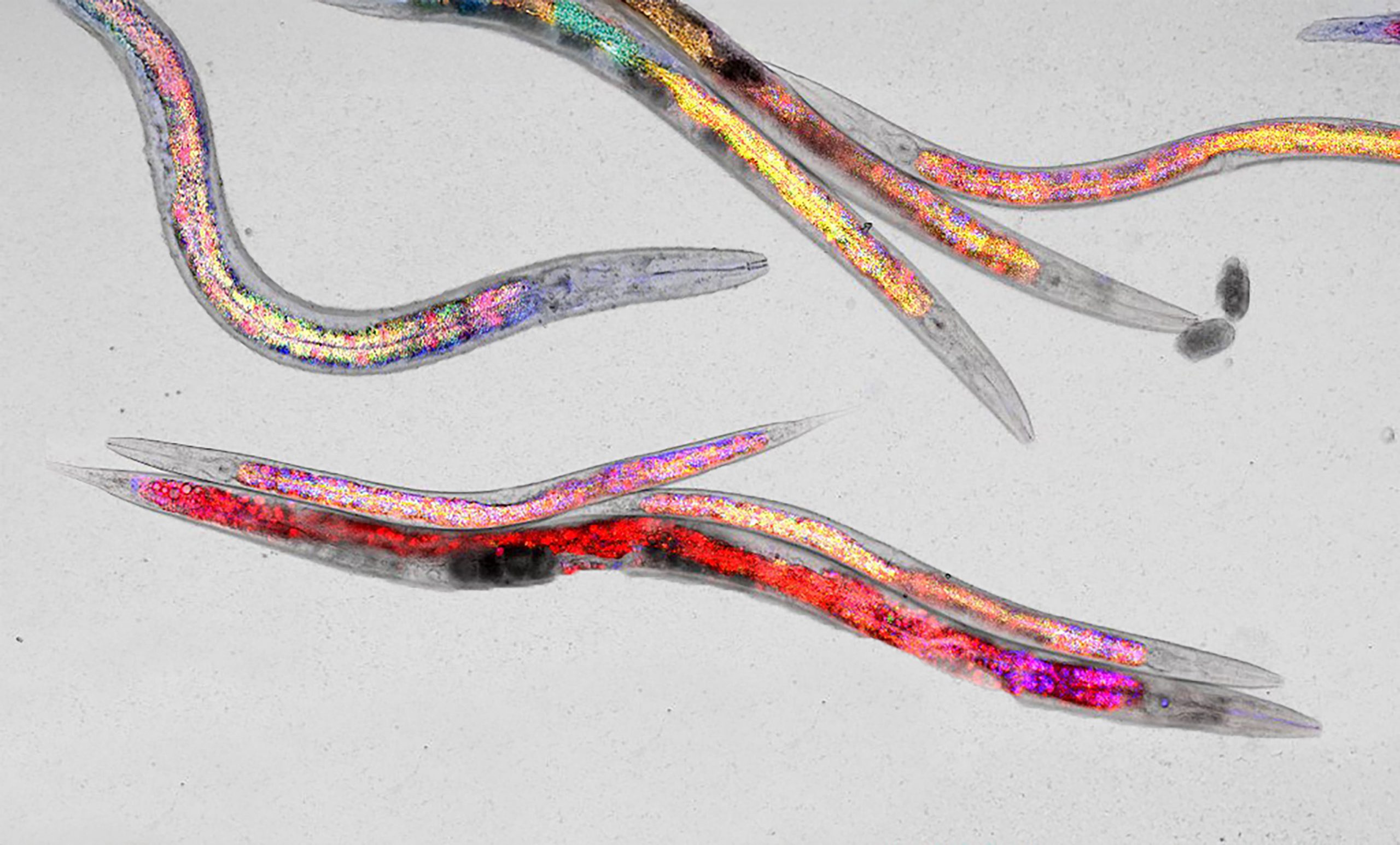
The researchers have discovered that a balanced diet promotes healthspan and specific components in the nematode’s diet exert a protective effect. The worms feed mainly on bacteria that contain double-stranded RNA molecules. “These dietary RNAs are absorbed in the gut and activate quality-control mechanisms to protect from cellular stress,” explains Emmanouil Kyriakakis, the study’s first author.” This low-level stress essentially trains the body to cope with protein damage more effectively.”
Diet-dependent mechanisms slow cellular aging
Diet activates autophagy—a cellular “clean-up” process that degrades and recycles damaged proteins. This mechanism reduces harmful protein aggregation and thus slows down cell aging. “We were surprised to find that the gut communicates with other organs,” says Kyriakakis. “We observed protective effects not only locally, but also in muscles and throughout the whole organism.”
Healthier aging — even in worms
Overall, the worms exposed to a balanced diet were more active and healthier in old age. “The dietary-RNA species elicit a systemic stress response that protects the worms from protein aggregation during aging,” says Kyriakakis. “thereby extending their healthspan.”
The findings confirm that diet strongly influences health in old age. “Specific food components can stimulate the body’s own protective mechanisms,” adds Spang. “So, a little stress can be good for you.” Whether individual nutrients can also spark beneficial effects in humans – and potentially help prevent age-related diseases – remains to be investigated. But it’s certainly conceivable. What is clear already: What we eat can shape the way we age.
Reference: “Bacterial RNA promotes proteostasis through inter-tissue communication in C. elegans” by Emmanouil Kyriakakis, Chiara Medde, Danilo Ritz, Geoffrey Fucile, Alexander Schmidt and Anne Spang, 1 October 2025, Nature Communications.
DOI: 10.1038/s41467-025-63987-x
Never miss a breakthrough: Join the SciTechDaily newsletter.
Follow us on Google and Google News.
6 Comments
CERP(Cytoplasmic Endoreticulum Regenerative Process)
Great INFO… Good Read!
Thanks 🍷
Not really beneficial. No applicable information. I’m pretty sure EVERYONE knows by now that diet influences health.
Enjoying specific tastes surely helps. Research needed, following on “cafeteria eating experiments with children”
“People today are living longer than ever before, …”
That is a questionable assertion. Certainly, fewer children die from childhood diseases as a result of improved hygiene, antibiotics, and vaccines for viruses. Fewer women of child-bearing age die in advanced countries, and even battlefield deaths of military-age males is less than what it was even decades ago. What that means is that more people are reaching old age. However, decades ago, Dr. Harrison Brown presented a graph showing the life expectancy of women from Roman times to the 1950s, for each decade of life. It strongly suggests that women in the North African Roman Empire lived longer than today. It’s just that a smaller percentage of those born managed to get through the risky years.
Would like to see research assessing the yumminess of specific foods on individual health and longevity.