
Close Menu
    Facebook X (Twitter) Instagram
    SciTechDaily
    • Biology
    • Chemistry
    • Earth
    • Health
    • Physics
    • Science
    • Space
    • Technology
    Facebook X (Twitter) Pinterest YouTube RSS
    SciTechDaily
    Home»Biology»Scientists Discover a Fundamental Aggravating Factor in Autoimmune Diseases
    Biology

    Scientists Discover a Fundamental Aggravating Factor in Autoimmune Diseases

    By Max Planck InstituteMarch 6, 2014No Comments3 Mins Read
    Facebook Twitter Pinterest Telegram LinkedIn WhatsApp Email Reddit
    Share
    Facebook Twitter LinkedIn Pinterest Telegram Email Reddit
    Scientists Discover a Fundamental Aggravating Factor in Autoimmune Diseases
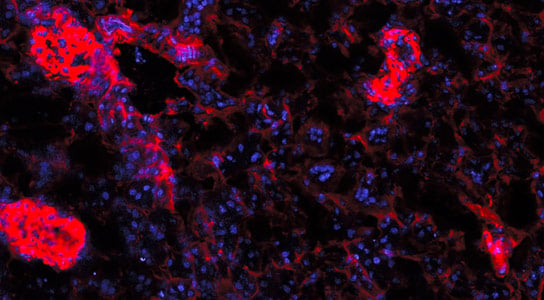
    Mice in which the scientists deactivated the PTP1B protein in B-cells have immune complex deposition (red) in their kidneys. The same development could be observed in patients with rheumatoid arthritis (blue: cell nuclei). Credit: MPI f. Immunobiology and Epigenetics/ D. Medgyesi

    Using genetic engineering, scientists have identified a factor that may play a significant role in autoimmune diseases.

    Scientists in Freiburg may have discovered a fundamental aggravating factor in autoimmune diseases. If B-lymphocytes lack the protein PTP1B, the cells will become hyperactive for stimulatory signals and can thus promote an autoimmune attack. This study offers an additional explanation to how B-cells regulate an immune response.

    In Germany, approximately 800,000 people suffer from rheumatoid arthritis. In this progressive disease, a person’s own immune system attacks and destroys connective tissue. However, the most important factors governing the progress of the disease are still unknown. Now, scientists working with Michael Reth and David Medgyesi from the Max Planck Institute of Immunobiology and Epigenetics have identified a factor that may play a significant role. Using genetic engineering, they deactivated the PTP1B protein in B-cells in the immune systems of mice. The B-cells then became much more responsive to activating signals and, in turn, served to reactivate the other cells.

    PTP1B could therefore have a monitoring function in the B-cell-mediated immune response. Until now, B-cells were mainly known for producing antibodies after coming into contact with pathogens. Only recently is more and more accepted by researchers that B-lymphocytes possess important regulatory function in the immune system. The current study now provides a new detail of this mechanism.

    A clinical investigation showed that B-cells in patients suffering from rheumatoid arthritis also produce unusually low amounts of the studied protein. In the patients’ other cell types, and in healthy subjects, this was not the case. “This suggests that the protein plays a significant role in the development or the aggravated course of rheumatoid arthritis”, says principal investigator Michael Reth. Reth is head of the Molecular Immunology department at the Max Planck Institute of Immunobiology and Epigenetics, as well as scientific director of the Center for Biological Signalling Studies (BIOSS), a German Cluster of Excellence at the University of Freiburg.

    In cases of rheumatoid arthritis in which conventional treatments are ineffective, patients can be treated with the drug Rituximab. The drug destroys all B-cells in the body and will thus at least halt the progress of the disease. “The B-cells produced after the Rituximab therapy possess similar amount of the PTP1B protein as cells in healthy people. This may contribute to the less severe autoimmune reaction”, explains first author David Medgyesi. Long-term studies are required to determine whether these newly produced cells will lose the protein over time.

    By the end of the 1990s, the laboratory headed by Michael Reth had already developed mice with B-cells in which specific genes could be knocked out using Cre-lox technology. In the meantime, this mouse strain is being used very successfully in over 200 laboratories around the world to study the functioning of the immune system.

    Reference: “The protein tyrosine phosphatase PTP1B is a negative regulator of CD40 and BAFF-R signaling and controls B cell autoimmunity” by David Medgyesi, Elias Hobeika, Robert Biesen, Florian Kollert, Adriano Taddeo, Reinhard E. Voll, Falk Hiepe and Michael Reth, 3 March 2014, Journal of Experimental Medicine.
    DOI: 10.1084/jem.20131196


    Never miss a breakthrough: Join the SciTechDaily newsletter.
    Follow us on Google and Google News.

    Epigenetics Immunobiology Immunology Max Planck Institute
    Share. Facebook Twitter Pinterest LinkedIn Email Reddit

    Related Articles

    Single Factor Can Reset the Immune System Back 500 Million Years

    Max Planck Researchers Discover New Weapon of the Immune System

    MOF-Associated Complexes Mediate Genetic Fair Play

    Decoded Shark Genome Provides New Insights into Immunity and Bone Formation

    Scientists Synthesize the First Biologically Effective Perfume

    Maggots Secretions Suppress Immune Response

    β-Catenin Regulates Telomerase in Stem Cells and Cancer Cells

    Researchers Use Bioinformatics and Epigenetics to Aid Cancer Research

    Researchers Track Development of T-cells in Living Zebrafish Embryos

    Leave A Reply Cancel Reply

    • Facebook
    • Twitter
    • Pinterest
    • YouTube

    Don't Miss a Discovery

    Subscribe for the Latest in Science & Tech!

    Trending News

    Your Blood Pressure Reading Could Be Wrong Because of One Simple Mistake

    Astronomers Stunned by Ancient Galaxy With No Spin

    Physicists May Be on the Verge of Discovering “New Physics” at CERN

    Scientists Solve 320-Million-Year Mystery of Reptile Skin Armor

    Scientists Say This Daily Walking Habit May Be the Secret to Keeping Weight Off After Dieting

    New Therapy Rewires the Brain To Restore Joy in Depression Patients

    Giant Squid Detected off Western Australia in Stunning Deep-Sea Discovery

    Popular Sugar-Free Sweetener Linked to Liver Disease, Study Warns

    Follow SciTechDaily
    • Facebook
    • Twitter
    • YouTube
    • Pinterest
    • Newsletter
    • RSS
    SciTech News
    • Biology News
    • Chemistry News
    • Earth News
    • Health News
    • Physics News
    • Science News
    • Space News
    • Technology News
    Recent Posts
    • Fur Seals’ Hearts Suddenly Spike Hours After Returning to Land
    • Scientists Say Cognitive Decline Isn’t Inevitable — Your Brain Can Improve at Any Age
    • This Weird Sea Creature May Have Rewritten Life’s Genetic Rulebook
    • The Hidden Types of Dementia Most People Have Never Heard Of
    • Scientists Discover Why Alcohol Prevents the Liver From Healing, Even After You Quit
    Copyright © 1998 - 2026 SciTechDaily. All Rights Reserved.
    • Science News
    • About
    • Contact
    • Editorial Board
    • Privacy Policy
    • Terms of Use

    Type above and press Enter to search. Press Esc to cancel.