
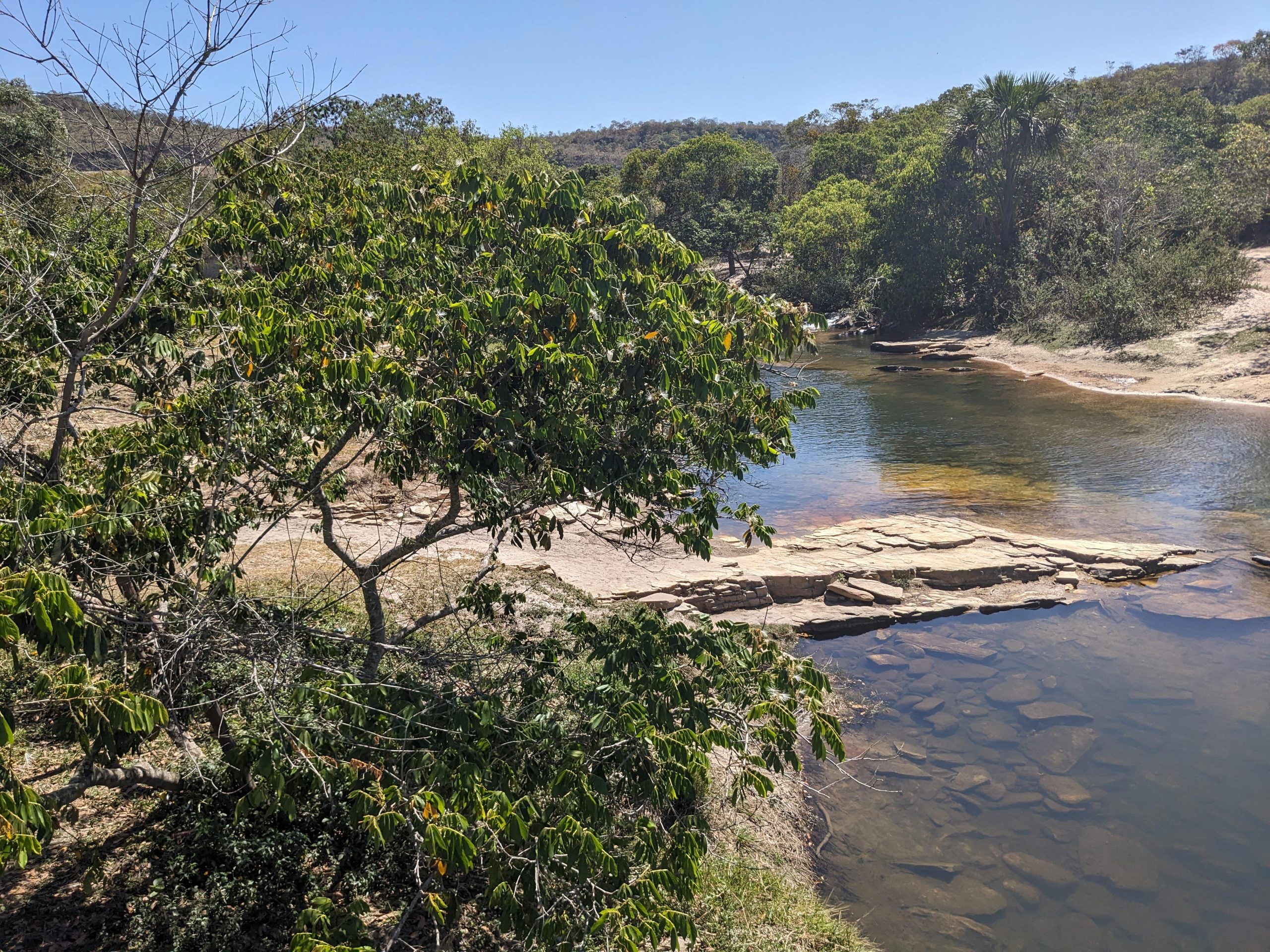
Riverside forests in Brazil have facilitated continuous tree migration between the Amazon and Atlantic rainforests. DNA evidence from Inga trees reveals multiple migration events, primarily from the Amazon.
New research reveals that forests along Brazil’s rivers have served as natural corridors, enabling tree species to migrate between the Amazon and Atlantic rainforests for millions of years.
Despite being separated by hundreds of miles of dry forest and savanna—environments unsuitable for most rainforest trees—these riverine forests have facilitated species movement over time.
Previously, scientists believed that tree species could only travel between the two rainforests during ancient periods of wetter climate, when much of South America was covered in continuous rainforest.
A Continuous Exchange of Species
But the new study – led by the Royal Botanic Garden Edinburgh (RBGE) and the University of Exeter – reveals a different story.
“Rather than tree species being exchanged during specific wetter periods in the past, we found that species have dispersed consistently over time,” said Dr James Nicholls, of RBGE. “This probably happens slowly, by generations of trees growing along the ‘highways’ provided by rivers that run through Brazil’s dry ecosystems.”

The research team – including scientists from Brazil – studied 164 species of Inga trees, which are common in Latin American rainforests.
By analyzing DNA, they reconstructed the trees’ family tree – seeing when each species split from its various ancestors. They then mapped where each species is found, allowing them to examine patterns of movement between the Amazon and Atlantic rainforests.
Tracing Tree Migration Patterns
They found 16-20 “dispersal events” when species arrived in the Atlantic forest from the Amazon, and successfully established themselves. These occurred throughout the evolutionary history of Inga – not just during periods when humid forests covered much of Brazil.
Meanwhile, the study only found one or two occasions when species moved from the Atlantic to the Amazon forest. The researchers think this may reflect the relative size of the forests – with the vast Amazon simply producing more outflow of tree seeds.
The findings highlight the importance of conserving riverside forests – which are protected in Brazilian law.
Professor Toby Pennington, from Exeter’s Department of Geography and the Global Systems Institute, and RGBE, said: “This legal protection – and efforts to preserve these riverside forests – are highly valuable for long-term habitat connectivity. The study also tells us something fundamental about the history of the incredible biodiversity of the Atlantic rainforest, which contains about 3,000 more plant species than the Brazilian Amazon. Only 20% of the Atlantic rainforest now remains intact. In the short term, we need to protect these precious rainforests. In the long term, our study shows that we must also conserve the connections between them.”
Reference: “Continuous colonization of the Atlantic coastal rain forests of South America from Amazônia” by James A. Nicholls, Jens J. Ringelberg, Kyle G. Dexter, Oriane Loiseau, Graham N. Stone, Phyllis D. Coley, Colin E. Hughes, Thomas A. Kursar, Erik J. M. Koenen, Flávia Garcia, Maristerra R. Lemes, Danilo R. M. Neves, María José Endara, Haroldo C. de Lima, Catherine A. Kidner and R. Toby Pennington, 1 January 2025, Proceedings of the Royal Society B: Biological Sciences.
DOI: 10.1098/rspb.2024.1559
The study was funded by the United States National Science Foundation.
Never miss a breakthrough: Join the SciTechDaily newsletter.
Follow us on Google and Google News.