
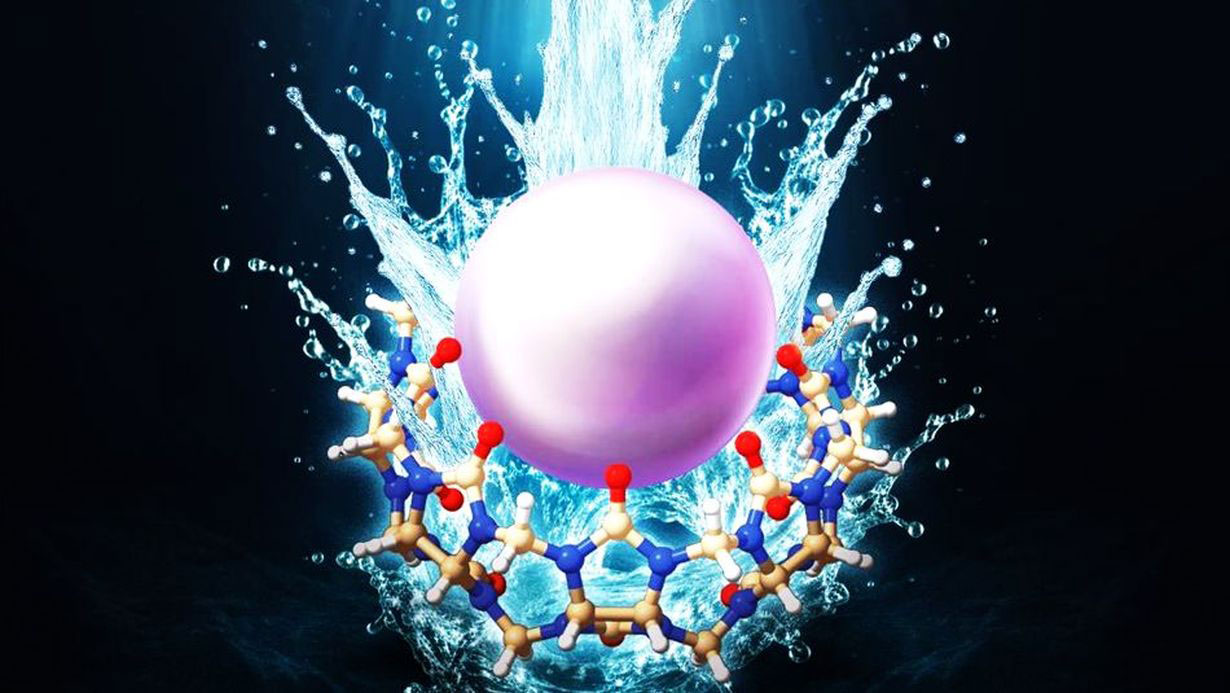
Water behaves differently when trapped in microscopic spaces instead of flowing freely. Researchers have shown that this confined water becomes “highly energetic,” influencing how molecules bind together.
Water is found almost everywhere on Earth. It makes up most of our planet’s surface, circulates through our bodies, and even hides in the tiniest molecular spaces. But what happens when water is trapped and unable to move freely?
Scientists from Karlsruhe Institute of Technology (KIT) and Constructor University in Bremen have shown for the first time that confined water can actively affect its environment and strengthen the bonds between molecules. Their discovery could inspire new approaches in drug development and the creation of advanced materials. The findings were published in the International Edition of the “Angewandte Chemie” journal.
Some of the planet’s water exists within microscopic pockets, such as the binding sites of proteins or inside synthetic molecular receptors. Until now, scientists have debated whether this trapped water simply coexists with nearby molecules or actually plays a role in how they interact.
“Usually, water molecules interact most strongly with each other. However, data obtained from experiment shows that water behaves unusually in such narrow cavities,” explains Dr. Frank Biedermann from KIT’s Institute of Nanotechnology. “We now could supply the theoretical basis of these observations and prove that the water in molecular cavities is energetically activated.”
The researchers describe this condition as “highly energetic” (not because the water glows or bubbles, but because it carries more energy than ordinary water). In this state, the confined water acts a bit like people packed into a crowded elevator: as soon as the door opens, they rush to get out. Similarly, highly energetic water escapes from its cavity when another molecule arrives, pushing that molecule into the space it leaves behind. This release of energy helps strengthen the connection between the incoming molecule and the cavity itself.
Findings Allow to Predict the Binding Force
The researchers used cucurbit[8]uril as the “host” molecule. It is able to receive other molecules termed “guest” molecules and, thanks to its high degree of symmetry, it can be analyzed significantly easier than complex systems such as proteins.
“Depending on the guest molecule, computer models enabled us to calculate how much more binding force the highly energetic water yields,” explains Professor Werner Nau from Constructor University in Bremen. “We found that the more energetically activated the water is, the better it favors binding between the guest molecule and the host when it is displaced.”
Biedermann adds: “The data obtained clearly shows that the concept of highly energetic water molecules is physically founded – and that those very water molecules are a central driving force during the formation of molecular bonds. Even natural antibodies, for example against SARS-CoV-2, might owe their effectiveness partly to the way how they transport water molecules into and out of their binding cavities.”
Usable for Drugs or New Materials
Biedermann’s and Nau’s findings might have a significant influence on medicine and materials sciences. For drug design, the identification of highly energetic water in target proteins opens the possibility to systematically design active agents in such a way that they displace this water, leverage its binding force, and thereby become more deeply anchored in the protein – which will improve the effectiveness of the drug. In materials science, the production of cavities that push out or displace such water might improve the material’s sensing or storing performance.
For their study, the researchers combined high-precision calorimetry – a method for measuring the heat released or absorbed during molecular processes – with computer models created by Dr. Jeffry Setiadi and Professor Michael K. Gilson at the University of California in San Diego.
Reference: “Thermodynamics of Water Displacement from Binding Sites and its Contributions to Supramolecular and Biomolecular Affinity” by Jeffry Setiadi, Frank Biedermann, Werner M. Nau and Michael K. Gilson, 4 June 2025, Angewandte Chemie International Edition.
DOI: 10.1002/anie.202505713
Never miss a breakthrough: Join the SciTechDaily newsletter.
Follow us on Google and Google News.