
Close Menu
    Facebook X (Twitter) Instagram
    SciTechDaily
    • Biology
    • Chemistry
    • Earth
    • Health
    • Physics
    • Science
    • Space
    • Technology
    Facebook X (Twitter) Pinterest YouTube RSS
    SciTechDaily
    Home»Chemistry»Unlocking the Mysteries of the Bio/Nano Interface
    Chemistry

    Unlocking the Mysteries of the Bio/Nano Interface

    By Lehigh UniversityMarch 11, 2021No Comments3 Mins Read
    Facebook Twitter Pinterest Telegram LinkedIn WhatsApp Email Reddit
    Share
    Facebook Twitter LinkedIn Pinterest Telegram Email Reddit
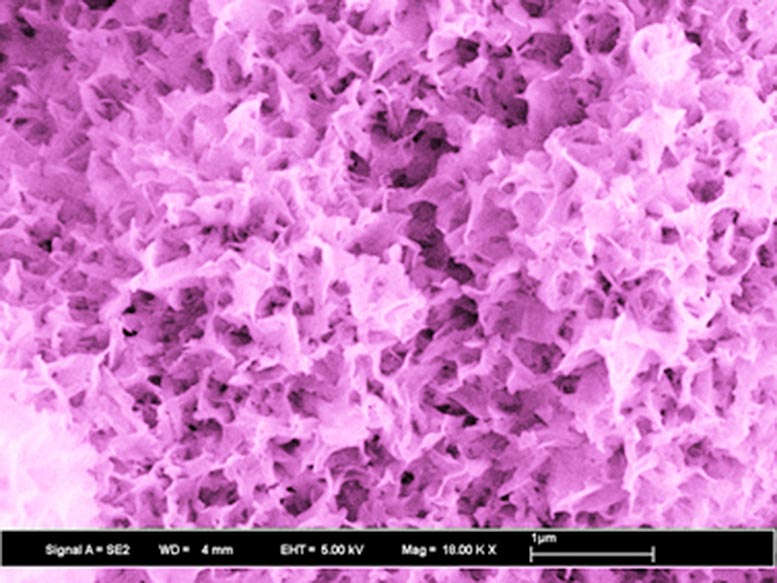
    Microstructures Forming Upon Nanoporous Glass Monolith
    “Flower-like” microstructures forming upon a nanoporous glass monolith featuring 31nm-diameter pores.
    Credit: Lehigh University | Thamma, Kowal, Falk, Jain

    Proteins choreograph the infinitesimal dance of living cells and functional biomaterials.

    Himanshu Jain
    Himanshu Jain is T.L. Diamond Distinguished Chair in Engineering and Applied Science, and Professor of Materials Science and Engineering, Lehigh University. Credit: Lehigh University

    An interdisciplinary research team at Lehigh University has unraveled how functional biomaterials rely upon an interfacial protein layer to transmit signals to living cells concerning their adhesion, proliferation, and overall development.

    According to an article published today in Scientific Reports, the nanoscale features and properties of an underlying substrate do not impact the biological response of cells directly. However, these properties indirectly influence cell behavior through their control over adsorbed proteins.

    Nanostructures Reshape Protein Layers

    In the article, “Nanostructure of bioactive glass affects bone cell attachment via protein restructuring upon adsorption,” the Lehigh team demonstrates that living cells respond to interfacial layer characteristics that arise as a consequence of micro- and nano-scale structures engineered into a substrate material. These infinitesimally tiny structures have an enormous impact upon the nature of the proteins and how they restructure themselves and electrostatically interact with the material, which in turn influences the manner in which cells attach to the substrate and develop over time.

    Matthias Falk
    Matthias Falk is a Professor for Cell Biology, Department of Biological Sciences, Lehigh University. Credit: Lehigh University

    Unprecedented Clarity on Protein Behavior

    “There are others who have studied the interfacial protein layer,” says Himanshu Jain, the T.L. Diamond Distinguished Chair in Engineering and Applied Science and Professor of Materials Science and Engineering at Lehigh, who also serves as director of Lehigh’s Institute for Functional Materials and Devices (I-FMD). “But this work showed directly and unambiguously for the first time how some specific nanoscale features of the substrate can impact the secondary molecular structure of the proteinated interface that in turn affects the response of the cells that are thousands of times larger.”

    Joining Professor Jain in guiding this research is Matthias Falk, a Professor of Cell Biology with Lehigh’s College of Arts and Sciences. The team is rounded out by two doctoral students jointly supervised by Falk and Jain — Dr. Tia Kowal, who received PhD in Biological Sciences and is now a postdoctoral researcher at Stanford Medicine, and lead author Dr. Ukrit Thamma, who completed his doctorate in Materials Science and Engineering and is now a lecturer at King Mongkut’s University of Technology in Bangkok, Thailand.

    “Lehigh is increasingly recognized as a place where interdisciplinary team science is taking root and flourishing,” says Jain. “The creation and mission of Lehigh’s Interdisciplinary Research Institutes is a strategic expression of this notion — and this project is an expression of that notion in action. And the crucial role that our students play, with support from a broad faculty team, speaks for itself.”

    To learn more about the research, please review the March 11 article “Nanostructure of bioactive glass affects bone cell attachment via protein restructuring upon adsorption” in the Nature Journal Scientific Reports.

    Reference: “Nanostructure of bioactive glass affects bone cell attachment via protein restructuring upon adsorption” by Ukrit Thamma, Tia J. Kowal, Matthias M. Falk and Himanshu Jain, 11 March 2021, Scientific Reports.
    DOI: 10.1038/s41598-021-85050-7

    Never miss a breakthrough: Join the SciTechDaily newsletter.
    Follow us on Google and Google News.

    Biochemistry Biomedical Engineering Bionanotechnology Cell Biology Lehigh University Materials Science Nanotechnology
    Share. Facebook Twitter Pinterest LinkedIn Email Reddit

    Related Articles

    Using “Hairy Nanocrystals” To Decrease Side Effects of Cancer Drugs

    Solving a Natural Riddle of Water Filtration to Create Clean Water While Consuming Less Energy

    Highly-Selective New Tool to Dissect the “Undruggable”

    Chemists Invent Shape-Shifting Nanomaterial With Intriguing Biomedical Potential

    Synthetic Melanin Dyes Developed for Natural-Looking Hair Colors

    A New Twist on DNA Origami: Meta-DNA Structures Transform the DNA Nanotechnology World

    New Breakthrough in “Molecular Computers” Improves Targeting of Cancer-Killing Car T Cells

    Nanostructure of Wood Revealed – Strength Gains Could Lead to Wooden Skyscrapers

    Luminescent Carbon Nanoparticles Exhibit Reversible Switching in Cancer Cells

    Leave A Reply Cancel Reply

    • Facebook
    • Twitter
    • Pinterest
    • YouTube

    Don't Miss a Discovery

    Subscribe for the Latest in Science & Tech!

    Trending News

    Artificial Sweeteners May Harm Future Generations, Study Suggests

    Splashdown! NASA Artemis II Returns From Record-Breaking Moon Mission

    What If Consciousness Exists Beyond Your Brain

    Scientists Finally Crack the 100-Million-Year Evolutionary Mystery of Squid and Cuttlefish

    Beyond “Safe Levels”: Study Challenges What We Know About Pesticides and Cancer

    Researchers Have Found a Dietary Compound That Increases Longevity

    Scientists Baffled by Bizarre “Living Fossil” From 275 Million Years Ago

    Your IQ at 23 Could Predict Your Wealth at 27, Study Finds

    Follow SciTechDaily
    • Facebook
    • Twitter
    • YouTube
    • Pinterest
    • Newsletter
    • RSS
    SciTech News
    • Biology News
    • Chemistry News
    • Earth News
    • Health News
    • Physics News
    • Science News
    • Space News
    • Technology News
    Recent Posts
    • What if Dark Matter Has Two Forms? Bold New Hypothesis Could Explain a Cosmic Mystery
    • Researchers Expose Hidden Chemistry of “Ore-Forming” Elements in Biology
    • Geologists Reveal the Americas Collided Earlier Than We Thought
    • 20x Difference: Study Reveals True Source of Airborne Microplastics
    • Scientists Uncover Hidden Force Powering Yellowstone’s Supervolcano
    Copyright © 1998 - 2026 SciTechDaily. All Rights Reserved.
    • Science News
    • About
    • Contact
    • Editorial Board
    • Privacy Policy
    • Terms of Use

    Type above and press Enter to search. Press Esc to cancel.