
Scientists at the Center for Electrochemical Sciences and the Max Planck Institute have discovered a way of using cost-effective biocatalysts in fuel cells, a step forward to using hydrogen to generate electricity.
In the future, it could be more economical and environmentally friendly to use hydrogen to generate electricity. Scientists at the Center for Electrochemical Sciences (CES) at Ruhr-Universität Bochum and the Max Planck Institute for Chemical Energy Conversion in Mülheim an der Ruhr have found a way of using cost-effective biocatalysts in fuel cells. Fuel cells generate electricity by converting hydrogen and oxygen into water. Previously, scientists and engineers used precious metal-based catalysts for this process. While these were efficient and stable, they were also expensive and only available in small quantities. The team of researchers in Bochum and Mülheim have now found a way of protecting the very efficient enzymes with a polymer against conditions in the fuel cells that are able to rapidly destroy the unprotected biocatalysts.
Many bacteria and algae are ahead of technology. They use hydrogenases, i.e. enzymes or biocatalysts from widely available elements such as iron and nickel, to generate hydrogen, completely avoiding the use of precious metals like platinum. Hydrogenases act as catalysts not only in the generation of hydrogen, but also in its uptake to produce electrons, which can then be used by fuel cells to generate electricity, water being the only waste product. The most efficient hydrogenases achieve the same conversion rates as platinum. “Hydrogenases may therefore be an interesting alternative to precious metals,” says Wolfgang Schuhmann, who holds the Chair of Analytical Chemistry at Ruhr-Universität Bochum.
However, until now, technology could not make use of these enzymes in fuel cells. This is because hydrogenases cannot work under the conditions prevailing in a fuel cell, where the level of oxygen and the high electrical potential deactivate the biocatalysts.
Redox hydrogel: a protective shield for efficient yet sensitive catalysts
The team from Bochum and Mülheim have now developed a concept that will allow the sensitive catalysts to function in fuel cells. Essentially, the researchers shield the catalyst with a protective matrix, whose properties they have tailored in such a way that the material suppresses the deactivation processes.
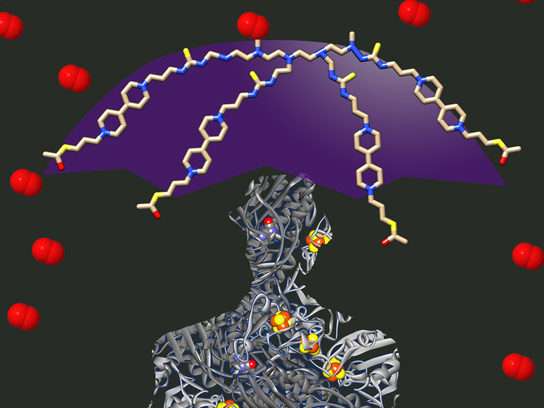
Instead of bringing the hydrogenase directly into contact with the electrode, they incorporate the sensitive catalyst into a redox hydrogel. This serves both as a redox buffer and an oxygen scavenger, and means that neither high potential nor oxygen has an impact on the biocatalyst in the hydrogel film. Under certain operating conditions, the fuel cell that has been modified with the hydrogel can convert chemical energy from hydrogen into electrical energy over several weeks. Without the hydrogel, the hydrogenase is rapidly destroyed.
“The hydrogel concept opens up the possibility of using other sensitive biological and artificial catalysts in fuel cells, whose intrinsic stability cannot be enhanced,” says Wolfgang Lubitz, Director at the Max Planck Institute for Chemical Energy Conversion in Mülheim an der Ruhr. “This represents a major step forward towards a significantly improved biofuel cell design and a sustainable energy industry in our society.”
The project was supported by the German Research Foundation (DFG) within the framework of the Cluster of Excellence RESOLV (EXC 1069).
Reference: “A redox hydrogel protects hydrogenase from high-potential deactivation and oxygen damage” by Nicolas Plumeré, Olaf Rüdiger, Alaa Alsheikh Oughli, Rhodri Williams, Jeevanthi Vivekananthan, Sascha Pöller, Wolfgang Schuhmann and Wolfgang Lubitz, 3 August 2014, Nature Chemistry.
DOI: 10.1038/nchem.2022
Never miss a breakthrough: Join the SciTechDaily newsletter.
Follow us on Google and Google News.