

Natural UV-protective compounds from algae are revealing unexpected biological activities.
Scientists have found that certain natural compounds produced by algae and cyanobacteria may offer benefits beyond sun protection, including support for skin health and cardiovascular function. In lab experiments, two mycosporine-like amino acids were found to do more than soak up ultraviolet light.
They also slowed down a major enzyme tied to blood pressure control, while showing antioxidant and anti-aging activity. The result hints that the same chemistry that helps ocean organisms handle harsh sunlight could someday inspire ingredients for both skincare products and functional foods.
These compounds, called mycosporine-like amino acids (MAAs), are produced by seaweeds and other tiny organisms that spend their lives exposed to intense light. MAAs work like built in sun filters by absorbing ultraviolet (UV) radiation before it can harm cells.
That protective role is exactly why cosmetic scientists have been interested in them as a more nature derived option than some synthetic UV filters. What is changing now is the growing evidence that MAAs may also interact with biological pathways in ways that have nothing to do with sunburn.
Expanding the Biological Role of MAAs
A study published in Bioscience, Biotechnology, and Biochemistry led by Hakuto Kageyama of Meijo University’s Graduate School of Environmental and Human Sciences reports that MAAs can inhibit angiotensin-converting enzyme, or ACE, a key regulator of blood pressure. ACE helps control how strongly blood vessels constrict or relax, and many widely prescribed hypertension drugs work by blocking it.
Prof. Kageyama says, “We discovered that MAAs can inhibit angiotensin-converting enzyme, suggesting a previously unrecognized potential for blood-pressure–related health benefits.”
Angiotensin-converting enzyme (ACE) is essential for maintaining healthy blood pressure because it helps regulate the narrowing and widening of blood vessels. Many widely used medications for high blood pressure work by suppressing this enzyme. As a result, identifying natural substances that can reduce ACE activity is a major focus in nutrition and health science.
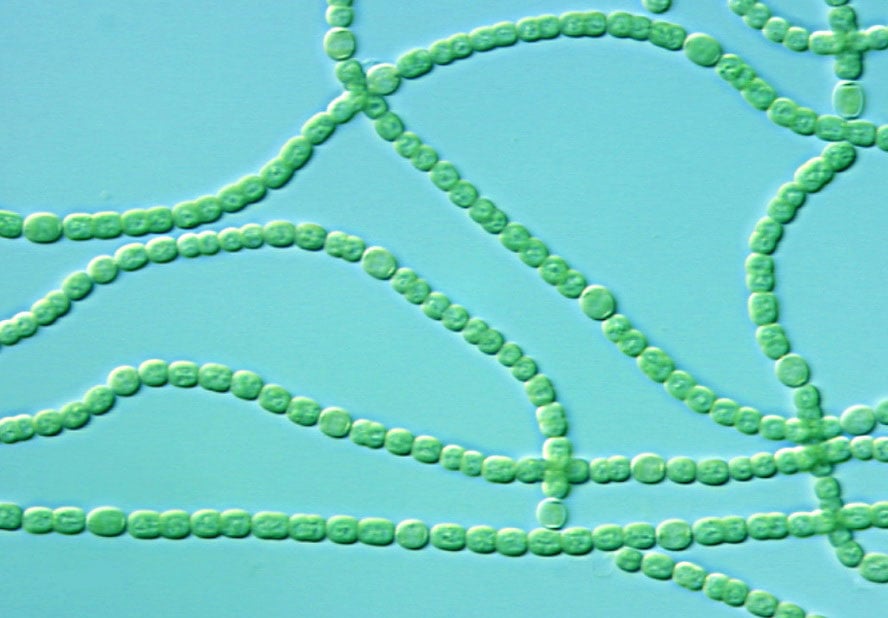
Algae and cyanobacteria synthesize MAAs as part of their built-in defense against sunlight. Although scientists have identified more than 70 different MAAs, commercial applications typically rely on only a small number of familiar types. Numerous chemically altered versions remain largely unexplored, even though minor changes in molecular structure can significantly influence how these compounds function in the body.
To better understand these differences, the research team compared two MAAs with distinct chemical features. One was porphyra-334, a commonly occurring MAA found in edible seaweed. The other was GlcHMS326, a less typical form that includes additional chemical groups. These added components subtly change the molecule’s structure and behavior.
Testing Stability and Antioxidant Effects
The scientists first isolated both compounds from their natural sources. Porphyra-334 was obtained from dried seaweed, while GlcHMS326 was extracted from a cyanobacterium collected at a hot spring in Thailand. The team then exposed the purified compounds to heat and light and assessed their biological effects using standard laboratory techniques.
A series of tests focused on antioxidant activity, which measures how effectively a substance can neutralize free radicals. Free radicals are unstable molecules that can damage cells and contribute to aging and disease. The researchers found that GlcHMS326 functioned as a powerful antioxidant that worked gradually over time, suggesting longer-lasting protection. In contrast, porphyra-334 displayed more limited antioxidant strength.
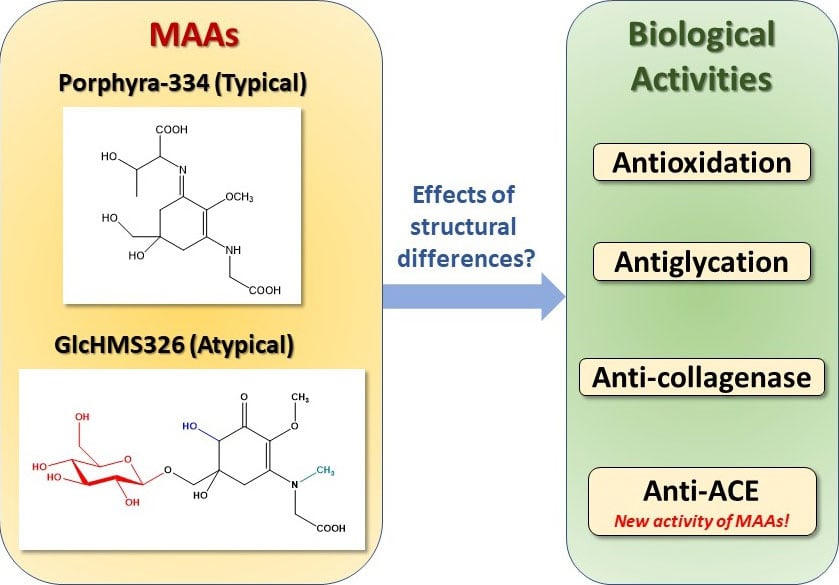
The researchers also examined antiglycation activity. Glycation is a process in which sugar molecules bind to proteins, reducing their flexibility and function. This process plays a role in skin aging and some chronic diseases. In these tests, porphyra-334 was more effective than GlcHMS326 at preventing protein damage.
In addition, both MAAs were tested for their ability to block collagenase, an enzyme that breaks down collagen and contributes to wrinkle formation. GlcHMS326 showed stronger collagenase inhibition, suggesting potential anti-aging benefits.
A New Link to Blood Pressure Regulation
One of the most notable findings came from experiments on ACE inhibition. Both compounds reduced the activity of this enzyme in laboratory tests, marking the first report of such an effect for MAAs. Although the observed effects were moderate and measured outside the human body, the discovery opens a new direction for future research. “Our data further support their potential as multifunctional ‘natural sunscreen’ ingredients,” says Prof. Kageyama. “Chemical modifications can substantially shift their functional profiles.”
The researchers emphasize that their findings are based on controlled laboratory experiments. Further studies are needed to determine whether similar effects occur in living organisms and whether practical doses can be achieved through food or cosmetic products. Still, the results are encouraging. Porphyra-334 is abundant in edible seaweed, which is already consumed widely in many countries. This raises the possibility that everyday foods may contain underappreciated bioactive compounds worthy of further health-related research.
Overall, the study provides new insight into how natural sun-protective molecules can serve multiple biological roles. By revealing how small chemical differences shape their activity, the research lays the groundwork for developing next-generation cosmetic products and functional foods inspired by nature.
Reference: “Comparative Functional Evaluation of the Atypically Modified GlcHMS326 and Porphyra-334, Two Structurally Distinct Mycosporine-Like Amino Acids” by Taiki Aono, Erika Katayama, Tomoki Tsuboi, Sasiprapa Samsri, Rungaroon Waditee-Sirisattha and Hakuto Kageyama, 19 January 2026, Bioscience, Biotechnology, and Biochemistry.
DOI: 10.1093/bbb/zbag011
This work was supported in part by the Japan Society for the Promotion of Science KAKENHI (Grant Number: 24K08623) and the Thailand Science Research and Innovation fund Chulalongkorn University (FOOD_FF_68_121_2300_022).
Never miss a breakthrough: Join the SciTechDaily newsletter.
Follow us on Google and Google News.