

Decoding Chocolate’s Melting Mystery
Scientists have decoded the physical process that takes place in the mouth when a piece of chocolate is eaten, as it changes from a solid into a smooth emulsion that many people find totally irresistible.
By analyzing each of the steps, the interdisciplinary research team at the University of Leeds hopes it will lead to the development of a new generation of luxury chocolates that will have the same feel and texture but will be healthier to consume.
During the moments it is in the mouth, the chocolate sensation arises from the way the chocolate is lubricated, either from ingredients in the chocolate itself or from saliva or a combination of the two.
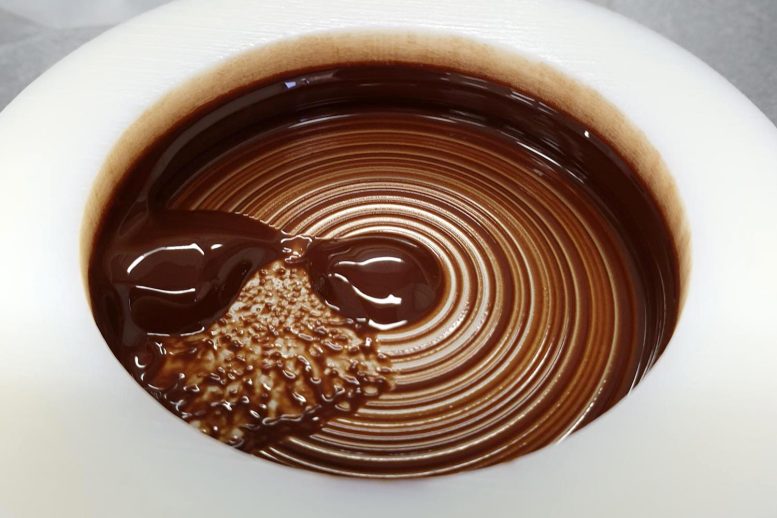
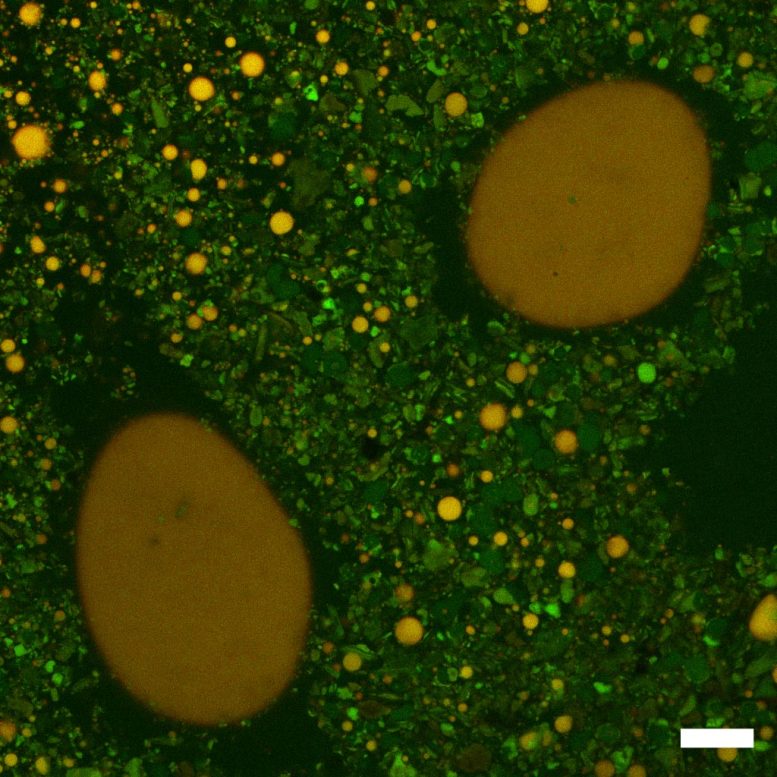
Fat plays a key function almost immediately when a piece of chocolate is in contact with the tongue. After that, solid cocoa particles are released and they become important in terms of the tactile sensation, so fat deeper inside the chocolate plays a rather limited role and could be reduced without having an impact on the feel or sensation of chocolate.
Insights from Lubrication Science
Anwesha Sarkar, Professor of Colloids and Surfaces in the School of Food Science and Nutrition at Leeds, said: “Lubrication science gives mechanistic insights into how food actually feels in the mouth. You can use that knowledge to design food with better taste, texture, or health benefits.
“If a chocolate has 5% fat or 50% fat it will still form droplets in the mouth and that gives you the chocolate sensation. However, it is the location of the fat in the make-up of the chocolate which matters in each stage of lubrication, and that has been rarely researched.
“We are showing that the fat layer needs to be on the outer layer of the chocolate, this matters the most, followed by effective coating of the cocoa particles by fat, these help to make chocolate feel so good.”
The study — published in the scientific journal ACS Applied Materials and Interface — did not investigate the question of how chocolate tastes. Instead, the investigation focused on its feel and texture.
Tribology and Chocolate Texture
Tests were conducted using a luxury brand of dark chocolate on an artificial 3D tongue-like surface that was designed at the University of Leeds. The researchers used analytical techniques from a field of engineering called tribology to conduct the study, which included in situ imaging.
Tribology is about how surfaces and fluids interact, the levels of friction between them and the role of lubrication: in this case, saliva or liquids from the chocolate. Those mechanisms are all happening in the mouth when chocolate is eaten.
When chocolate is in contact with the tongue, it releases a fatty film that coats the tongue and other surfaces in the mouth. It is this fatty film that makes the chocolate feel smooth throughout the entire time it is in the mouth.
Dr. Siavash Soltanahmadi, from the School of Food Science and Nutrition at Leeds and the lead researcher in the study, said: “With the understanding of the physical mechanisms that happen as people eat chocolate, we believe that a next generation of chocolate can be developed that offers the feel and sensation of high-fat chocolate yet is a healthier choice.
“Our research opens the possibility that manufacturers can intelligently design dark chocolate to reduce the overall fat content.
“We believe dark chocolate can be produced in a gradient-layered architecture with fat covering the surface of chocolates and particles to offer the sought-after self-indulging experience without adding too much fat inside the body of the chocolate.”
Revenue from chocolate sales in the UK is forecast to grow over the next five years, according to research from the business intelligence agency MINTEL. Sales are expected to grow 13% between 2022 and 2027 to reach £6.6 billion.
The researchers believe the physical techniques used in the study could be applied to the investigation of other foodstuffs that undergo a phase change, where a substance is transformed from a solid to a liquid, such as ice cream, margarine, or cheese.
Reference: “Insights into the Multiscale Lubrication Mechanism of Edible Phase Change Materials” by Siavash Soltanahmadi, Michael Bryant and Anwesha Sarkar, 12 January 2023, ACS Applied Materials and Interface.
DOI: 10.1021/acsami.2c13017
This project received funding from the European Research Council under the European Union’s Horizon 2020 research and innovation program.
Never miss a breakthrough: Join the SciTechDaily newsletter.
Follow us on Google and Google News.
2 Comments
Wish this were true, that”healthier” chocolate was the goal. But we all know cheaper chocolate that seems “luxurious” but made from junk will be the end game here. That will make the price of real chocolate uncompetitive on the shelf. Capitalism has zero incentive to favor healthy over profitable.
…there are boutique chocolatiers that do cater to the “healthier” market
for being a science based website, I’m always impressed at the level of asinine comments posted