
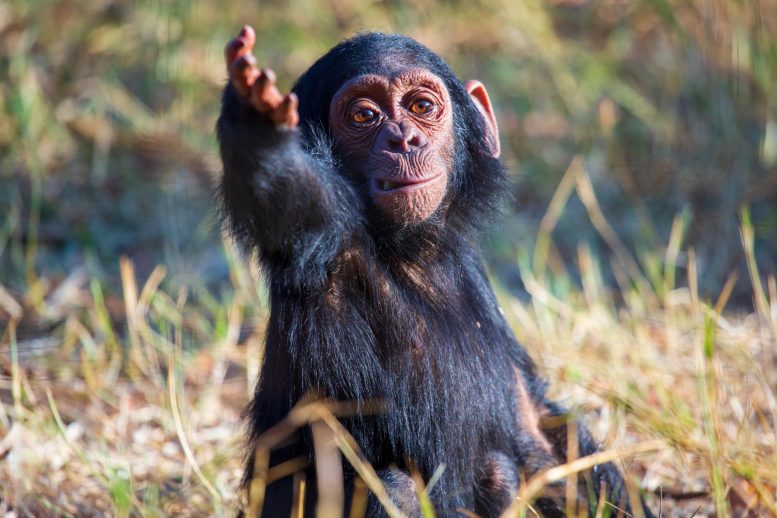
A study finds that young chimpanzees combine gestures, sounds, and facial expressions as they grow, paralleling human infant communication. This research provides clues about the evolutionary origins of human language.
New research suggests that young chimpanzees meld various gestures, sounds, and facial cues in a manner that echoes how communication develops in human infants.
The study, led by psychologists at Durham University, suggests that these combinations of different communicative cues could potentially enhance the clarity of their messages to other chimpanzees, especially in varied contexts like play or conflict.
The researchers found that this ability develops throughout infancy and adolescence.
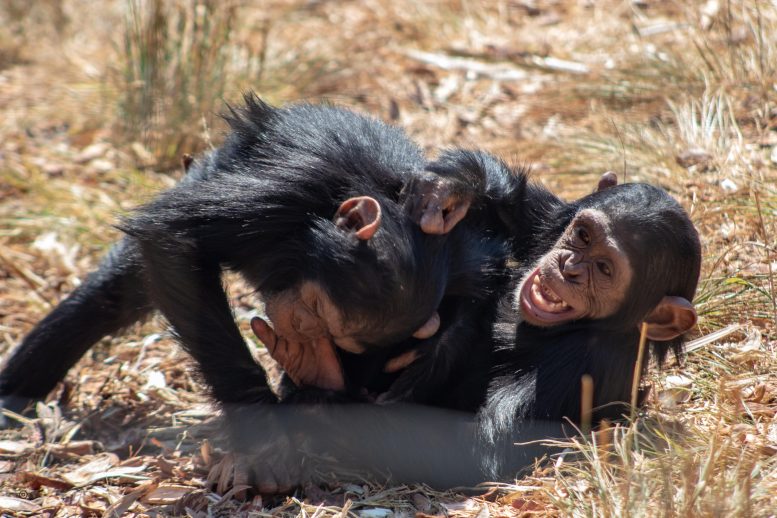
Such combined signals included combining playful open-mouth faces with laughing, touching another chimpanzee while whimpering, and baring their teeth while squeaking.
The researchers say that understanding this “multimodal” form of communicating could shed important light on how communication evolved in humans and our closest ape relatives, and tell us more about how our own language skills emerge.
Their study, which also involved the University of Portsmouth, is published in the journal Animal Behaviour.
Researchers observed 28 semi-wild chimpanzees, ranging in age from one to 11 years old, at the Chimfunshi Wildlife Orphanage Trust sanctuary in northern Zambia.
While previous studies on apes have largely looked at different forms of communication signals in isolation (gestures, vocalizations, facial expressions), the new findings looked at how chimpanzees combined these different forms of communication to see how this developed with age and in varying circumstances.
The researchers found that chimpanzees consistently used standalone communication signals – such as grunting, arm movements, or facial expressions – across all ages and in different situations.
Increased Complexity in Communication with Age
However, they also showed that as the chimpanzees got older, they were more likely to combine different communication signals together.
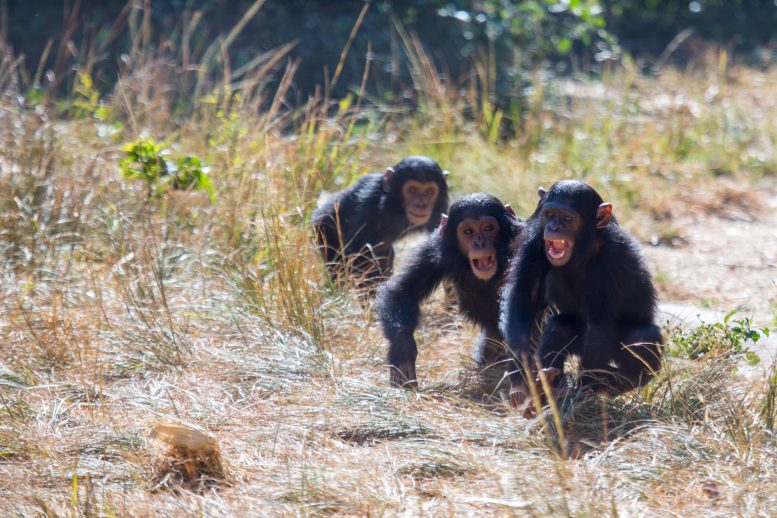
This was especially the case when the chimpanzees were responding to aggression or were playing, two situations where it is important for them to make clear what they were communicating to avoid risky fallout, the researchers said.
The older adolescent chimpanzees studied were also more likely to use a combination of different communication signals instead of individual gestures or expressions, especially during aggression scenarios.
Research lead author Emma Doherty, a Research Postgraduate in the Department of Psychology, Durham University, said: “When we think about human language, we know that it is a combination of different types of communication such as speech, facial expressions, and gestures.
“The way we communicate likely has deep evolutionary roots that are shared with some of our closest living relatives such as apes.
Juvenile female Chitalu acknowledges an approaching adolescent male with a grunt vocalization and a light touch gesture as he walks by during group feeding. Credit: Emma Doherty
“Our study provides evidence that the way chimpanzees communicate with increased complexity as they get older is consistent with the development of communication we see in human infants.
“By studying the development of this multi-layered way of communicating among young chimpanzees we can learn more about the reasons behind this and shed light on the potential evolutionary continuity between humans and other apes.”
The researchers said that more work should be carried out to observe multimodal signals in primates in the wild to further understand how the development of communication is affected by different environments.
They added that studying multimodal communication – instead of observing individual communication signals in isolation – could provide better evidence of how communication develops in apes and potentially help us to understand the evolution of human communication.
Multimodal Communication as a Key to Language Evolution
Research corresponding author Dr. Zanna Clay, Associate Professor in the Department of Psychology, Durham University, said: “A lot of the focus of research so far into communication, both in humans and other animals, looks at individual communication signals independently, but we know humans combine these signals all the time from early infancy.
“As a close relative of humans, apes give us a snapshot into how these signals could have evolved into multimodal communications, ultimately culminating in human language.”
Reference: “Multimodal communication development in semiwild chimpanzees” by Emma Doherty, Marina Davila-Ross and Zanna Clay, 5 June 2023, Animal Behaviour.
DOI: 10.1016/j.anbehav.2023.03.020
The research was funded by a Durham University Doctoral Scholarship, the British Association of Biological Anthropology and Osteoarchaeology, the Lucie Burgers Foundation for Comparative Behavioural Research.
Never miss a breakthrough: Join the SciTechDaily newsletter.
Follow us on Google and Google News.