
Close Menu
    Facebook X (Twitter) Instagram
    SciTechDaily
    • Biology
    • Chemistry
    • Earth
    • Health
    • Physics
    • Science
    • Space
    • Technology
    Facebook X (Twitter) Pinterest YouTube RSS
    SciTechDaily
    Home»Biology»Scientists Discover That Chromosomes Are Fluid
    Biology

    Scientists Discover That Chromosomes Are Fluid

    By CNRSSeptember 26, 202212 Comments2 Mins Read
    Facebook Twitter Pinterest Telegram LinkedIn WhatsApp Email Reddit
    Share
    Facebook Twitter LinkedIn Pinterest Telegram Email Reddit
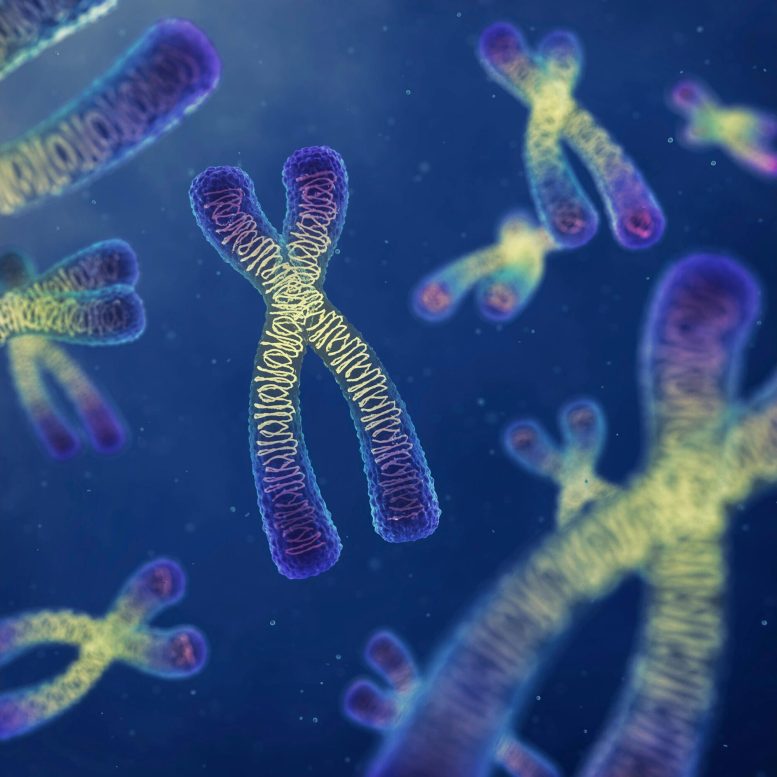
    Chromosomes Science Illustration
    The study found that chromosomes are fluid, almost liquid, outside of their division phases.

    Chromosome Manipulation in Live Cells Indicates That They Are Fluid

    Researchers from CNRS, the Curie Institute, and Sorbonne University have successfully physically acted on chromosomes in live cells for the first time. They found that, outside of cell division phases, chromosomes are actually very fluid—almost liquid—by subjecting to different forces using magnets. The study was recently published in the prestigious journal Science.

    When they are not in their division phases, chromosomes are fluid, though not quite liquid. This discovery was made possible by the first-ever direct mechanical manipulation of chromosomes in the nucleus of live cells.

    New Understanding of Chromosome Structure

    Previously, chromosomes, which are extraordinarily long DNA molecules, were represented as entangled like loose balls of yarn and creating a sort of gel. This new publication’s findings present a completely different picture. Chromosomes are fluid and free to move, unrestricted by the other parts that make up the nucleus and can reorganize themselves.

    To reach these conclusions published in Science, scientists from CNRS, the Curie Institute, and Sorbonne University, working in the Nuclear Dynamics, Physical Chemistry and Cell Biology, and Cancer laboratories, in collaboration with scientists from the Massachusetts Institute of Technology, attached magnetic nanoparticles to a small portion of a chromosome in a living cell. Then, they stretched the chromosome, exerting different degrees of force, thanks to a micro-magnet outside the cell. Using this approach, the teams managed to measure the response of a chromosome to external forces, for the very first time in a living cell.

    Through these experiments, the scientists were able to see that the range of forces exerted naturally in the nucleus – for example by enzymes replicating DNA – is sufficient to substantially alter the conformation of a chromosome. This major discovery, at the interface between physics and biology, changes the hitherto established representation of chromosomes. It also adds new elements to our understanding of biological processes, the biophysics of chromosomes, and the organization of the genome.

    Reference: “Live-cell micromanipulation of a genomic locus reveals interphase chromatin mechanics” by  Veer I. P. Keizer, Simon Grosse-Holz, Maxime Woringer, Laura Zambon, Koceila Aizel, Maud Bongaerts, Fanny Delille, Lorena Kolar-Znika, Vittore F. Scolari, Sebastian Hoffmann, Edward J. Banigan, Leonid A. Mirny, Maxime Dahan, Daniele Fachinetti and Antoine Coulon, 28 July 2022, Science.
    DOI: 10.1126/science.abi9810

    Never miss a breakthrough: Join the SciTechDaily newsletter.
    Follow us on Google and Google News.

    Cell Biology Chromosomes CNRS MIT Popular
    Share. Facebook Twitter Pinterest LinkedIn Email Reddit

    Related Articles

    Inside the Cell’s Identity Crisis: MIT’s Revolutionary Genetic “Memories” Discovery

    MIT Revolutionizes Cellular Imaging: A New Way To See the Activity Inside a Living Cell

    MIT Researchers Devised a Way To Program Memories Into Bacterial Cells by Rewriting Their DNA

    Biologists Discover a Trigger for Cell Extrusion – Process for Eliminating Unneeded Cells

    MIT Biologists and Mathematicians Reveal How Egg Cells Get So Big

    Solving a 100-Year-Old Paradox: Why Cancer Cells Waste So Much Energy

    “Symphony of Cellular Activities” Revealed by Fluorescent Imaging Technique

    MIT Develops a Synthetic Gene Circuit to Trigger Immune System Attack on Cancer

    MIT Biological Engineers Program Human Cells to Store Complex Histories in Their DNA

    12 Comments

    1. Bet on September 26, 2022 12:24 pm

      https://scitechdaily.com/scientists-discover-that-chromosomes-are-fluid/

      Reply
    2. fierycloud on September 26, 2022 8:50 pm

      If the electronic or magnetic field affect the chromosomes operating?

      Reply
    3. BibhutibhusanPatel on September 26, 2022 9:58 pm

      Fluid state or proporty of chromosom though followed,multiplication confirms the same relating the complex and highly critical structure to define real state proporties.So,no new observation.But,thanks to the authors for work.

      Reply
    4. BibhutibhusanPatel on September 26, 2022 11:46 pm

      Chromosomes are ìnteracted with electromagnetic radiation or wave.So,by magnetism their natural state can be determined as fluid or liquid.

      Reply
    5. Lorraine on September 27, 2022 10:21 am

      So it’s possible that scientists will be able to cure genetic defects or be Gods and create super human beings? Just saying, because you can doesn’t mean you should. Mom of 2 Special Needs sons.

      Reply
    6. Mike on September 28, 2022 6:03 am

      If you can get rid of nematodes I’ll be impressed

      Reply
    7. Allamanous on September 29, 2022 2:24 am

      Does this mean if you inject the same fluid into DNA you’d live longer?

      Reply
    8. Kiumars Lalezarzadeh on September 30, 2022 7:23 pm

      Could this be the “living water”?!

      Reply
    9. CJ Patriot on October 2, 2022 5:36 am

      Ummm, since feel electrophoresis has been used for literally decades, I’m truly not surprised. Someone is seriously behind the curve ball…

      Reply
    10. CJ Patriot on October 2, 2022 5:37 am

      *gel*

      Reply
    11. Matt Walsh on October 3, 2022 12:23 pm

      Very fascinating discovery.

      Reply
    12. Thnidu on October 3, 2022 3:45 pm

      BibhutibhusanPatel: Your comment, besides being misspelled and ungrammatical, makes no sense at all. This is not said to blame you, since you’re obviously not a native speaker of English, but it is why neither I nor anyone else so far have expressed agreement or disagreement with you.

      Reply
    Leave A Reply Cancel Reply

    • Facebook
    • Twitter
    • Pinterest
    • YouTube

    Don't Miss a Discovery

    Subscribe for the Latest in Science & Tech!

    Trending News

    Mezcal “Worm” in a Bottle Mystery: DNA Testing Reveals a Surprise

    New Research Reveals That Your Morning Coffee Activates an Ancient Longevity Switch

    This Is What Makes You Irresistible to Mosquitoes

    Shockingly Powerful Giant Octopuses Ruled the Seas 100 Million Years Ago

    Scientists Stunned by New Organic Molecules Found on Mars

    Rewriting Dinosaur Evolution: Scientists Unearth Remarkable 150-Million-Year-Old Stegosaur Skull

    Omega-3 Supplements Linked to Cognitive Decline in Surprising New Study

    First-of-Its-Kind Discovery: Homer’s Iliad Found Embedded in a 1,600-Year-Old Egyptian Mummy

    Follow SciTechDaily
    • Facebook
    • Twitter
    • YouTube
    • Pinterest
    • Newsletter
    • RSS
    SciTech News
    • Biology News
    • Chemistry News
    • Earth News
    • Health News
    • Physics News
    • Science News
    • Space News
    • Technology News
    Recent Posts
    • New Research Challenges Long-Held Beliefs About How the Brain Makes Decisions
    • Breakthrough Technology Reveals New Treatment Targets for Cancer
    • Scientists Discover New Way To Make Drug-Resistant Cancer Treatable Again
    • This Simple Exercise Trick Builds Muscle With Less Effort, Study Finds
    • Middle Age Is Becoming a Breaking Point in America, Study Reveals
    Copyright © 1998 - 2026 SciTechDaily. All Rights Reserved.
    • Science News
    • About
    • Contact
    • Editorial Board
    • Privacy Policy
    • Terms of Use

    Type above and press Enter to search. Press Esc to cancel.