

Close Menu
    Facebook X (Twitter) Instagram
    SciTechDaily
    • Biology
    • Chemistry
    • Earth
    • Health
    • Physics
    • Science
    • Space
    • Technology
    Facebook X (Twitter) Pinterest YouTube RSS
    SciTechDaily
    Home»Chemistry»Scientists Finally Capture Mysterious Molecule That’s Eluded Detection for 70 Years
    Chemistry

    Scientists Finally Capture Mysterious Molecule That’s Eluded Detection for 70 Years

    By David Callahan, KTH, Royal Institute of TechnologyApril 1, 20261 Comment3 Mins Read
    Facebook Twitter Pinterest Telegram LinkedIn WhatsApp Email Reddit
    Share
    Facebook Twitter LinkedIn Pinterest Telegram Email Reddit
    Abstract Chemistry Molecule
    Scientists have directly observed elusive oxygen-rich tetroxide molecules long predicted to exist in oxidation reactions, confirming a decades-old theory central to chemistry. Detected using advanced mass spectrometry, these short-lived compounds appear under everyday conditions and may quietly influence processes ranging from air pollution to biological oxidation. Credit: Shutterstock

    Researchers directly observed tetroxides for the first time, showing they exist in normal air conditions and play key roles in atmospheric chemistry, combustion, and medicine.

    Scientists have, for the first time, directly detected an extremely short-lived molecule that has long been considered central to how oxidation works in everything from air pollution to human biology.

    The breakthrough, reported in Science Advances, comes from a collaboration between researchers at KTH Royal Institute of Technology in Sweden and Kinetic Chemistry Research in California. They successfully observed oxygen-rich tetroxides, a class of molecules first proposed more than 70 years ago but never seen directly until now.

    “This compound is the equivalent of the Higgs boson for oxidation chemistry,” says Barbara Nozière, professor of physical chemistry at KTH Royal Institute of Technology. “Its existence was assumed for decades but nobody had ever seen it.”

    Decades-Old Theory Confirmed: The Russell Mechanism

    Scientists first proposed tetroxides in the 1950s as part of the Russell mechanism, a reaction in which two unstable organic radicals briefly combine. This interaction produces a molecule containing four oxygen atoms linked together, but only for a fraction of a second.

    Despite their short lifetimes, tetroxides are believed to play a central role in oxidation reactions, which drive combustion, influence air quality, and occur continuously inside living organisms. These reactions help break down pollutants in the atmosphere, but they can also generate harmful byproducts, including compounds that contribute to smog and tiny airborne particles.
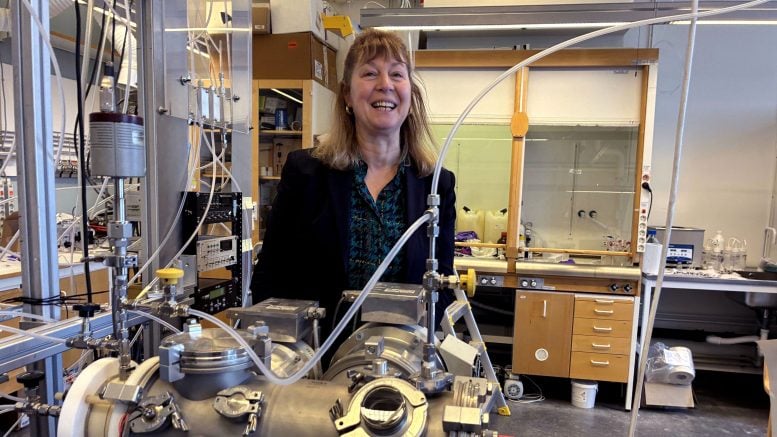
    Barbara Noziere
    Barbara Noziere, pictured here with the spectrometer she used for first-ever observations of tetroxides. Credit: David Callahan/KTH

    Until now, evidence for these molecules was indirect, inconsistent, or based on experiments under extremely cold and controlled laboratory conditions. The researchers confirmed their presence using an advanced mass spectrometry method designed to detect highly unstable molecules without breaking them apart.

    Breakthrough Detection Method Reveals Stability in Air

    Unexpectedly, the team found that tetroxides are relatively stable in air, unlike results from earlier experimental conditions.

    “The study confirms that tetroxides can exist at room temperature, in air, without needing extremely cold conditions used in earlier experiments,” Noziere says.

    Implications for Atmosphere, Pollution, and Chemical Reactions

    Finding tetroxides in both outdoor environments and living organisms suggests they may take part in previously unknown reaction pathways and produce new oxidation products that require further study.

    This could affect how long pollutants, such as paint solvents or smoke, remain in the atmosphere, as well as how other airborne compounds and aerosol particles form.

    Noziere adds that measuring their lifespan, between 0.2 and 200 milliseconds, helps scientists better understand the speed of these reactions and the range of products they can generate.

    The discovery also has important implications for medical research, including studies of oxidative stress and cancer treatments, where the Russell mechanism is already being explored in new therapeutic strategies, she says.

    Reference: “Observing elusive tetroxides in gas-phase radical reactions supports the Russell mechanism” by Barbara Nozière and Roger Patrick, 13 March 2026, Science Advances.
    DOI: 10.1126/sciadv.aeb6495

    The research was funded with a grant from the European Research Council.

    Never miss a breakthrough: Join the SciTechDaily newsletter.
    Follow us on Google and Google News.

    Environmental Science KTH Royal Institute of Technology Molecular Chemistry Organic Chemistry
    Share. Facebook Twitter Pinterest LinkedIn Email Reddit

    Related Articles

    Record-Shattering Molecule Stores Data at “Dark Side of the Moon” Temperatures

    Calcium’s Cosmic Secret: How a Common Mineral May Have Sparked Life on Earth

    These “Weird” Crystals Explode in Light

    Weak Forces, Super Materials: The Breakthrough Changing Material Science

    Artificial Photosynthesis Breakthrough Transforms Trash Into Fuel and Pharmaceuticals

    Scientists Thought They Made a Mistake – But It Led to a Groundbreaking “Molecular Einstein” Discovery

    Psychedelic Breakthrough: Scientists Successfully Achieve Total Synthesis of Ibogaine

    Decoding a Decade-Long Puzzle: Scientists Complete First-Ever Total Synthesis of Natural Anticancer Compound

    Shape-Shifting Membrane Transforms Carbon Capture Technology

    1 Comment

    1. kamir bouchareb st on April 3, 2026 7:34 am

      what is it this

      Reply
    Leave A Reply Cancel Reply

    • Facebook
    • Twitter
    • Pinterest
    • YouTube

    Don't Miss a Discovery

    Subscribe for the Latest in Science & Tech!

    Trending News

    Popular Sugar-Free Sweetener Linked to Liver Disease, Study Warns

    What Is Hantavirus? The Deadly Disease Raising Alarm Worldwide

    Scientists Just Discovered How the Universe Builds Monster Black Holes

    Scientists Unveil New Treatment Strategy That Could Outsmart Cancer

    A Simple Vitamin May Hold the Key to Treating Rare Genetic Diseases

    Scientists Think the Real Fountain of Youth May Be Hiding in Your Gut

    Ravens Don’t Follow Wolves, They Predict Them

    This Common Knee Surgery May Be Doing More Harm Than Good

    Follow SciTechDaily
    • Facebook
    • Twitter
    • YouTube
    • Pinterest
    • Newsletter
    • RSS
    SciTech News
    • Biology News
    • Chemistry News
    • Earth News
    • Health News
    • Physics News
    • Science News
    • Space News
    • Technology News
    Recent Posts
    • James Webb Telescope Reveals the Universe’s Hidden Cosmic Web in Stunning Detail
    • Scientists Build a Living AI Device Using Real Brain Cells
    • Why Are So Many New Fathers Dying? Scientists Say the U.S. Has a Dangerous Blind Spot
    • Scientists Identify Simple Supplement That Greatly Reduces Alzheimer’s Damage
    • You May Have a Dangerous Type of Cholesterol Even if Your Tests Look Normal
    Copyright © 1998 - 2026 SciTechDaily. All Rights Reserved.
    • Science News
    • About
    • Contact
    • Editorial Board
    • Privacy Policy
    • Terms of Use

    Type above and press Enter to search. Press Esc to cancel.