
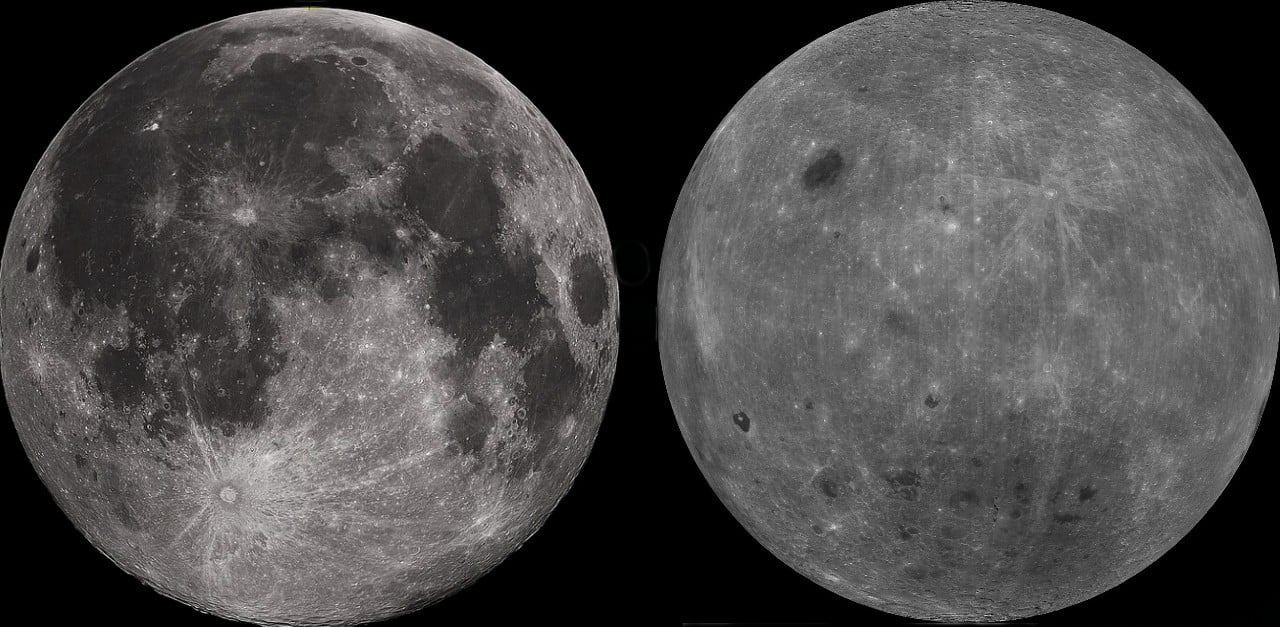
Scientists have discovered that the far side of the Moon is colder deep within its interior than the side that always faces Earth.
By analyzing rock and soil samples collected by China’s Chang’e 6 mission, researchers found the far side’s lava formed at temperatures about 100 °C lower than similar samples from the near side. This temperature difference hints that the Moon’s “two faces” go far deeper than the surface — possibly caused by uneven heat-producing elements or an ancient impact that shifted them toward the near side.
Chang’e 6 Mission Unveils Lunar Secrets
The hidden interior of the Moon’s far side may be significantly cooler than the side that always faces Earth, according to a new study co-led by researchers from UCL (University College London) and Peking University.
Published in Nature Geoscience, the research examined lunar rock and soil fragments collected last year by China’s Chang’e 6 mission from a massive crater on the far side of the Moon.
The scientists confirmed that the sample is around 2.8 billion years old and analyzed its mineral composition to determine how it formed. Their results suggest that the rock originated from lava deep inside the Moon at roughly 1,100 degrees Celsius, about 100 degrees cooler than samples taken from the near side.
Evidence for a “Two-Faced Moon”
Co-author Professor Yang Li, based at UCL’s Department of Earth Sciences and Peking University, said: “The near side and far side of the moon are very different at the surface and potentially in the interior. It is one of the great mysteries of the moon. We call it the two-faced moon. A dramatic difference in temperature between the near and far side of the mantle has long been hypothesised, but our study provides the first evidence using real samples.”
Co-author Mr. Xuelin Zhu, a PhD student at Peking University, said: “These findings take us a step closer to understanding the two faces of the moon. They show us that the differences between the near and far side are not only at the surface but go deep into the interior.”

Why the Far Side May Be Cooler
The far side has a thicker crust, is more mountainous and cratered, and appears to have been less volcanic, with fewer dark patches of basalt formed from ancient lava.
In their paper, the researchers noted that the far side of the interior may have been cooler due to having fewer heat-producing elements – elements such as uranium, thorium, and potassium, which release heat due to radioactive decay.
Previous studies have suggested that this uneven distribution of heat-producing elements might have occurred after a massive asteroid or planetary body smashed into the far side, shaking up the moon’s interior and pushing denser materials containing more heat-producing elements across to the near side.
Alternative Theories of Lunar Evolution
Other theories are that the moon might have collided with a second, smaller moon early in its history, with near-side and far-side samples originating from two thermally different moonlets, or that the near side might be hotter due to the tug of Earth’s gravity.
For the new study, the research team analyzed 300 g of lunar soil allocated to the Beijing Research Institute of Uranium Geology. Sheng He, first author from the institute, explained: “The sample collected by the Chang’e 6 mission is the first ever from the far side of the moon.” The team mapped selected parts of the sample, made up largely of grains of basalt, with an electron probe,[1] to determine its composition.
Probing Lunar Rocks with Precision Tools
The researchers measured tiny variations in lead isotopes using an ion probe[2] to date the rock as 2.8 billion years old (a technique relying on the fact that uranium decays into lead at a steady rate). The data were processed using a method refined by Professor Pieter Vermeesch of UCL Earth Sciences.
They then used several techniques to estimate the temperature of the sample while at different stages of its past when it was deep in the moon’s interior.
The first step was to analyze the composition of minerals and compare it to computer simulations to estimate the temperature of the rock when it formed (crystallized). This was compared to similar estimates for near-side rocks, with a difference of 100 degrees C.
The second approach was to go back further in the sample’s history, inferring from its chemical make-up how hot its “parent rock” would have been (i.e., before the parent rock melted into magma and later solidified again into the rock collected back by Chang’e 6), comparing this to estimates for near-side samples collected by the Apollo missions. They again found about a 100 degrees C difference.
Satellite Data Adds More Evidence
As returned samples are limited, they worked with a team from Shandong University to estimate parent rock temperatures using satellite data of the Chang’e landing site on the far side, comparing this with equivalent satellite data from the near side, again finding a difference (this time of 70 degrees C).
On the moon, heat-producing elements such as uranium, thorium, and potassium tend to occur together alongside phosphorus and rare earth elements in material known as “KREEP”-rich (the acronym derives from potassium having the chemical symbol K, rare-earth elements (REE), and P for phosphorus).
Theories of Lunar Origins and Heat Imbalance
The leading theory of the moon’s origin is that it formed out of debris created from a massive collision between Earth and a Mars-sized protoplanet, and began wholly or mostly made of molten rock (lava or magma). This magma solidified as it cooled, but KREEP elements were incompatible with the crystals that formed and thus stayed for longer in the magma. Scientists would expect the KREEP material to be evenly spread across the moon. Instead, it is thought to be bunched up in the near-side mantle. The distribution of these elements may be why the near side has been more volcanically active.
Although the present temperature of the far and near sides of the moon’s mantle is not known from this study, any imbalance in temperature between the two sides will likely persist for a very long time, with the moon cooling down very slowly from the moment it formed from a catastrophic impact. However, the research team are currently working on getting a definitive answer to this question.
Notes
- An electron probe fires a concentrated beam of electrons at a sample. This induces the sample to emit X-rays. The pattern of these X-rays can be analyzed to identify the elements that make up the sample.
- The ion probe, or Secondary Ion Mass Spectrometry (SIMS), fires a beam of ions at a sample. This knocks secondary ions off the sample’s surface. The pattern of these ions, including for instance isotopes of elements like lead, can be analysed to determine how many atoms of each isotope are present.
Reference: “A relatively cool lunar farside mantle inferred from Chang’e-6 basalts and remote sensing” by Sheng He, Yang Li, Xuelin Zhu, Jian Chen, Ziying Li, Ting Li, Jun Zhong, Jing Tan, Qian He, Zhuoyue Fu, Ye Zheng, Jieqi Xing and Zelong Shi, 30 September 2025, Nature Geoscience.
DOI: 10.1038/s41561-025-01815-z
Never miss a breakthrough: Join the SciTechDaily newsletter.
Follow us on Google and Google News.