
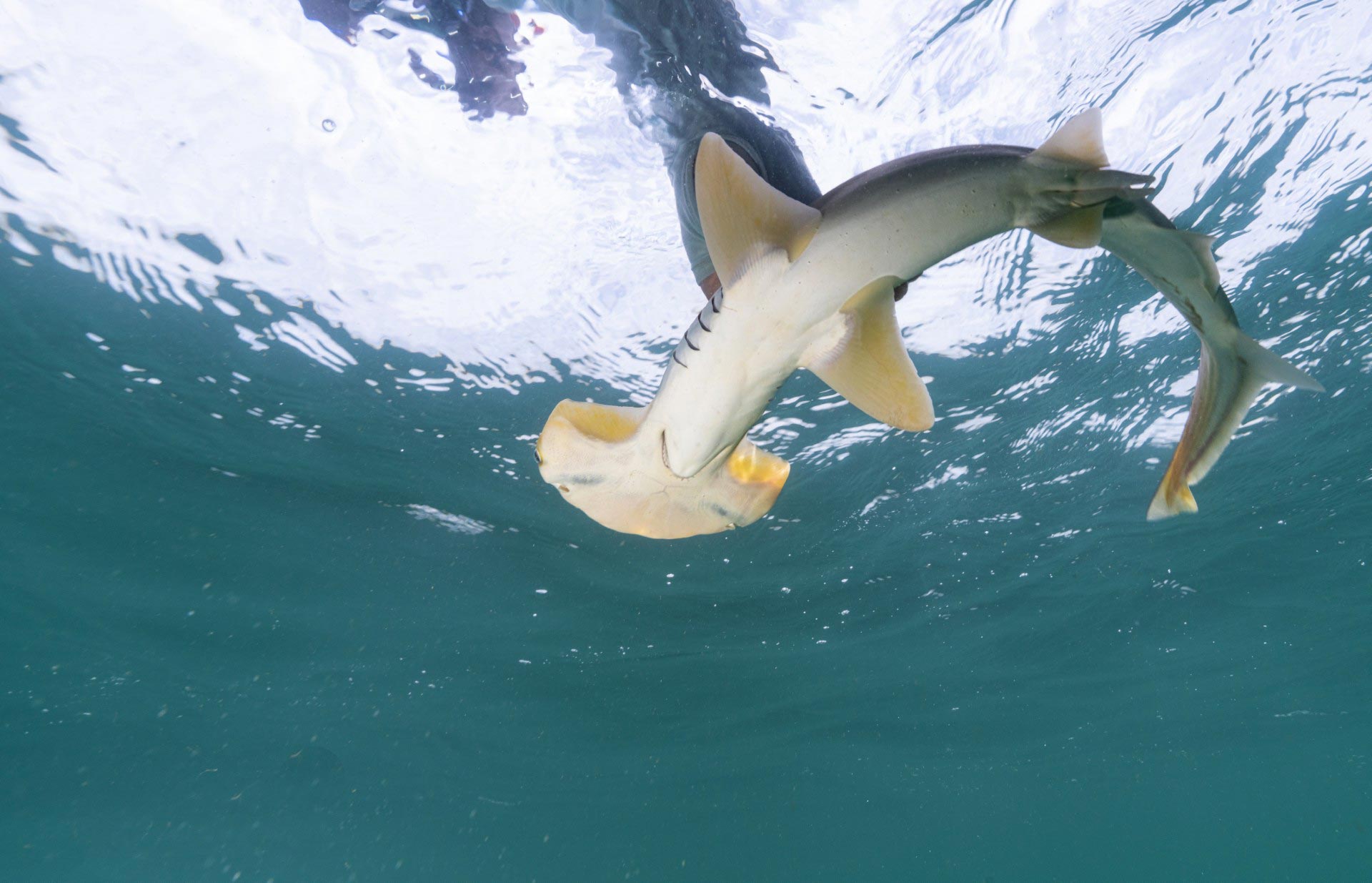
A drop of seawater may be the key to finding and saving the world’s most elusive hammerhead sharks.
A Florida International University (FIU) scientist has developed a powerful new test that can identify small, hard-to-find hammerhead sharks without ever observing them directly — a major advance for species struggling to survive.
The technique works without capturing or disturbing the animals. Instead, it detects subtle traces the sharks leave behind in seawater. Much like biological signatures suspended in ocean currents, fragments of genetic material reveal where the sharks have recently been. In a study published in Frontiers in Marine Science, FIU marine biologist Diego Cardeñosa, who is affiliated with FIU’s Institute of Environment and the Global Forensic and Justice Center, shows how this method can help researchers locate endangered sharks and better protect them.
A Lifeline for Critically Endangered Hammerheads
Several small-bodied hammerhead species, including the scalloped bonnethead, scoophead, and Pacific bonnethead, have been driven close to extinction by overfishing. Their numbers have dropped so low that scientists have had difficulty studying them at all. With limited knowledge of their behavior and habitats, conservation efforts have lagged behind — until now. Cardeñosa’s environmental DNA (eDNA) test could offer a turning point for these vulnerable sharks.
“Just by screening different locations along their distribution range from Mexico to Northern Peru, we can identify high-priority areas where conservation resources might be needed,” Cardeñosa said. “The short-term goal is to find these three species, as they’re likely among the most critically endangered coastal sharks in the world.”
Searching Remote Coastal Refuges
According to Cardeñosa, these hammerheads were likely far more common before heavy fishing pressure drastically reduced their populations. Today, they are mostly found in shallow, isolated coastal areas where scientific surveys are rare, and fisheries oversight is limited. One such location is Colombia’s Uramba/Bahía Málaga National Natural Park, where Cardeñosa conducted his research and where some of the last remaining populations may still exist.
“You can drop a hook and line there and, within 10 minutes, catch one or two of these species,” he said. In most other regions, confirmed sightings are extremely rare. The scalloped bonnethead was last documented in Mexico in 1994, while the scoophead has not been recorded there since 2007. In Honduras, one of these species was only recently identified after going undetected for decades.
“That’s how hard it is to find them,” Cardeñosa said. “It’s on us if we want to act to protect them or if we just let them slip away.”
Protecting Evolutionary History
For Cardeñosa, the stakes extend beyond maintaining healthy ecosystems.
“A lot of these are some of the most derived or newest shark species on the evolutionary scale,” he said. “If they disappear, we’re also losing a piece of our planet’s evolutionary history. Extinction is forever, and that’s enough reason for me to do something.”
A Tool With Broad Scientific Impact
Cardeñosa hopes the research will draw attention to these little-known sharks while also highlighting the potential of eDNA technology.
“It’s fascinating that you can take a simple water sample and know whether a species was there or not,” he said.
Because these sharks span such a wide geographic range, the data gathered through this approach helps scientists decide where conservation efforts will be most effective. The benefits extend beyond hammerheads. Once collected, water samples and their extracted DNA can be stored in laboratories for years, allowing future researchers to investigate other species that may have passed through the same waters.
Reference: “Ghosts of the current: environmental DNA assays to detect conservation priority areas for three critically endangered hammerhead sharks” by Diego Cardeñosa, 30 September 2025, Frontiers in Marine Science.
DOI: 10.3389/fmars.2025.1688088
Never miss a breakthrough: Join the SciTechDaily newsletter.
Follow us on Google and Google News.