
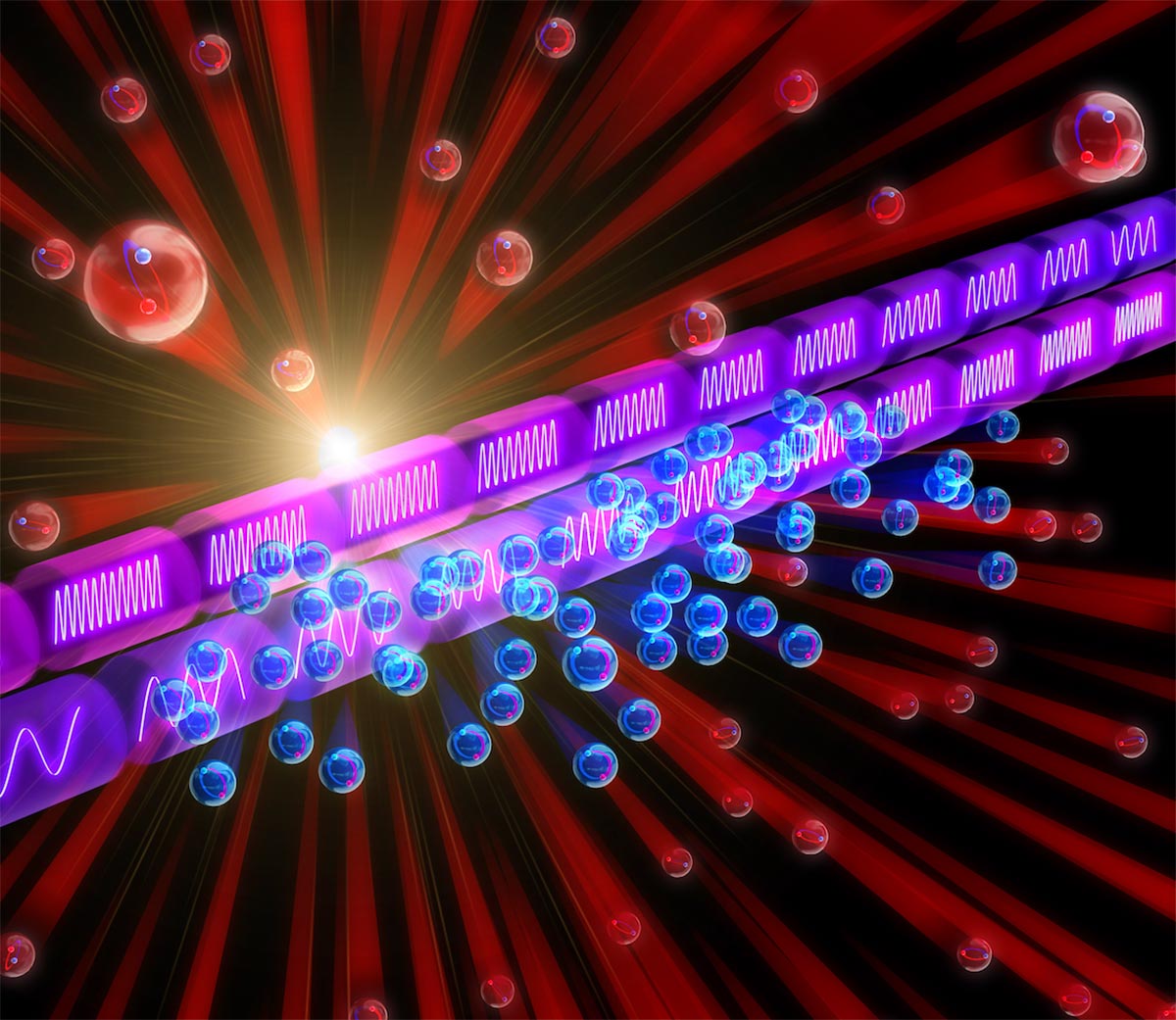
By using lasers to cool positronium atoms to nearly absolute zero, scientists have advanced our understanding of antimatter, potentially shedding light on cosmological mysteries like the missing matter in the universe.
Most atoms are made from positively charged protons, neutral neutrons, and negatively charged electrons. Positronium is an exotic atom composed of a single negative electron and a positively charged antimatter positron.
It is naturally very short-lived, but researchers including those from the University of Tokyo successfully cooled and slowed down samples of positronium using carefully tuned lasers. They hope this research will help others explore exotic forms of matter, and that such research might unlock the secrets of antimatter.
The Mystery of Missing Universe
Some of our universe is missing. You may have heard such a bizarre statement if you’ve read much about cosmology in the last few decades. The reason scientists say this is because almost all the stuff we see in the universe is made from matter, including you and the planet you’re standing on.
However, for a long time we’ve known about antimatter, which as the name suggests, is sort of the opposite of regular matter, in that antimatter particles share the same mass and other properties of their matter counterparts, but have an opposite charge. When matter and antimatter particles collide, they annihilate, and it’s widely believed they were created in equal amounts at the dawn of time. But that’s not what we see now.

Advancements in Antimatter Research
“Modern physics only accounts for a part of the total energy of the universe. The study of antimatter might help us account for this discrepancy, and we’ve just taken a big step in this direction with our latest research,” said Associate Professor Kosuke Yoshioka from the Photon Science Center.
“We have successfully slowed and cooled down exotic atoms of positronium, which is 50% antimatter. This means that for the first time, it can be explored in ways previously impossible, and that will necessarily include a deeper study of antimatter.”
Understanding Positronium’s Properties
Positronium sounds like something straight out of science fiction, and despite being very short-lived, it is very much a real thing. Think of it like the familiar atom hydrogen, with its central, positively charged and relatively large proton and tiny, negatively charged electron in orbit, except you swap the proton for the antimatter version of the electron, the positron.
This yields an exotic atom which is electrically neutral but doesn’t have a large nucleus; instead the electron and positron exist in mutual orbit, making it a two-body system. Even hydrogen is a multibody system, as a proton is really three smaller particles, called quarks, stuck together. And because positronium is a two-body system, it can be completely described by traditional mathematical and physical theories, making it ideal to test predictions with extreme accuracy.

“For researchers like us, involved in what is called precision spectroscopy, being able to precisely examine the properties of cooled positronium means we can compare them with precise theoretical calculations of its properties,” said Yoshioka. “Positronium is one of the few atoms made up entirely of only two elementary particles, which allows for such exact calculations. The idea of cooling positronium has been around for around 30 years, but a casual comment by undergraduate student Kenji Shu, who is now an assistant professor in my group, prompted me to take on the challenge of achieving it, and we finally did.”
Breakthrough in Cooling Positronium
Yoshioka and his team had several difficulties to overcome when trying to cool positronium. Firstly, there is the issue of its short life: one-ten millionth of a second. Secondly, there is its extreme light mass. As it’s so lightweight, you can’t use a cold physical surface or other substance to cool positronium down, so the team used lasers.
You may think lasers are very hot, but really, they are just packets of light, and it’s the way the light is used that determines the physical impact it has on something. In this case, a weak and finely tuned laser gently pushes against a positronium atom in the opposite direction to its movement, slowing it down and cooling it in the process.

Doing this repeatedly and in as little as one-ten millionth of a second cooled portions of positronium gas down to about 1 degree above absolute zero (-273 degrees Celsius), the coldest anything can get. Given positronium gas is at 600 kelvins, or 327 degrees Celsius, before cooling, this is quite a dramatic change in such a short space of time.
“Our computer simulations based on theoretical models suggest that the positronium gas might be even colder than we can currently measure in our experiments. This implies that our unique cooling laser is very effective at reducing the temperature of positronium and the concepts can hopefully help researchers study other exotic atoms,” said Yoshioka.
“This experiment used a laser in just one dimension, however, and if we utilize all three, we can measure the properties of positronium even more precisely. These experiments will be significant because we may be able to study the effect of gravity on antimatter. If antimatter behaves differently to regular matter due to gravity, it could help explain why some of our universe is missing.”
Reference: “Cooling positronium to ultralow velocities with a chirped laser pulse train” by K. Shu, Y. Tajima, R. Uozumi, N. Miyamoto, S. Shiraishi, T. Kobayashi, A. Ishida, K. Yamada, R. W. Gladen, T. Namba, S. Asai, K. Wada, I. Mochizuki, T. Hyodo, K. Ito, K. Michishio, B. E. O’Rourke, N. Oshima and K. Yoshioka, 11 September 2024, Nature.
DOI: 10.1038/s41586-024-07912-0
This study was supported by the MEXT Quantum Leap Flagship Program (MEXT Q-LEAP) Grant No. JPMXS0118067246, JST FOREST Program (Grant Number JPMJFR202L), JSPS KAKENHI Grant Numbers JP16H04526, JP17H02820, JP17H06205, JP17J03691, JP18H03855, JP19H01923, JP21K13862, JP22KJ0637, JP24H00217, Grant for Basic Science Research Projects from The Sumitomo Foundation, MATSUO FOUNDATION, Mitutoyo Association for Science and Technology (MAST), Research Foundation for Opto-Science and Technology, and Mitsubishi Foundation. This work was performed under the approval of the Photon Factory Program Advisory Committee (Proposal Numbers 2020G101, 2022G087, 2023G660).
Never miss a breakthrough: Join the SciTechDaily newsletter.
Follow us on Google and Google News.
1 Comment
Scientists Freeze Ghostly Atom, Paving Way for Cosmic Revelations.
VERY GOOD.
Please ask researchers to think deeply:
Are you freezing time or space?
Scientific research guided by correct theories can help humanity avoid detours, failures, and pomposity. Please witness the exemplary collaboration between theoretical physicists and experimentalists:
(1) https://scitechdaily.com/microscope-spacecrafts-most-precise-test-of-key-component-of-the-theory-of-general-relativity/#comment-854286.
(2) https://scitechdaily.com/microscope-spacecrafts-most-precise-test-of-key-component-of-the-theory-of-general-relativity/#comment-858364.