

Close Menu
    Facebook X (Twitter) Instagram
    SciTechDaily
    • Biology
    • Chemistry
    • Earth
    • Health
    • Physics
    • Science
    • Space
    • Technology
    Facebook X (Twitter) Pinterest YouTube RSS
    SciTechDaily
    Home»Biology»Scientists Have Created Genetically Modified Drought-Resistant Plants
    Biology

    Scientists Have Created Genetically Modified Drought-Resistant Plants

    By Heidelberg UniversityJuly 20, 2022No Comments3 Mins Read
    Facebook Twitter Pinterest Telegram LinkedIn WhatsApp Email Reddit
    Share
    Facebook Twitter LinkedIn Pinterest Telegram Email Reddit
    Lone Plant Growing
    The researchers are currently trying to find out what causes this improved drought resistance.

    Researchers from Heidelberg University uncover a crucial protein in a mechanism that regulates the life of proteins.

    Proteins serve a variety of purposes in plants in addition to being the fundamental building blocks of life. More than 20 billion protein molecules make up a typical plant cell, helping to stabilize its structure and sustain cellular metabolism.

    Researchers at Heidelberg University’s Centre for Organismal Studies have shed light on a biological process that increases the life of plant proteins. They have now discovered a crucial protein, called N-terminal acetylation, that controls this mechanism. The study’s findings were published in the journals Molecular Plant and Science Advances.

    The Importance of N-terminal Acetylation

    N-terminal acetylation is a chemical marker that develops during the production of proteins. Plants do this by affixing an acetic acid residue to the beginning of the protein. The majority of proteins are shielded from degradation by the so-called proteasome, a form of molecular shredder, by this acetic acid residue.

    The important protein that has now been found, according to the Heidelberg researchers led by Professor Dr. Rüdiger Hell and Dr. Markus Wirtz, is known as the Huntingtin Yeast Interactor Protein K (HYPK). It promotes N-terminal acetylation, extending the lifespan of plant proteins—important for, among other things, adapting to environmental circumstances.
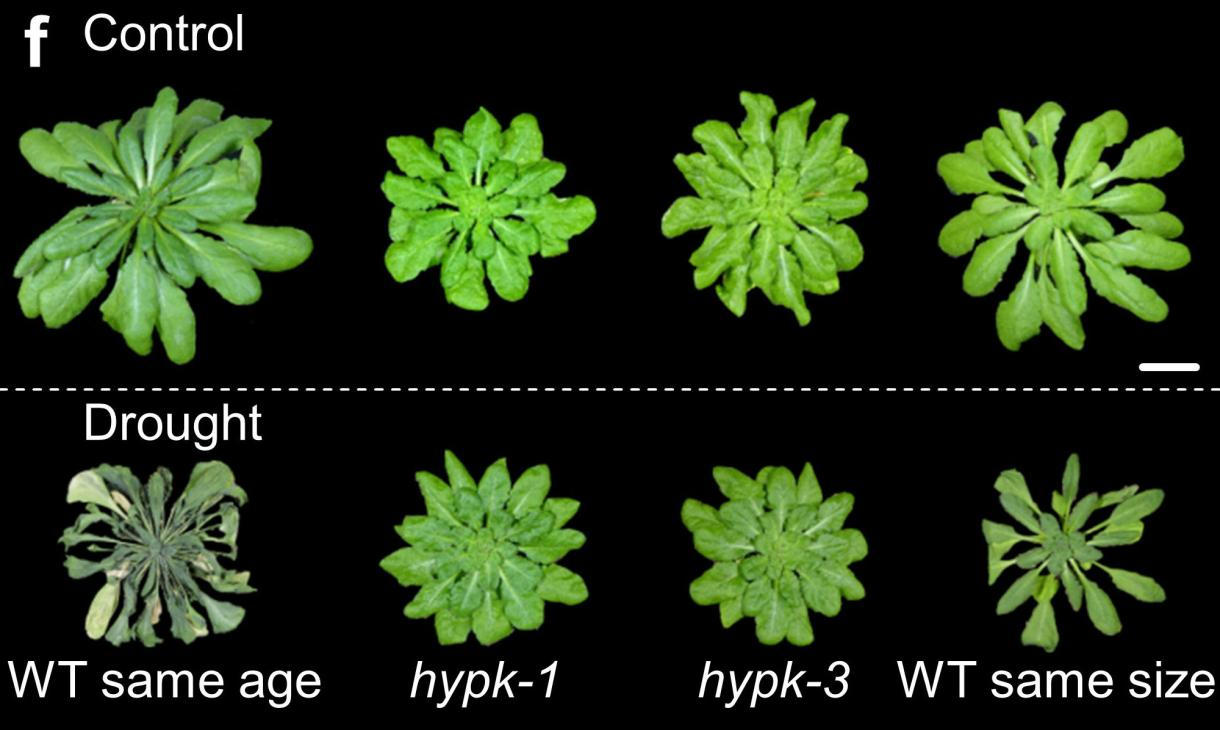
    Drought Resistance Plants
    A graphic comparing phenotype of well-supplied (Control) and drought-stressed wild type (WT) plants and HYPK mutants. The drought stress was applied to approx. five-week-old plants for 24 days. Scale bar = 2 cm. Credit: Miklánková et al., Sci. Adv. 8, eabn6153 (2022), CC BY-NC 4.0

    The Heidelberg team used thale cress (Arabidopsis thaliana) to investigate the regulation properties of the HYPK protein. Due to its well-studied genome, the plant from the family Brassicaceae is a popular model organism.

    Research on genetically altered plants has shown that the life of proteins is reduced when the HYPK protein is absent and N-terminal acetylation does not take place. At the same time, the plant’s resistance to ongoing drought rises. Rüdiger Hell states, “Our current research is directed to finding out how this improved drought resistance comes about.”

    HYPK Protein Found Across Diverse Organisms

    In cooperation with researchers from the Chinese Academy of Sciences in Beijing (China) under the direction of Professor Dr. Yonghong Wang, the Heidelberg scientists also discovered that HYPK performs its regulatory function not only in thale cress but also in rice, one of the world’s oldest crops. The protein is also found in humans and in many fungi.

    “The mechanism involved in acetylation and its control by HYPK appears to be one that developed billions of years ago and has been retained in very different organisms to this day,” explains Markus Wirtz.

    The studies are being funded by the German Research Foundation.

    References:

    “HYPK promotes the activity of the Nα-acetyltransferase A complex to determine proteostasis of nonAc-X2/N-degron–containing proteins” by Pavlína Miklánková, Eric Linster, Jean-Baptiste Boyer, Jonas Weidenhausen, Johannes Mueller, Laura Armbruster, Karine Lapouge, Carolina De La Torre, Willy Bienvenut, Carsten Sticht, Matthias Mann, Thierry Meinnel, Irmgard Sinning, Carmela Giglione, Rüdiger Hell and Markus Wirtz, 15 June 2022, Science Advances.
    DOI: 10.1126/sciadv.abn6153

    “OsHYPK-mediated protein N-terminal acetylation coordinates plant development and abiotic stress responses in rice” by Xiaodi Gong, Yaqian Huang, Yan Liang, Yundong Yuan, Yuhao Liu, Tongwen Han, Shujia Li, Hengbin Gao, Bo Lv, Xiahe Huang, Eric Linster, Yingchun Wang, Markus Wirtz and Yonghong Wang, 4 April 2022, Molecular Plant.
    DOI: 10.1016/j.molp.2022.03.001

    Never miss a breakthrough: Join the SciTechDaily newsletter.
    Follow us on Google and Google News.

    Genetics Heidelberg University Plant Science Plants Protein
    Share. Facebook Twitter Pinterest LinkedIn Email Reddit

    Related Articles

    This Tiny Plant Has Huge Potential for Food, Fuel, and Climate Solutions

    Walnut Trees’ 40-Million-Year-Old Secret: How They Switch Genders Every Season

    Scientists Use CRISPR To Turn Sugarcane Into a Super Crop

    Green Ancestors: Decoding the Secrets of 600 Million Years of Plant Life

    Scientists Debunk the Myth: Do Trees Really Have Feelings?

    Tricking Pests With Sex Pheromones: New Engineered Plants Could Replace Pesticides

    Revealed: Plants Molecular ‘Alarm’ System That Protects Them From Predators

    Researchers Find that Popdc Proteins Help the Heart Adapt to Stress

    Researcher Studies Root Growth to Develop Hardier, Weather-resistant Crops

    Leave A Reply Cancel Reply

    • Facebook
    • Twitter
    • Pinterest
    • YouTube

    Don't Miss a Discovery

    Subscribe for the Latest in Science & Tech!

    Trending News

    The Universe Is Expanding Too Fast and Scientists Can’t Explain Why

    “Like Liquid Metal”: Scientists Create Strange Shape-Shifting Material

    Early Warning Signals of Esophageal Cancer May Be Hiding in Plain Sight

    Common Blood Pressure Drug Shows Surprising Power Against Deadly Antibiotic-Resistant Superbug

    Scientists Uncover Dangerous Connection Between Serotonin and Heart Valve Disease

    Scientists Discover a “Protector” Protein That Could Help Reverse Hair Loss

    Bone-Strengthening Discovery Could Reverse Osteoporosis

    Scientists Uncover Hidden Trigger Behind Stem Cell Aging

    Follow SciTechDaily
    • Facebook
    • Twitter
    • YouTube
    • Pinterest
    • Newsletter
    • RSS
    SciTech News
    • Biology News
    • Chemistry News
    • Earth News
    • Health News
    • Physics News
    • Science News
    • Space News
    • Technology News
    Recent Posts
    • A Common Diabetes Drug May Hold the Key to Stopping HIV From Coming Back
    • Ancient “Syphilis-Like” Disease in Vietnam Challenges Key Scientific Assumptions
    • Drinking Alcohol To Cope in Your 20s Could Damage Your Brain for Life
    • Scientists Crack Alfalfa’s Chromosome Mystery After Decades of Debate
    • Ancient Ant-Plant Alliance Collapses As Predatory Wasps Move In
    Copyright © 1998 - 2026 SciTechDaily. All Rights Reserved.
    • Science News
    • About
    • Contact
    • Editorial Board
    • Privacy Policy
    • Terms of Use

    Type above and press Enter to search. Press Esc to cancel.