
Rising temperatures affect the plants that agriculture — and we —depend on. New research sheds light on how plants resist drought.
All life forms have to adapt to the environment in which they live. A warming climate can lead to more frequent drought. This can affect Earth’s biological diversity.
The climate also impacts agriculture and all the plants we depend on for food.
Knowing more about how plants adapt to drought is therefore important for agriculture – and the rest of us. Researchers are on the case at NTNU and other institutions. The results can help us cultivate plants that are better able to withstand drought.
Two Factors Affect Adaptation
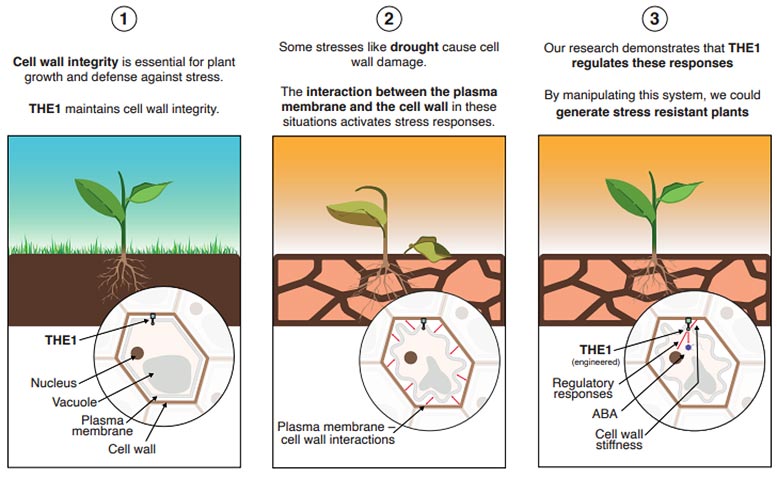
“Two key factors influence the ability of plants to resist drought stress,” says Thorsten Hamann, a professor at NTNU’s Department of Biology.
Stiff cell walls that surround the plant cells give them structural support and reduce water loss when the plants are exposed to drought. The second factor is abscisic acid, a hormone that regulates drought adaptation in all land plants.
“Although plant cell walls and abscisic acid are essential for plant life, we know very little about the processes activating abscisic acid production and regulating cell wall stiffness,” says Hamann.
But the planet seems to be changing, and it is important to get ahead of the curve of rising temperatures.
Applied Emerging Technology
Hamann is currently on a research residency at UCLA in California. His research group examined two model plants, thale cress (Arabidopsis thaliana) and common garden peas (Pisum sativum).
Model plants are plant species that for various reasons are commonly used in experiments and can therefore yield comparable results between different research projects. Another important reason for their use is that the cells of model plants go through a full life cycle in just nine weeks, enabling a quick turnaround for completing experiments with them.
The researchers adapted Brillouin spectroscopy for their experiments, a microscopy technique commonly used in materials technology, but which they were able to adapt to their purpose.
“We used this technique to investigate the tiny fluctuations inside the plant cells that influence cell wall stiffness and the processes regulating it,” says Hamann.
The research group also arrived at results that are startling enough to have been published in the Proceedings of the National Academy of Sciences (PNAS) Journal.
Could Be Good News for Agriculture
“We identified a molecular component, which is required for modulating not only cell wall stiffness but also abscisic acid production,” Hamann says.
This molecular component is called THE1 or Theseus1. Originally, it was found in the thale cress, one of the species that the research group investigated this time as well.
They arrived at even more interesting results by combining several findings from studies on cell biology and the chemical processes behind plant metabolism.
“We found that intact cell walls are absolutely necessary to produce abscisic acid in the plants we examined,” says Hamann.
Without whole cell walls, the plants’ ability to adapt does not function. This is important to know.
“These findings provide novel mechanistic insights into processes responsible for plant adaptation to a changing environment and drought,” Hamann says.
They could also be good news for agriculture if they can help us cultivate plants that can withstand drought better.
Increasing our knowledge “enables us to better improve crop yields using knowledge-based approaches,” Hamann says.
Reference: “THESEUS1 modulates cell wall stiffness and abscisic acid production in Arabidopsis thaliana” by Laura Bacete, Julia Schulz, Timo Engelsdorf, Zdenka Bartosova, Lauri Vaahtera, Guqi Yan, Joachim Matthias Gerhold, Tereza Tichá, Camilla Øvstebø, Nora Gigli-Bisceglia, Svanhild Johannessen-Starheim, Jeremie Margueritat, Hannes Kollist, Thomas Dehoux, Scott A. M. McAdam and Thorsten Hamann, 23 December 2021, Proceedings of the National Academy of Sciences.
DOI: 10.1073/pnas.2119258119
Never miss a breakthrough: Join the SciTechDaily newsletter.
Follow us on Google and Google News.