

Researchers from the University of Pennsylvania demonstrated in a proof-of-concept study that a hands-free device could successfully automate the treatment and removal of dental plaque and bacteria that cause tooth decay.
In the future, a shape-shifting robotic microswarm may serve as a toothbrush, rinse, and dental floss all in one. The technology, created by a multidisciplinary team at the University of Pennsylvania, has the potential to provide a brand-new, automated method for carrying out the repetitive but important daily duties of brushing and flossing. For people who lack the manual dexterity to efficiently clean their teeth alone, this system could be extremely helpful.
These microrobots are composed of iron oxide nanoparticles with catalytic and magnetic properties. Researchers were able to control their movement and configuration using a magnetic field to either produce bristle-like structures that remove dental plaque from the wide surfaces of teeth or elongated threads that can slide between teeth like a piece of floss. In both situations, the nanoparticles are driven by a catalytic reaction to release antimicrobials that eliminate harmful oral bacteria on site.
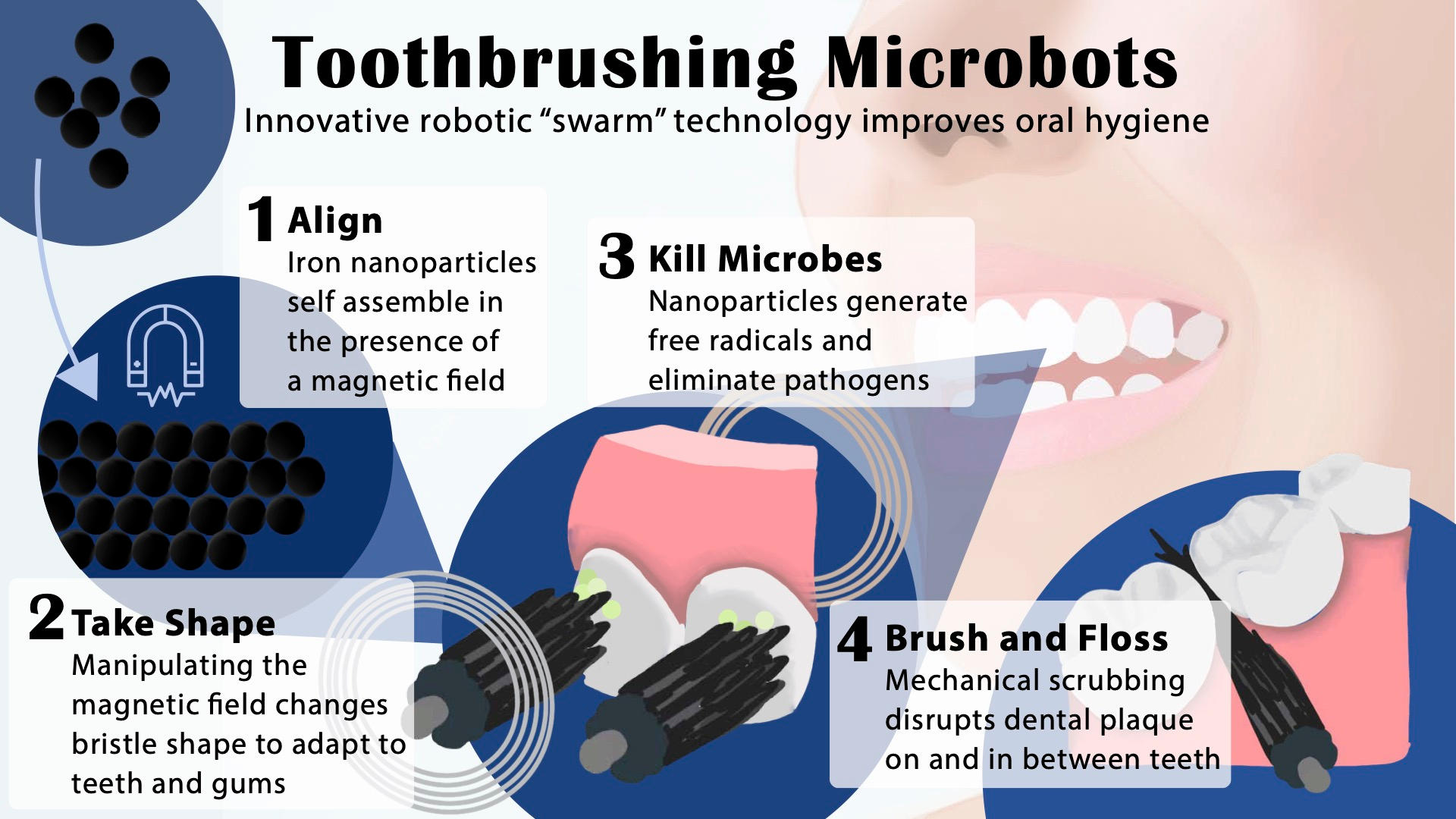
Experiments using this system on mock and real human teeth showed that the robotic assemblies can conform to a variety of shapes to nearly eliminate the sticky biofilms that lead to cavities and gum disease. The Penn team shared their findings establishing a proof-of-concept for the robotic system in the journal ACS Nano.
“Routine oral care is cumbersome and can pose challenges for many people, especially those who have a hard time cleaning their teeth,” says Hyun (Michel) Koo, a professor in the Department of Orthodontics and divisions of Community Oral Health and Pediatric Dentistry at Penn’s School of Dental Medicine and co-corresponding author on the study. “You have to brush your teeth, then floss your teeth, then rinse your mouth; it’s a manual, multi-step process. The big innovation here is that the robotics system can do all three in a single, hands-free, automated way.”
“Nanoparticles can be shaped and controlled with magnetic fields in surprising ways,” says Edward Steager, a senior research investigator in Penn’s School of Engineering and Applied Science and co-corresponding author. “We form bristles that can extend, sweep, and even transfer back and forth across a space, much like flossing. The way it works is similar to how a robotic arm might reach out and clean a surface. The system can be programmed to do the nanoparticle assembly and motion control automatically.”
Disrupting Oral Care Technology
“The design of the toothbrush has remained relatively unchanged for millennia,” says Koo.
While adding electric motors elevated the basic ‘bristle-on-a-stick format’, the fundamental concept remained the same. “It’s a technology that has not been disrupted in decades.”
Several years ago, Penn researchers within the Center for Innovation & Precision Dentistry (CiPD), of which Koo is a co-director, took steps toward a major disruption, using this microrobotics system.
Their innovation arose from a bit of serendipity. Research groups in both Penn Dental Medicine and Penn Engineering were interested in iron oxide nanoparticles but for very different reasons. Koo’s group was intrigued by the catalytic activity of the nanoparticles. They can activate hydrogen peroxide to release free radicals that can kill tooth-decay-causing bacteria and degrade dental plaque biofilms. Meanwhile, Steager and engineering colleagues, including Dean Vijay Kumar and Professor Kathleen Stebe, co-director of CiPD, were exploring these nanoparticles as building blocks of magnetically controlled microrobots.
With support from Penn Health Tech and the National Institutes of Health’s National Institute of Dental and Craniofacial Research, the Penn collaborators married the two applications in the current work, constructing a platform to electromagnetically control the microrobots, enabling them to adopt different configurations and release antimicrobials on site to effectively treat and clean teeth.
“It doesn’t matter if you have straight teeth or misaligned teeth, it will adapt to different surfaces,” says Koo. “The system can adjust to all the nooks and crannies in the oral cavity.”
The researchers optimized the motions of the microrobots on a small slab of tooth-like material. Next, they tested the microrobots’ performance adjusting to the complex topography of the tooth surface, interdental surfaces, and the gumline, using 3D-printed tooth models based on scans of human teeth from the dental clinic. Finally, they trialed the microrobots on real human teeth that were mounted in such a way as to mimic the position of teeth in the oral cavity.
On these various surfaces, the researchers found that the microrobotics system could effectively eliminate biofilms, clearing them of all detectable pathogens. The iron oxide nanoparticles have been FDA approved for other uses, and tests of the bristle formations on an animal model showed that they did not harm the gum tissue.
Indeed, the system is fully programmable; the team’s roboticists and engineers used variations in the magnetic field to precisely tune the motions of the microrobots as well as control bristle stiffness and length. The researchers found that the tips of the bristles could be made firm enough to remove biofilms but soft enough to avoid damage to the gums.
The customizable nature of the system, the researchers say, could make it gentle enough for clinical use, but also personalized, able to adapt to the unique topographies of a patient’s oral cavity.
To advance this technology to the clinic, the Penn team is continuing to optimize the robots’ motions and considering different means of delivering the microrobots through mouth-fitting devices.
They’re eager to see their device help patients.
“We have this technology that’s as or more effective as brushing and flossing your teeth but doesn’t require manual dexterity,” says Koo. “We’d love to see this helping the geriatric population and people with disabilities. We believe it will disrupt current modalities and majorly advance oral health care.”
Reference: “Surface Topography-Adaptive Robotic Superstructures for Biofilm Removal and Pathogen Detection on Human Teeth” by Min Jun Oh, Alaa Babeer, Yuan Liu, Zhi Ren, Jingyu Wu, David A. Issadore, Kathleen J. Stebe, Daeyeon Lee, Edward Steager and Hyun Koo, 28 June 2022, ACS Nano.
DOI: 10.1021/acsnano.2c01950
The study was funded by the National Institute of Dental and Craniofacial Research, Procter and Gamble, and Sungkyunkwan University.
Never miss a breakthrough: Join the SciTechDaily newsletter.
Follow us on Google and Google News.