

Close Menu
    Facebook X (Twitter) Instagram
    SciTechDaily
    • Biology
    • Chemistry
    • Earth
    • Health
    • Physics
    • Science
    • Space
    • Technology
    Facebook X (Twitter) Pinterest YouTube RSS
    SciTechDaily
    Home»Space»Scientists Identify 37 Active Volcanoes on Venus – “Planet’s Interior Is Still Churning”
    Space

    Scientists Identify 37 Active Volcanoes on Venus – “Planet’s Interior Is Still Churning”

    By University of MarylandJuly 21, 20201 Comment4 Mins Read
    Facebook Twitter Pinterest Telegram LinkedIn WhatsApp Email Reddit
    Share
    Facebook Twitter LinkedIn Pinterest Telegram Email Reddit
    Active Volcanoes
    A new study identified 37 recently active volcanic structures on Venus.

    New 3D model provides evidence that Venus is churning inside.

    A new study identified 37 recently active volcanic structures on Venus. The study provides some of the best evidence yet that Venus is still a geologically active planet. A research paper on the work, which was conducted by researchers at the University of Maryland and the Institute of Geophysics at ETH Zurich, Switzerland, was published in the journal Nature Geoscience on July 20, 2020.

    “This is the first time we are able to point to specific structures and say ‘Look, this is not an ancient volcano but one that is active today, dormant perhaps, but not dead,’” said Laurent Montési, a professor of geology at UMD and co-author of the research paper. “This study significantly changes the view of Venus from a mostly inactive planet to one whose interior is still churning and can feed many active volcanoes.”
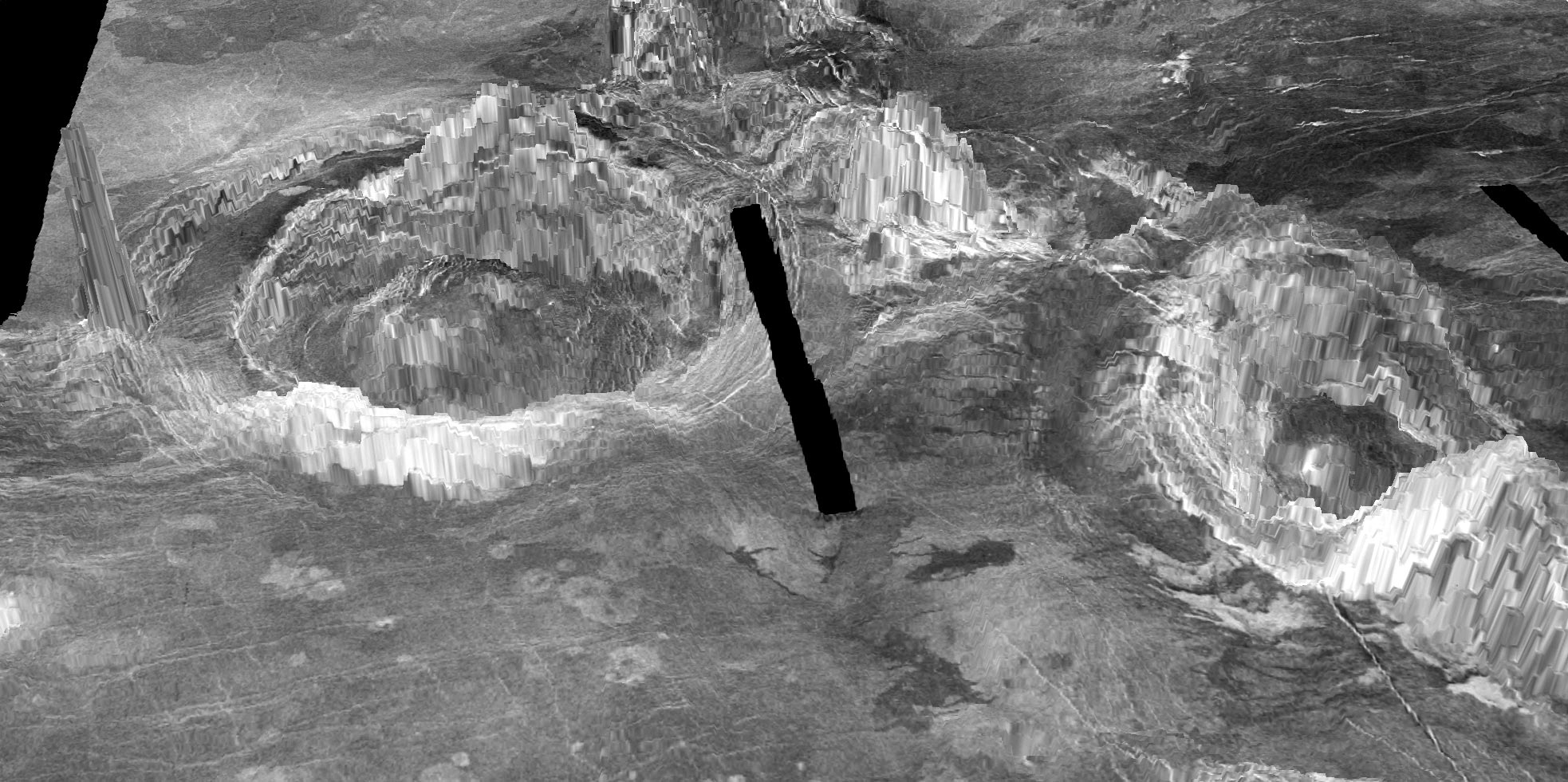
    Two Coronae Surface of Venus
    The 3D rendition above shows two coronae observed on the surface of Venus. The ring-like structures are formed when hot material from deep inside the planet rises through the mantle and erupts through the crust. Research by UMD’s Laurent Montesi found that at least 37 coronae on Venus represent recent geologic activity, including the one named Aramaiti, seen on the left in this image. The black line represents a gap in data. (Image courtesy Laurent Montési). Credit: University of Maryland

    Scientists have known for some time that Venus has a younger surface than planets like Mars and Mercury, which have cold interiors. Evidence of a warm interior and geologic activity dots the surface of the planet in the form of ring-like structures known as coronae, which form when plumes of hot material deep inside the planet rise through the mantle layer and crust. This is similar to the way mantle plumes formed the volcanic Hawaiian Islands.

    But it was thought that the coronae on Venus were probably signs of ancient activity, and that Venus had cooled enough to slow geological activity in the planet’s interior and harden the crust so much that any warm material from deep inside would not be able to puncture through. In addition, the exact processes by which mantle plumes formed coronae on Venus and the reasons for variation among coronae have been matters for debate.

    Global Map of Venus
    In the global map of Venus above, active coronae appear in red and inactive coronae appear in white. Credit: Anna Gülcher

    In the new study, the researchers used numerical models of thermo-mechanic activity beneath the surface of Venus to create high-resolution, 3D simulations of coronae formation. Their simulations provide a more detailed view of the process than ever before.

    The results helped Montési and his colleagues identify features that are present only in recently active coronae. The team was then able to match those features to those observed on the surface of Venus, revealing that some of the variation in coronae across the planet represents different stages of geological development. The study provides the first evidence that coronae on Venus are still evolving, indicating that the interior of the planet is still churning.

    “The improved degree of realism in these models over previous studies makes it possible to identify several stages in corona evolution and define diagnostic geological features present only at currently active coronae,” Montési said. “We are able to tell that at least 37 coronae have been very recently active.”

    The active coronae on Venus are clustered in a handful of locations, which suggests areas where the planet is most active, providing clues to the workings of the planet’s interior. These results may help identify target areas where geologic instruments should be placed on future missions to Venus, such as Europe’s EnVision that is scheduled to launch in 2032.

    Reference: “Corona structures driven by plume–lithosphere interactions and evidence for ongoing plume activity on Venus” by Anna J. P. Gülcher, Taras V. Gerya, Laurent G. J. Montési and Jessica Munch, 20 July 2020, Nature Geoscience.
    DOI: 10.1038/s41561-020-0606-1

    This study was supported by NASA (Award No. NNX14AG51G), the Swiss National Science Foundation (Award No. 200021_182069) and the EU project Subitop. The content of this article does not necessarily reflect the views of these organizations.

    Never miss a breakthrough: Join the SciTechDaily newsletter.
    Follow us on Google and Google News.

    Planets Popular University of Maryland Venus Volcano
    Share. Facebook Twitter Pinterest LinkedIn Email Reddit

    Related Articles

    Scientists Discover a Giant Hidden Lava Tunnel Beneath Venus

    Is Venus Alive? A Churning Crust Could Be Powering Its 85,000 Volcanoes

    Planet Resurfacing: Venus Volcanism Could Have Been Fueled by Ancient, High-Energy Impacts

    Venus Is Alive!

    Volcanic Activity on Venus – Earth’s Evil Twin – Revealed in NASA’s Magellan Data

    Bizarre Geologic Activity on Venus: “Squishy” Outer Shell May Be Resurfacing the Planet

    From Temperate World to Acidic Hothouse: How Massive Volcanism May Have Altered Venus’ Climate

    Evidence of Explosive Volcanic Activity on Venus

    Planetary Researchers Surprised to Find a “Ring of Fire” on Venus

    1 Comment

    1. kk on March 16, 2021 11:27 am

      love

      Reply
    Leave A Reply Cancel Reply

    • Facebook
    • Twitter
    • Pinterest
    • YouTube

    Don't Miss a Discovery

    Subscribe for the Latest in Science & Tech!

    Trending News

    Massive Study Warns Marijuana Use in Teens Is Linked to Serious Mental Illness

    Scientists Discover a Completely Unexpected Way T Cells Kill Cancer

    Scientists Just Found the Solar System’s Original “Planet Factory”

    Study Warns Widely Used Food Preservatives Linked to High Blood Pressure and Heart Disease

    New Treatment Could Reverse Osteoarthritis Within Weeks

    Physicists Have Measured “Negative Time” in Bizarre Quantum Experiment

    The Deadly Tapeworm Spreading Across America Has Reached the Pacific Northwest

    Could Low Vitamin D Be Making Your Pain Worse?

    Follow SciTechDaily
    • Facebook
    • Twitter
    • YouTube
    • Pinterest
    • Newsletter
    • RSS
    SciTech News
    • Biology News
    • Chemistry News
    • Earth News
    • Health News
    • Physics News
    • Science News
    • Space News
    • Technology News
    Recent Posts
    • Scientists Challenge a 70-Year-Old Theory of Language With a Surprising Discovery
    • Scientists Discover Mysterious Creature Living in the Great Salt Lake – and It Exists Nowhere Else on Earth
    • It’s Alive? Surprising Discovery Changes What We Know About Fog
    • Simple Family Routines May Be the Secret to a Smoother Start at School
    • Brain Study Overturns Long-Held Beliefs About How Humans Learn Speech
    Copyright © 1998 - 2026 SciTechDaily. All Rights Reserved.
    • Science News
    • About
    • Contact
    • Editorial Board
    • Privacy Policy
    • Terms of Use

    Type above and press Enter to search. Press Esc to cancel.