
New research maps genetic “hotspots” for hemochromatosis, revealing uneven risk and possible underdiagnosis across the UK and Ireland.
A new study indicates that residents of the Outer Hebrides and north-west Ireland face the greatest likelihood of developing a hereditary disorder that causes the body to accumulate excessive iron. This condition, hemochromatosis—also known as the ‘Celtic curse’ – can lead to serious health problems if left untreated.
Researchers say this is the first comprehensive effort to chart genetic susceptibility to hemochromatosis across the UK and Ireland, even though the illness has long been recognized as more common among people of Scottish and Irish descent. The findings suggest that directing genetic screening toward the highest risk regions could allow doctors to identify vulnerable individuals sooner and reduce the risk of long-term complications.
Hemochromatosis develops gradually. Over many years, excess iron can build up in vital organs, increasing the risk of liver damage, liver cancer, and arthritis. Detecting the disorder early is critical, as treatment is straightforward. Regular blood donation lowers iron levels and can prevent many of the most serious outcomes.
The disease results from inherited changes in DNA known as genetic variants. In the UK and Ireland, the strongest known risk factor is a variant called C282Y.
Mapping genetic risk across the British Isles
To better understand where this risk is concentrated, scientists at the University of Edinburgh examined genetic information from more than 400,000 participants in the UK BioBank and Viking Genes projects. They assessed how frequently the C282Y variant appears in 29 regions across the British Isles and Ireland.
The highest estimated carrier rate was found among people with ancestry from north-west Ireland, where about one in 54 individuals carry the variant. The next highest rates were observed in the Outer Hebrides (one in 62) and Northern Ireland (one in 71).
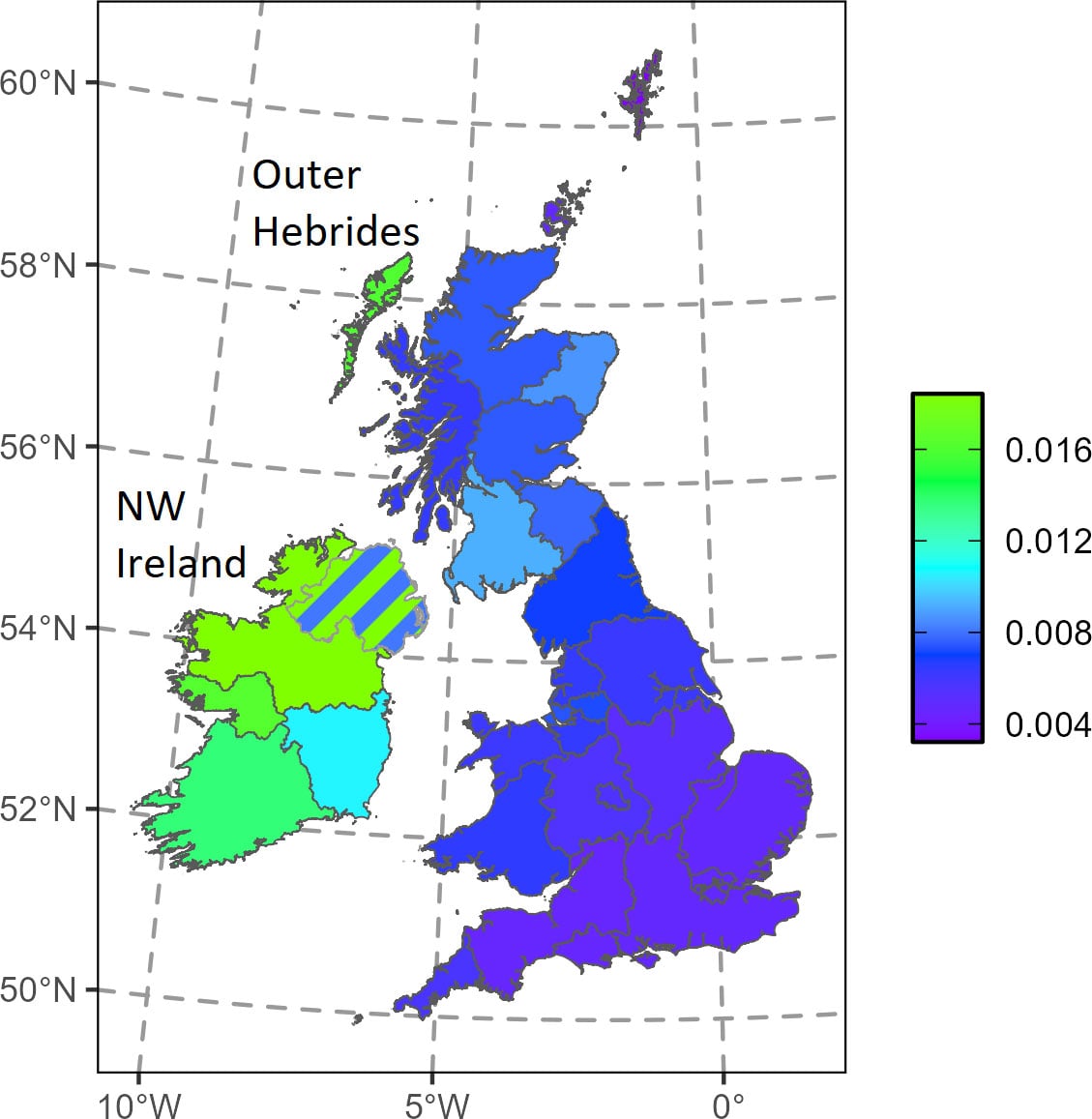
Map of the landscape of hereditary hemochromatosis risk across the UK and Ireland. Areas with a higher frequency of the disease-causing C282Y genetic variant are indicated in green. Hatching is used to represent two communities in Northern Ireland, each with different risks. Credit: University of EdinburghElevated risk was also identified in mainland Scotland, particularly in Glasgow and southwest Scotland, where roughly one in 117 people are estimated to carry the variant. These findings reinforce the historical association reflected in the nickname ‘Celtic Curse’.
According to the researchers, concentrating screening programs in these higher risk communities could uncover a substantial number of undiagnosed cases.
Diagnosis patterns and possible under-diagnosis
The team also reviewed NHS England records and identified more than 70,000 diagnosed cases of hemochromatosis. Diagnosis rates were nearly four times higher among white Irish individuals than among white British individuals.
Within the white British population, individuals from Liverpool were 11 times more likely to have a diagnosis than those from Kent. The researchers suggest that this difference may reflect historical migration patterns, as more than 20 percent of Liverpool’s population was Irish in the 1850s.
In general, the distribution of diagnosed cases in England mirrors the underlying genetic risk. However, several areas, including Birmingham, Cumbria, Northumberland, and Durham, show fewer diagnoses than expected based on their genetic profiles. Experts say these regions may have undetected cases and could benefit from expanded genetic screening.
Comparable NHS prevalence data were not available for Scotland, Wales, and Northern Ireland, so those nations were not included in the diagnosis analysis.
Expert reactions
Professor Jim Flett Wilson, Chair of Human Genetics at the University of Edinburgh, said: “If untreated, the iron-overload disease hemochromatosis can lead to liver cancer, arthritis, and other poor outcomes. We have shown that the risk in the Hebrides and Northern Ireland is much higher than previously thought, with about one in every 60 people at risk, about half of whom will develop the disease. Early detection prevents most of the adverse consequences and a simple treatment – giving blood – is available. The time has come to plan for community-wide genetic screening in these high-risk areas, to identify as many people as possible whose genes mean they are at high risk of this preventable illness.”
Jonathan Jelley MBE JP, CEO of Hemochromatosis UK, said: “Although there are other forms and genotypes that can lead to iron overload, available research indicates C282Y presents as the greatest risk. This hugely important work has the potential to lead to greater targeted awareness, increased diagnosis, and better treatment pathways for thousands of people affected by genetic hemochromatosis.
“As a charity, we have already begun work on targeting and prioritizing hotspot areas of the UK for support including with our National Helpline and clinician education. Using this study, we will continue to campaign for better allocation of public resources to this preventable condition that is all too often overlooked.”
Torcuil Crichton, the Labour MP for Na h-Eileanan an Iar (the Western Isles), has hemochromatosis and supports the call for community screening for hemochromatosis genetic variants in the Western Isles.
Torcuil Crichton MP said: “This research writes the case for community-wide screening in the Western Isles, Northern Ireland, and other hemochromatosis hotspots. I have previously raised this with Ministers in the House of Commons and this new evidence ought to be enough to persuade the UK National Screening Committee to review its position and approve a pilot screening programme. The Western Isles offer a contained and distinct population sample to start from.
“Early identification, which I was lucky to have, means a whole range of bad health outcomes can be avoided and I’ll be urging Ministers and the Screening Committee to reconsider their stance.”
Reference: “The landscape of hereditary haemochromatosis risk and diagnosis across the British Isles and Ireland” by Shona M. Kerr, Benjamin S. Fletcher, Gannie Tzoneva, Alan R. Shuldiner, Edmund Gilbert and James F. Wilson, 3 February 2026, Nature Communications.
DOI: 10.1038/s41467-025-65511-7
The study was funded by the charity Haemochromatosis-UK.
Never miss a breakthrough: Join the SciTechDaily newsletter.
Follow us on Google and Google News.
18 Comments
Did they forget about the Isle of Man? It’s missing from the middle of the map, and many people on the island have ancestors from the Hebrides.
It probably isn’t in the UK BioBank dataset.
When England was starving and committing G€N0C!DE against the Irish, it’s likely that such poor diet and lack of nutritional support led to the Irish adapting by absorbing more than iron from less. Now that nutrition is available, that extra absorption of iron is indeed a lasting curse. When does England get held responsible for all the damage around the world they’ve caused?
You’re talking nonsense, it’s a genetic disease introduced via Scandinavia, Denmark I think has the highest instances of this genetic disorder. People just don’t starve and develop a genetic disorder., English people get this to solo Welsh Norwegian , Icelandic peoples Sweed and like I said Denmark you don’t get a genetic mutation through starvation, otherwise we would’ve seen lots of incidents like this around the world we don’t it’s specific to Northwest Europe, and in the UK, hardly anybody knows about it
People don’t adapt genetically over 2 years. Especially when their key diet was potatoes (18 per day)… which aren’t high in iron.
How ridiculous a comment . Hate makes the mind irrational it seems
57.years old. Diagnosed with this 7 years ago. If you are aWhite male who is unusually tired in your 40s or 50s get tested. It made all my small joints hurt. Spine was the worst. If detected late in life, you’ll probably have liver issues, especially if you are a drinker also.
Honestly treated by diet change and a whole lot of blood draws.
Ireland is not British so is not part of the “British Isles”.
Isles meaning plural, of course Ireland is part of the British Isles it is also a republic, but the British Isles contained mainland Britain and Ireland, go and read a book
Irishman here. Ireland is not part of these so-called “British Isles”. The fact that the British invented and still use this despicable term shows time and again how stupid and ignorant they are.
I believe the term was first used by some Greek chap in ancient times, not by the British, and definitely long before the English arrived.
Isles meaning plural, of course Ireland is part of the British Isles it is also a republic, but the British Isles contained mainland Britain and Ireland, go and read a book
Hardly anybody in the British Isles have heard of this genetic disease, but it can be very prevalent, you can walk into a hospital in Britain, go to the genetic clinic see genetic diseases affecting everybody from around the world all different ones you’ll never see a poster of this in a British hospital, I have it it’s not very nice at all severe severe effects in the London borough I live there’s one place that does Venicesection, you cannot give blood. It’s not allowed if you have genetic haemochromatosis for some reason now the only place in that borough they’re closing down to expand their sickle cell anaemia clinic. Even though sickle cell anaemia is well created for very well created for with lots of places offering services but the indigenous population of these islands does have a genetic illness that needs taken care of and the only place I can get treatment is closing down, this very much needs to be screened for in children way before complications arise I hope it happens, but I won’t hold my breath because it only affects the indigenous population of the British Isles of after all
Irishman here. Ireland is not part of these so-called “British Isles”. The fact that the British invented and still use this despicable term shows time and again how stupid and ignorant they are.
American of Northern Irish descent. My mother was from County Fermanagh. My husband also American of Irish, German & Baltic descent. My daughter was diagnosed with hemochromatosis several years ago. She told my husband and I and her 2 brothers, to go for genetic testing and sure enough my husband and I are both carriers and our sons both have hemochromatosis as well. One more severe than the other.
Needless to stay the hematologist at New York Presbyterian was flabbergasted. He said he never had such young people know that they have hemochromatosis. Unfortunately people usually don’t find out until they’re older and it’s done some damage. Basically they just have to do therapeutic phlebotomy. He also discouraged them from drinking which is great because they’re very into fitness. I’m sure they they were drinking at college but have curtailed it because of it’s potential risk to their livers.
They’re very fortunate to know at this young age so they can keep an eye on it. It is fascinating to find out that it skipped a couple of generations. My mother was actually anemic and she was the one from Ireland. My dad was third generation Irish. He may have had it but he didn’t fatigue easily which is one of the signs. He was very energetic even through his 89th year before he passed.
Anyway, as far as the English in Ireland, I can hear my Northern Irish grandma in my head and I won’t say what she would say to the argument above 😂 but she was no fan of the royals and she’d be saying something about Andrew at this very moment if she were alive.
You are ALL disagreeing, while overlooking an important point…. You are arguing GEOGRAPHY/ POLITICS/ ANTHROPOLOGY/ GENETICS , all at once… I am of Irish, Scottish, Scandinavian, decent… Genetically intertwined, Politically NOT… ANTHROPOLOGY & GENETICS does not follow politics, geographic boundaries, or results of wars, necessarily…. I have 3 Bachelor degrees, and 2 Masters degrees (PRE-INTERNET) brick a mortar institutions (pre-1990). Who wants to argue now??? Do your research before sticking your head out here to look ignorant and stupid !!!
You are ALL disagreeing, while overlooking an important point…. You are arguing GEOGRAPHY/ POLITICS/ ANTHROPOLOGY/ GENETICS , all at once… I am of Irish, Scottish, Scandinavian, decent… Genetically intertwined, Politically NOT… ANTHROPOLOGY & GENETICS does not follow politics, geographic boundaries, or results of wars, necessarily…. I have 3 Bachelor degrees, and 2 Masters degrees (PRE-INTERNET) brick a mortar institutions (pre-1990). Who wants to argue now??? Do your research before sticking your head out here to look ignorant and stupid !!!
My uncle passed away from the adverse effects of undiagnosed hemochromatosis. However, he saved my father’s life as he also has hemochromatosis and is now much healthier and doing well with diet and phlebotomy. I’m a carrier but also female so I don’t I’ll ever have any issues – but knowing this allowed me to get my child tested. It’s interesting learning more about the research that’s being conducted as this is such an easy thing to manage if tested/diagnosed early and with such a simple blood test.