
Close Menu
    Facebook X (Twitter) Instagram
    SciTechDaily
    • Biology
    • Chemistry
    • Earth
    • Health
    • Physics
    • Science
    • Space
    • Technology
    Facebook X (Twitter) Pinterest YouTube RSS
    SciTechDaily
    Home»Biology»Scientists Just Made Brillouin Microscopy 1,000x Faster
    Biology

    Scientists Just Made Brillouin Microscopy 1,000x Faster

    By European Molecular Biology LaboratoryMarch 3, 2025No Comments3 Mins Read
    Facebook Twitter Pinterest Telegram LinkedIn WhatsApp Email Reddit
    Share
    Facebook Twitter LinkedIn Pinterest Telegram Email Reddit
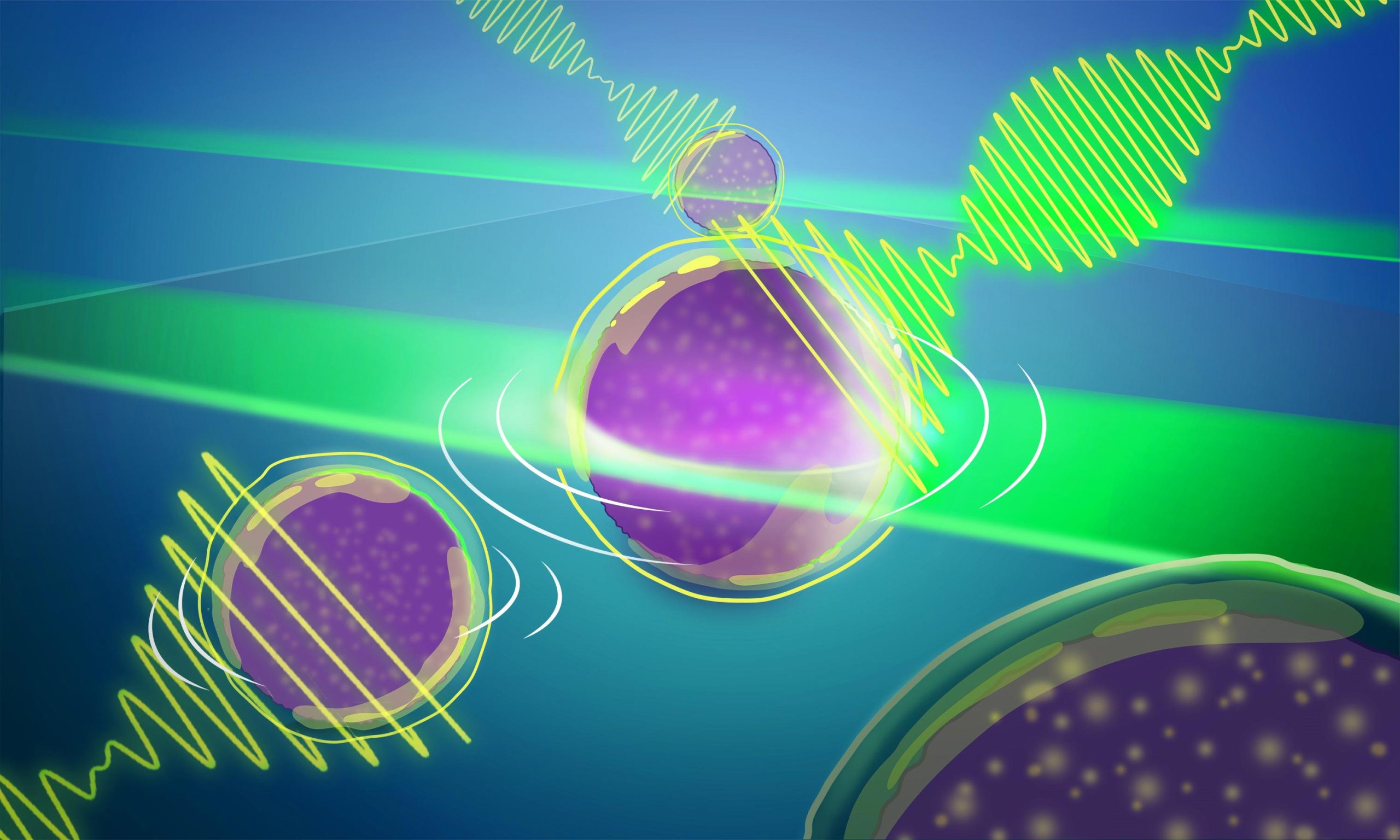
    New Brillouin Microscopy Approach
    An artist’s representation of the new Brillouin microscopy approach that allows entire light-sheets to interact with 3D biological samples. The scattered light reveals a unique optical interference signal that can be recorded with a custom-developed spectrometer, tremendously speeding up image acquisition. Credit: Daniela Velasco/EMBL

    A new EMBL innovation dramatically improves Brillouin microscopy, enabling faster, more efficient 3D imaging of light-sensitive samples.

    • EMBL scientists previously developed a microscope using Brillouin scattering, a technique that analyzes how light interacts with natural thermal vibrations to reveal a material’s mechanical properties.
    • In their latest advancement, the researchers have increased the speed and efficiency of Brillouin microscopy by approximately 1,000 times.
    • The upgraded technique now captures an entire 10,000-pixel plane—rather than a 100-pixel line—enabling rapid 3D imaging suitable for observing living organisms in real time.

    A 1,000-Fold Speed Boost for Brillouin Microscopy

    EMBL researchers have made a major breakthrough, introducing a novel methodology that enhances microscopy capabilities for life scientists. This advancement increases the speed and throughput of Brillouin microscopy by 1,000 times, enabling more efficient imaging of light-sensitive organisms.

    “We were on a quest to speed up image acquisition,” said Carlo Bevilacqua, lead author of the study published in Nature Photonics and an optical engineer in EMBL’s Prevedel Team. “Over the years, we have progressed from being able to see just a pixel at a time to a line of 100 pixels, to now a full plane that offers a view of approximately 10,000 pixels.”

    The Science Behind Brillouin Microscopy

    This technology is based on a phenomenon first predicted in 1922 by French physicist Léon Brillouin. He discovered that when light interacts with a material, it exchanges energy with natural thermal vibrations, slightly shifting its frequency (or color). By analyzing the scattered light spectrum, scientists can extract valuable information about a material’s physical properties.

    From Single Pixels to a Full 2D Field of View

    Using Brillouin scattering for microscopy purposes came much later – in the early 2000s – when other technological advancements enabled scientists to measure tiny frequency shifts with high precision and sufficient throughput. This allowed them to compute mechanical properties of living biological samples. However, at that point, scientists were only able to view one pixel at a time. The process was therefore quite time-consuming, and it severely limited how the microscopy method could be used in biology. In 2022, Bevilacqua and others in the Prevedel group were able to first expand the field of view to a line, and now with this latest development, to a full 2D field of view, which also helps speed up 3D imaging.

    A New Era for Mechanical Imaging

    “Just as the development of light-sheet microscopy here at EMBL marked a revolution in light microscopy because it allowed for faster, high-resolution, and minimally phototoxic imaging of biological samples, so too does this advance in the area of mechanical or Brillouin imaging,” said Robert Prevedel, Group Leader and senior author on the paper. “We hope this new technology – with minimal light intensity – opens one more ‘window’ for life scientists’ exploration.”

    Reference: “Full-field Brillouin microscopy based on an imaging Fourier-transform spectrometer” by Carlo Bevilacqua, and Robert Prevedel, 20 February 2025, Nature Photonics.
    DOI: 10.1038/s41566-025-01619-y

    Never miss a breakthrough: Join the SciTechDaily newsletter.
    Follow us on Google and Google News.

    EMBL Microscopy
    Share. Facebook Twitter Pinterest LinkedIn Email Reddit

    Related Articles

    Scientists Just Captured the Stunning Process That Shapes Chromosomes

    Microscopic Warfare: These Bacteria Deploy Tiny Spearguns To Fight Back

    Innovative Microscopy Tool Provides a New Way To See What Lies Between Cells

    Gut Bacteria Secretly Rewire the Brain – New Study Reveals How

    World’s First “Molecular Movie”: Witness DNA Becoming Life’s Blueprint in Real-Time

    12 New Weevil Species Discovered Across Japan, Malaysia, Vietnam, and Taiwan

    Hidden Vitamin B1 Deficiencies: How Common Drugs May Be Starving Your Brain

    How Cells Outsmart Starvation: Scientists Discover Intriguing New Mechanism

    Revolution in Microscopy: Witness Life Form in Real Time

    Leave A Reply Cancel Reply

    • Facebook
    • Twitter
    • Pinterest
    • YouTube

    Don't Miss a Discovery

    Subscribe for the Latest in Science & Tech!

    Trending News

    Why Popular Diabetes Drugs Like Ozempic Don’t Work for Everyone: The “Genetic Glitch”

    Scientists Stunned After Finding Plant Thought Extinct for 60 Years

    Scientists Discover Tiny New Spider That Hunts Prey 6x Its Size

    Natural Component From Licorice Shows Promise for Treating Inflammatory Bowel Disease

    Scientists Warn: Popular Sweetener Linked to Dangerous Metabolic Effects

    Monster Storms on Jupiter Unleash Lightning Beyond Anything on Earth

    Scientists Create “Liquid Gears” That Spin Without Touching

    The Simple Habit That Could Help Prevent Cancer

    Follow SciTechDaily
    • Facebook
    • Twitter
    • YouTube
    • Pinterest
    • Newsletter
    • RSS
    SciTech News
    • Biology News
    • Chemistry News
    • Earth News
    • Health News
    • Physics News
    • Science News
    • Space News
    • Technology News
    Recent Posts
    • Seeing the Invisible: Scientists Develop New Way To Track Particles in 3D
    • The Atomic Gap That Could Cost the Semiconductor Industry Billions
    • Earth’s Secret Advantage: Why Most Alien Worlds May Be Too Dry for Life
    • Ancient Bacteria Turned a DNA System Into a Cell Skeleton
    • Researchers Finally Solve 50-Year-Old Blood Group Mystery
    Copyright © 1998 - 2026 SciTechDaily. All Rights Reserved.
    • Science News
    • About
    • Contact
    • Editorial Board
    • Privacy Policy
    • Terms of Use

    Type above and press Enter to search. Press Esc to cancel.