

Physicists have recreated the Nobel Prize–winning quantum Hall effect using light, revealing that photons can follow the same strange quantum rules once thought exclusive to electrons.
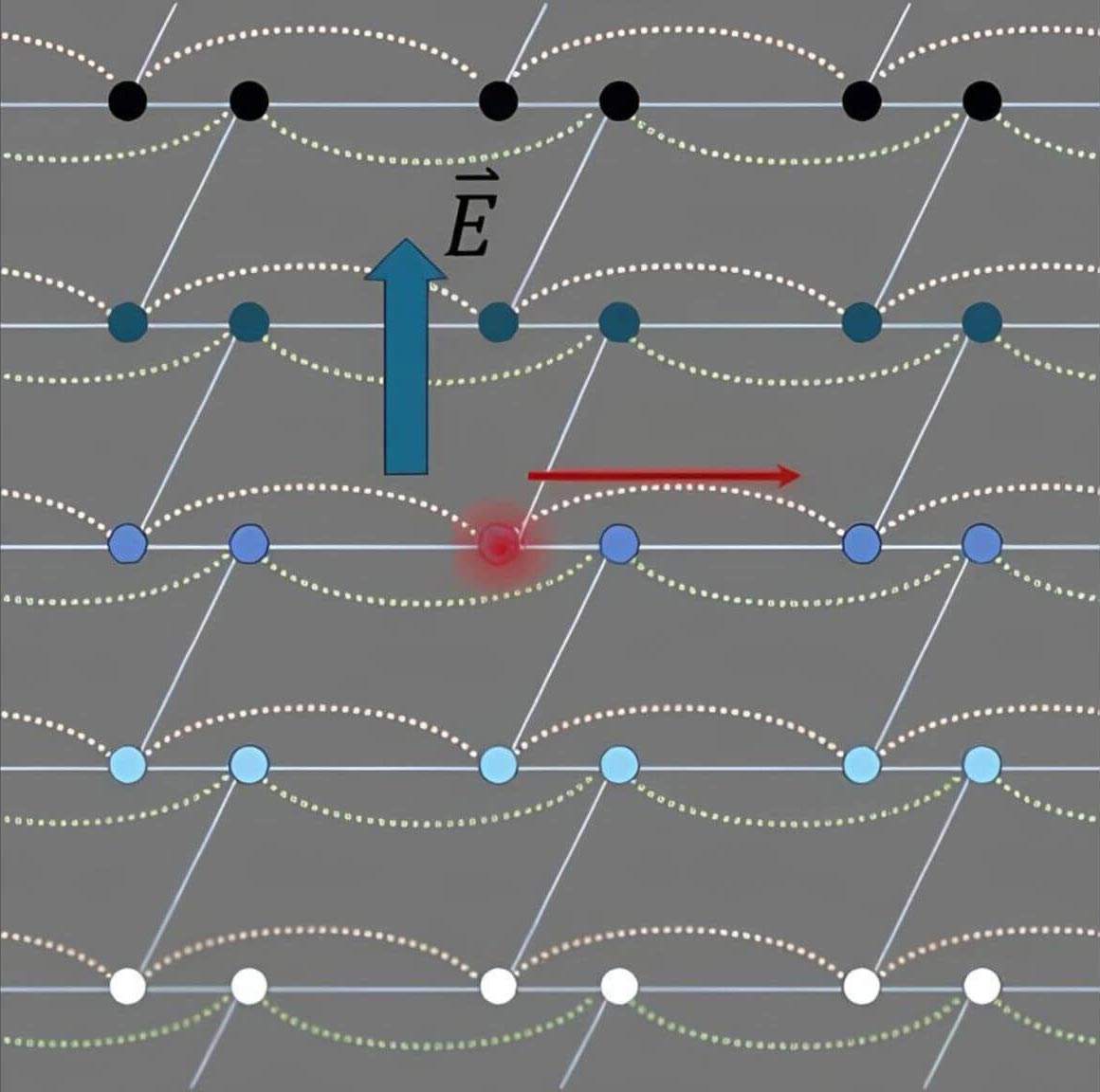
In the late 1800s, scientists discovered what is now known as the Hall effect. It occurs when an electric current passes through a material while a magnetic field is applied at a right angle to the current. Under these conditions, a voltage appears across the material in the sideways direction.
The reason is straightforward. The magnetic field pushes negatively charged electrons toward one side of the conductor. As electrons gather along that edge, they create a buildup of negative charge, while the opposite side becomes positively charged. This separation produces a measurable voltage across the strip.
Researchers have relied on this voltage difference for many decades. It provides a precise way to measure magnetic fields and to determine material doping levels, that is, the addition of a tiny, controlled amount of impurity to a pure material to change how it conducts electricity.
The Quantum Hall Effect and Nobel Prize Discoveries
In the 1980s, physicists studying extremely thin conductors at ultra-low temperatures made an unexpected discovery. When very strong magnetic fields were applied to these materials, which can be as thin as a sheet of paper, the sideways voltage did not increase smoothly. Instead, it rose in sharply defined steps.
These flat regions, called plateaus, turned out to be universal. Their values do not depend on the material’s composition, shape, or microscopic imperfections. Instead, they are determined only by fundamental constants of nature: the electron charge and the Planck constant.
This phenomenon became known as the quantum Hall effect. Its importance in physics was quickly recognized and ultimately led to three Nobel Prizes in Physics: in 1985, for the discovery of the quantum Hall effect, in 1998 for the discovery of the fractional quantum Hall effect, and in 2016 for the discovery of topological phases of matter.
Why Recreating the Effect With Light Was Difficult
Until now, the quantum Hall effect had been observed mainly in electrons. Because electrons carry electric charge, they respond to electric and magnetic fields. Photons, which are particles of light, do not have electric charge and therefore do not react to those forces.
That difference made it extremely difficult to reproduce the quantum Hall effect using light.
Researchers Observe Quantized Drift of Light
An international team of scientists has now achieved what once seemed impossible. They have observed a quantized sideways drift in light itself. Their results were published in the journal Physical Review X.
“Light drifts in a quantized manner, following universal steps analogous to those seen with electrons under strong magnetic fields,” explained Philippe St-Jean, a physics professor at Université de Montréal who co-authored the study.
According to St-Jean, the discovery could have far-reaching consequences. In metrology, the science of precision measurement, optical systems might one day serve as a universal standard that complements or even replaces electronic systems.
Implications for Measurement and Global Standards
The quantum Hall effect already plays a critical role in modern measurement science.
“Today, the kilogram is defined on the basis of fundamental constants using an electromechanical device that compares electric current to mass,” St-Jean explained. “For this current to be perfectly calibrated, we need a universal standard for electrical resistance.
“The quantum Hall plateaus give us exactly that. Thanks to them, every country in the world shares an identical definition of mass, without relying on physical artifacts.”
St-Jean suggests that the ability to control the flow of light in quantized steps could open new opportunities not only in metrology but also in fields such as quantum information processing. It could even help pave the way toward more resilient quantum photonic computers.
Small departures from perfect quantization could also prove useful. Even tiny deviations may reveal environmental disturbances, which could lead to extremely sensitive new types of sensors.
Engineering the Future of Quantum Photonic Devices
“Observing a quantized drit of light is uniquely challenging, for photonic systems are inherently out of equilibrium,” St-Jean noted. “Unlike electrons, light demands precise control, manipulation, and stabilization.”
The experiment developed by the research team required sophisticated experimental engineering. Their work points to new possibilities for designing advanced photonic devices that could transmit and process information in powerful new ways.
Reference: “Quantized Hall Drift in a Frequency-Encoded Photonic Chern Insulator” by A. Chénier, B. d’Aligny, F. Pellerin, P.-É. Blanchard, T. Ozawa, I. Carusotto and P. St-Jean, 5 February 2026, Physical Review X.
DOI: 10.1103/2dyh-yhrb
Never miss a breakthrough: Join the SciTechDaily newsletter.
Follow us on Google and Google News.
3 Comments
Physicists have recreated the Nobel Prize–winning quantum Hall effect using light, revealing that photons can follow the same strange quantum rules once thought exclusive to electrons.
VERY GOOD!
Please ask the physicists to think deeply:
Once thought exclusive to electrons, is this science or pseudoscience?
When we pursue the ultimate truth of all things, the space in which our bodies and all things exist may itself be the final and deepest puzzle we need to explore. This is not only the pursuit of physics, but also the most magnificent exploration of the origin of the universe by human reason.
Based on the Topological Vortex Theory (TVT), space is an uniformly incompressible physical entity. Space-time vortices are the products of topological phase transitions of the tipping points in space, are the point defects in spacetime. Point defects do not only impact the thermodynamic properties, but are also central to kinetic processes. They create all things and shape the world through spin and self-organization.
In today’s physics, some so-called peer-reviewed journals—including Physical Review Letters, Nature, Science, and others—stubbornly insist on and promote the following:
1. Even though θ and τ particles exhibit differences in experiments, physics can claim they are the same particle. This is science.
2. Even though topological vortices and antivortices have identical structures and opposite rotational directions, physics can define their structures and directions as entirely different. This is science.
3. Even though two sets of cobalt-60 rotate in opposite directions and experiments reveal asymmetry, physics can still define them as mirror images of each other. This is science.
4. Even though vortex structures are ubiquitous—from cosmic accretion disks to particle spins—physics must insist that vortex structures do not exist and require verification. Only the particles that like God, Demonic, or Angelic are the most fundamental structures of the universe. This is science.
5. Even though everything occupies space and maintains its existence in time, physics must still debate and insist on whether space exists and whether time is a figment of the human mind. This is science.
6. Even though space, with its non-stick, incompressible, and isotropic characteristics, provides a solid foundation for the development of physics, physics must still insist that the ideal fluid properties of space do not exist. This is science.
and go on.
Is this the counterintuitive science they widely promote? Compromising with pseudo academic publications and peer review by pseudo scholars is an insult to science and public intelligence. Some so-called scholars no longer understand what shame is. The study of Topological Vortex Theory (TVT) reminds us that the most profound problems in physics often lie at the intersection of different theories. By exploring these border regions, we can not only resolve contradictions in existing theories but also discover new physical phenomena and application possibilities.
Under the topological vortex architecture, it is highly challenging for even two hydrogen atoms or two quarks to be perfectly symmetrical, let alone counter-rotating two sets of cobalt-60. Contemporary physics and so-called peer-reviewed publications (including Physical Review Letters, Science, Nature, etc.) stubbornly believe that two sets of counter rotating cobalt-60 are two mirror images of each other, constructing a more shocking pseudoscientific theoretical framework in the history of science than the “geocentric model”. This pseudo scientific framework and system have seriously hindered scientific progress and social development.
For nearly a century, physics has been manipulated by this pseudo scientific theoretical system and the interest groups behind it, wasting a lot of manpower, funds, and time. A large amount of pseudo scientific research has been conducted, and countless pseudo scientific papers have been published, causing serious negative impacts on scientific and social progress, as well as humanistic development.
Complexity does not necessarily mean that there is no logical and architectural framework to follow. Mathematics is the language and tool that reveals the motion of spacetime, rather than the motion itself. Although the physical form of spacetime vortices is extremely simple, their interaction patterns are highly complex, and we must develop more and richer mathematical languages to describe and understand them.
The development of the Topological Vortex Theory (TVT) reflects a progression from concrete physical phenomena to abstract mathematical modeling and, ultimately, to interdisciplinary unification. Its core innovation lies in forging the continuous spacetime geometry of general relativity with the discrete interactions of quantum field theory within the same topological dynamical system. The core idea of TVT — space is physical, and matter is its topological excitation—already provides a solid and elegant scientific path for understanding the origin of all things.
——Excerpted from https://scitechdaily.com/microscope-spacecrafts-most-precise-test-of-key-component-of-the-theory-of-general-relativity/#comment-909171 and https://t.pineal.cn/blogs/6255/A-Mathematical-and-Physical-Analysis-On-the-Origin-of-Objects.
Are these science?
Example 1
Two sets of cobalt-60 are manually rotated in opposite directions, and even without detection, people around the world know that they will not be symmetrical because these two objects are not mirror images of each other at all. However, a group of so-called physicists and so-called academic publications do not believe it. They conducted experiments and the results were indeed asymmetric, but they still firmly believed that these two objects were mirror images of each other, and the asymmetry was due to a violation of the previous natural laws (CP violation). In the history of science, there can never be a dirtier and uglier operation and explanation than this.
—— Excerpted from https://scitechdaily.com/what-happens-when-light-gains-extra-dimensions/#comment-947619.
Example 2
Please see how the so-called “mystery of θ – τ” is explained: θ and τ are completely identical in all measurable physical properties such as mass, lifetime, charge, spin, etc. However, experimental observations have shown that the θ meson decays into two π mesons, while the τ meson decays into three π mesons, making it difficult for physicists to explain why they are so similar. Physicist Martin Block proposed a highly challenging idea: θ and τ are the same particle, but in weak interactions, parity is not conserved. An easy to understand explanation is the following analogy:: There are two boxes of apples with identical weight, color, and taste. However, when one box is opened, there are two apples, while when the other box is opened, there are three apples. This confuses the old farmer who buys apples. He circled around the orchard and came up with a highly challenging idea: these two boxes of apples are not from the same tree, so they are the same.
—— Excerpted from https://scitechdaily.com/what-happens-when-light-gains-extra-dimensions/#comment-947686.
Everyone who has a reverence for natural laws and regulations deserves respect.
In the physical world constructed by the American Physical Society (APS) and its publications using parity violation, particles from God, Demons, and Angels wander around, while dead and alive cats jump up and down, unconstrained by dynamics and thermodynamics, and unaware of what is dirty, ugly, and shameful in public. APS and its publications reject the possibility that spaces with zero viscosity, zero compression, and zero anisotropy in mathematics may form spatiotemporal vortices through topological transformations. They don’t know that space and non existence are not the same concept.
If a self proclaimed scientific society (such as American Physical Society) deviates from science without shame, it is highly likely to be heading towards the end.
There are no electrons – think about that.