
Close Menu
    Facebook X (Twitter) Instagram
    SciTechDaily
    • Biology
    • Chemistry
    • Earth
    • Health
    • Physics
    • Science
    • Space
    • Technology
    Facebook X (Twitter) Pinterest YouTube RSS
    SciTechDaily
    Home»Technology»Scientists Just Taught Light to Transmit Meaning – And It’s Revolutionizing Communications
    Technology

    Scientists Just Taught Light to Transmit Meaning – And It’s Revolutionizing Communications

    By Light Publishing Center, Changchun Institute of Optics, Fine Mechanics And Physics, CASMarch 11, 2025No Comments3 Mins Read
    Facebook Twitter Pinterest Telegram LinkedIn WhatsApp Email Reddit
    Share
    Facebook Twitter LinkedIn Pinterest Telegram Email Reddit
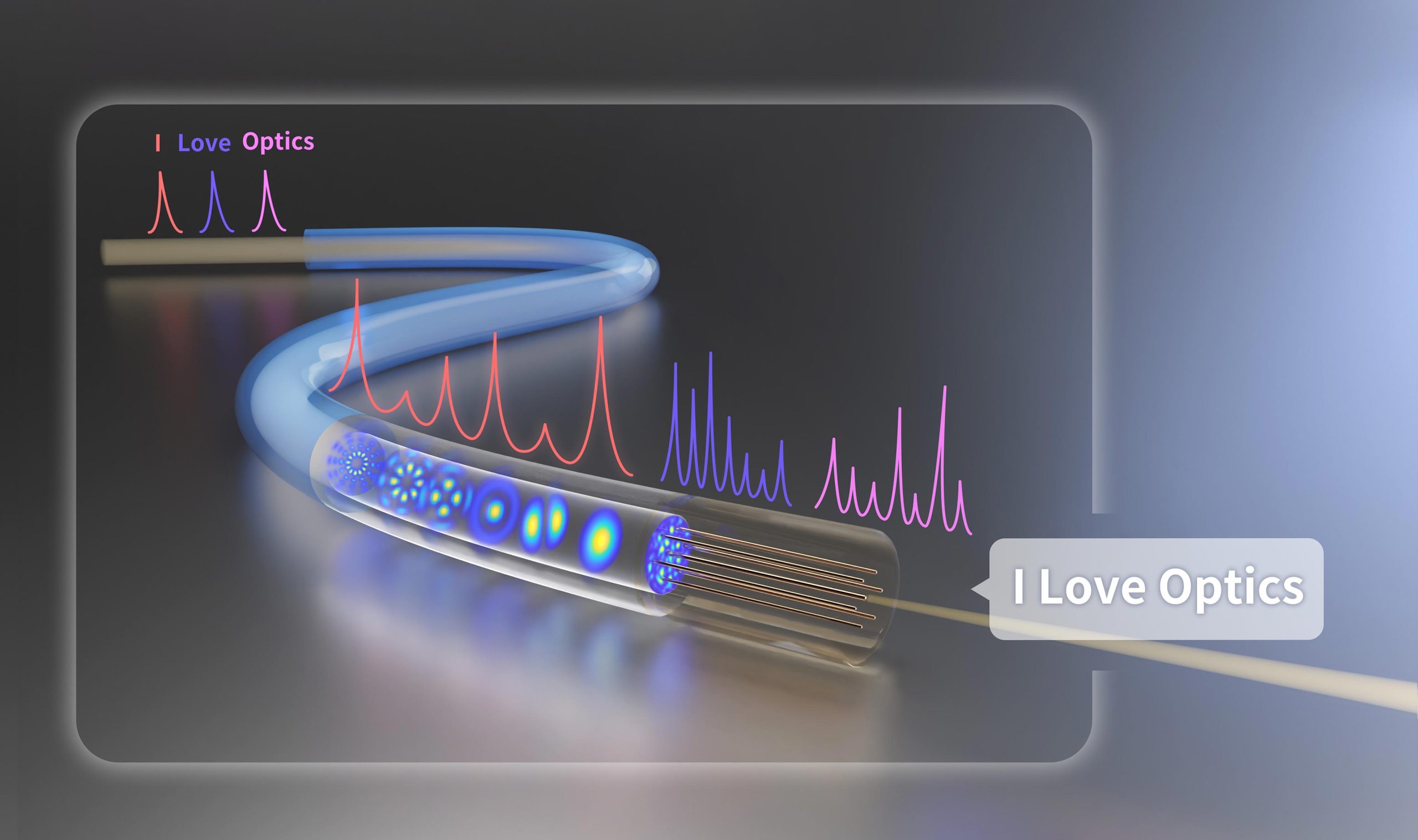
    Propagation of Light Pulses With Intermodal Dispersion in MMF
    Propagation of light pulses with intermodal dispersion in MMF. Words are mapped to different frequencies (different colors), the optical pulses are stretched into different temporal dispersion curves. This allows for the identification of the pulse frequencies at the receiver, thereby enabling the reconstruction of the input words. Credit: Gao, Z., Jiang, T., Zhang, M. et al.

    Scientists are revolutionizing optical communication with a cutting-edge semantic transmission system that vastly improves efficiency and robustness.

    By leveraging multimode fiber (MMF), this approach encodes information in frequencies rather than raw data, achieving a seven-fold boost in capacity over traditional methods. Not only does this technology enhance data transmission, but it also proves remarkably effective in sentiment analysis, allowing accurate interpretation even in noisy environments.

    The Challenge of Increasing Communication Demand

    The growing demand for faster and more efficient communication is pushing conventional systems to their limits. A promising solution is semantic communication, a technology that prioritizes transmitting meaningful information rather than raw data, making communication more efficient and resourceful.

    In a recent study published in Light: Science & Applications, a team of researchers from Huazhong University of Science and Technology, China, led by Professor Ming Tang and Dr. Hao Wu, along with doctoral students Zheng Gao and Ting Jiang, introduced an innovative optical semantic communication system. Their approach uses multimode fiber (MMF) to significantly boost data transmission capacity and reliability.

    Enhancing Data Transmission with High-Dimensional Encoding

    Describing their breakthrough, the scientists explain:

    “We achieved high-dimensional semantic encoding and decoding in the frequency domain through leveraging intermodal dispersion in MMFs. By mapping symbols to distinct frequencies, we demonstrated a seven-fold increase in transmission capacity compared to conventional communication encoding methods. The system also integrates PAM-4 to enhance spectral efficiency, achieving 9.12 bits/s/Hz without decoding errors.”
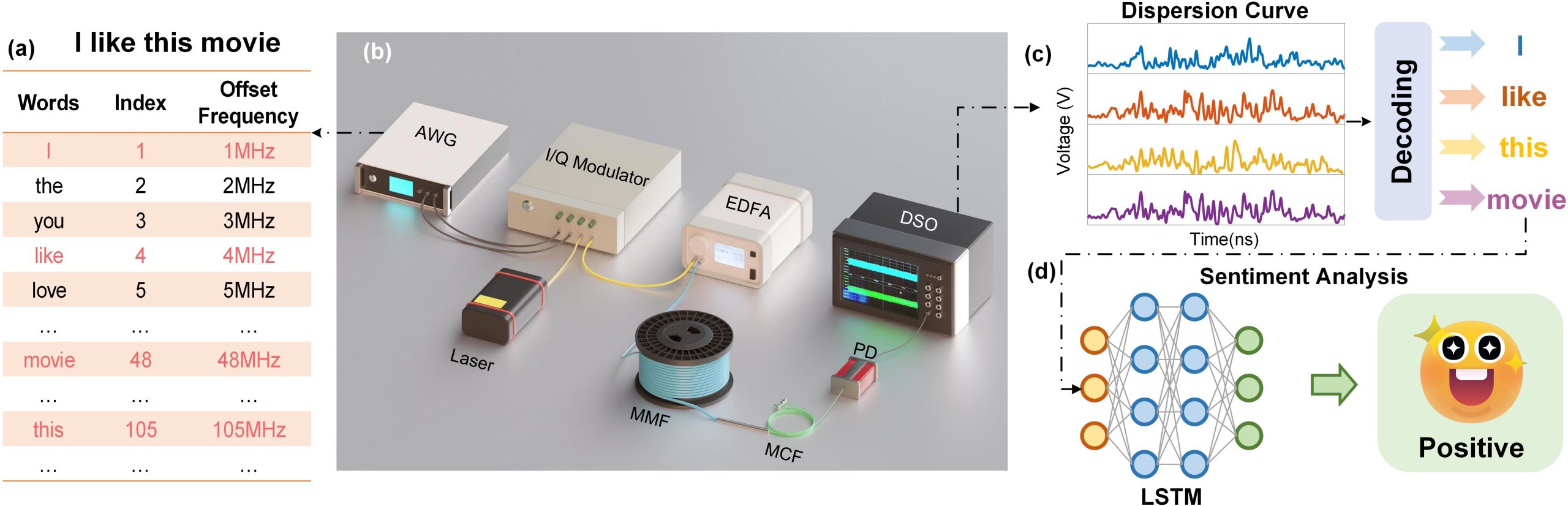
    Optical Semantic Communication Through Multimode Fiber Experimental System
    Experimental system. a, encoding: Each word is mapped to an optical frequency according to the encoding table. b, Schematic of the experimental setup. c, decoding: Recognize each dispersion curve as the corresponding frequency using the fingerprint dictionary, and then reconstruct the words based on the encoding table. d, implement sentiment analysis using a deep learning model. Credit: Gao, Z., Jiang, T., Zhang, M. et al.

    Boosting Noise Tolerance for Sentiment Analysis

    “Beyond improving transmission capacity, we explored the application in sentiment analysis using the IMDb movie review dataset. By encoding semantically similar symbols to adjacent frequencies, the system’s noise tolerance was effectively improved, facilitating accurate sentiment analysis even under high symbol error rate conditions. This approach highlights the potential of MMF-based semantic communication to enhance both capacity and robustness in optical communication systems, offering promising applications in bandwidth-constrained and noisy environments,” they added.

    The Future of Optical Semantic Communication

    “The innovative method of using MMFs for semantic communication presents a significant advancement in the field of optical communications. The capability to directly transmit semantic information via optical frequencies, along with the system’s high capacity and robustness, makes it a promising solution for future communication technologies,” the scientists forecast.

    Reference: “Optical semantic communication through multimode fiber: from symbol transmission to sentiment analysis” by Zheng Gao, Ting Jiang, Mingming Zhang, Hao Wu and Ming Tang, 23 January 2025, Light: Science & Applications.
    DOI: 10.1038/s41377-024-01726-5

    Never miss a breakthrough: Join the SciTechDaily newsletter.
    Follow us on Google and Google News.

    Chinese Academy of Sciences Fiber Optics Optics Telecommunications
    Share. Facebook Twitter Pinterest LinkedIn Email Reddit

    Related Articles

    Unmatched Data Capacity and Security With Revolutionary Vortex Beams

    See Only What You Should: UCLA’s Game-Changing Imaging Tech

    Next Generation Optical Fibers With 10,000 Times Lower Backscatter

    World’s First Transmission of 1 Petabit/S Using a Single-Core Multimode Optical Fiber

    New Hollow Optical Fiber Greatly Reduces Signal Noise

    Light, Fantastic: The Path Ahead for Faster, Nanoscale Photonic Computer Processors

    UC Engineers Break Distance Barriers for Fiber Optic Signals

    Enhanced Hollow-Core Fiber Features Performance-Enabling Properties

    New Fiber Optic Technology Could Boost Internet Bandwidth

    Leave A Reply Cancel Reply

    • Facebook
    • Twitter
    • Pinterest
    • YouTube

    Don't Miss a Discovery

    Subscribe for the Latest in Science & Tech!

    Trending News

    JWST Finds a “Star” 100 Billion Times Brighter Than Any Star Should Be

    Scientists Find a Hidden Biological Link Across Different Forms of Autism

    Astronomers Discover a Ghostly River of Stars That Could Reveal Dark Matter

    Why Is Colorectal Cancer Rising in People Under 50? New Clues Point to the Environment

    Quantum Fluctuations Break a Crystal’s Symmetry Rules

    Why Does an Irregular Heartbeat Strike 40 Years Early in Some People?

    Scientists Reveal How ADHD Could Fuel Creative Thinking

    Scientists Find Just 3 Minutes of Sprinting Can Transform Blood Chemistry

    Follow SciTechDaily
    • Facebook
    • Twitter
    • YouTube
    • Pinterest
    • Newsletter
    • RSS
    SciTech News
    • Biology News
    • Chemistry News
    • Earth News
    • Health News
    • Physics News
    • Science News
    • Space News
    • Technology News
    Recent Posts
    • Common Plant Chemical Linked to Widespread Organ Damage in Aquatic Animals
    • Scientists Discover a Hidden Baobab Species in Madagascar
    • Dogs and Humans May Share a Surprising Biological Secret to Longevity
    • A 150-Million-Year-Old Dinosaur Flight Mystery May Finally Have an Answer
    • Giant Crocodylians Ruled South America’s Ancient Food Chain
    Copyright © 1998 - 2026 SciTechDaily. All Rights Reserved.
    • Science News
    • About
    • Contact
    • Editorial Board
    • Privacy Policy
    • Terms of Use

    Type above and press Enter to search. Press Esc to cancel.