
Close Menu
    Facebook X (Twitter) Instagram
    SciTechDaily
    • Biology
    • Chemistry
    • Earth
    • Health
    • Physics
    • Science
    • Space
    • Technology
    Facebook X (Twitter) Pinterest YouTube RSS
    SciTechDaily
    Home»Biology»Scientists Link Bipolar Disorder to Mitochondrial Disease
    Biology

    Scientists Link Bipolar Disorder to Mitochondrial Disease

    By Adam Phillips, RIKENJune 11, 2018No Comments3 Mins Read
    Facebook Twitter Pinterest Telegram LinkedIn WhatsApp Email Reddit
    Share
    Facebook Twitter LinkedIn Pinterest Telegram Email Reddit
    Mutation Links Bipolar Disorder to Mitochondrial Disease
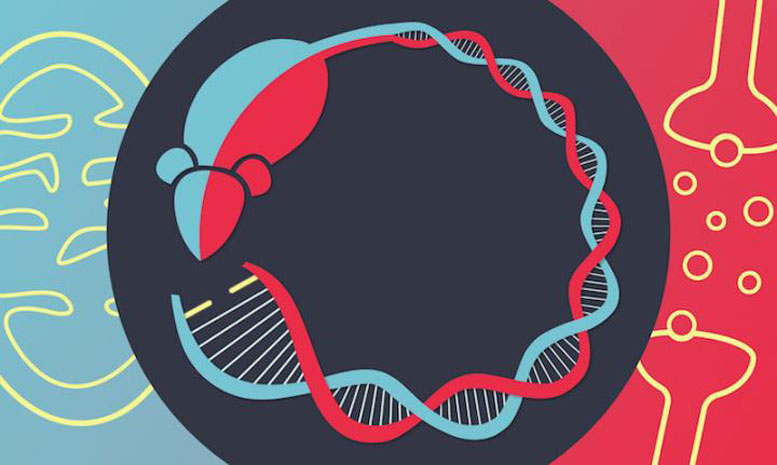
    This is an abstract rendition of the paper’s themes. Mutations in the gene ANT1 may confer a risk for bipolar disorder through a complex interplay between serotonin and mitochondrial signaling in the brain. Milena Menezes Carvalho/RIKEN National Science Institute

    Mutations in the gene ANT1 may confer a risk for bipolar disorder through a complex interplay between serotonin and mitochondrial signaling in the brain. These two pathways have been separately implicated in bipolar disorder, but the link between levels of the neurotransmitter serotonin and mitochondrial dysfunction had not been established. Researchers at the RIKEN Center for Brain Science (CBS) in Japan now report that mitochondrial dysfunction affects the activity of serotonergic neurons in mice with mutations of ANT1.

    Mitochondria are the vital organelles that deliver energy to all cells and mitochondrial damage has been found, for example, in brain imaging of bipolar patients and in post-mortem brains. Roughly 20% of patients with mitochondrial disease also have bipolar disorder, a major psychiatric disease characterized by manic and depressive episodes. Altered serotonin functioning, on the other hand, seems to be involved in bipolar disorder because drugs that target serotonin levels can effectively treat the condition. “Our study suggests that mitochondrial dysfunction can alter activity of serotonergic neurons in bipolar disorder, and this is the first time these two lines of evidence have been linked,” says Tadafumi Kato, research group leader at CBS. The research was published on June 8 in the journal Molecular Psychiatry.
    Bipolar Disorder Linked to Mitochondrial Disease
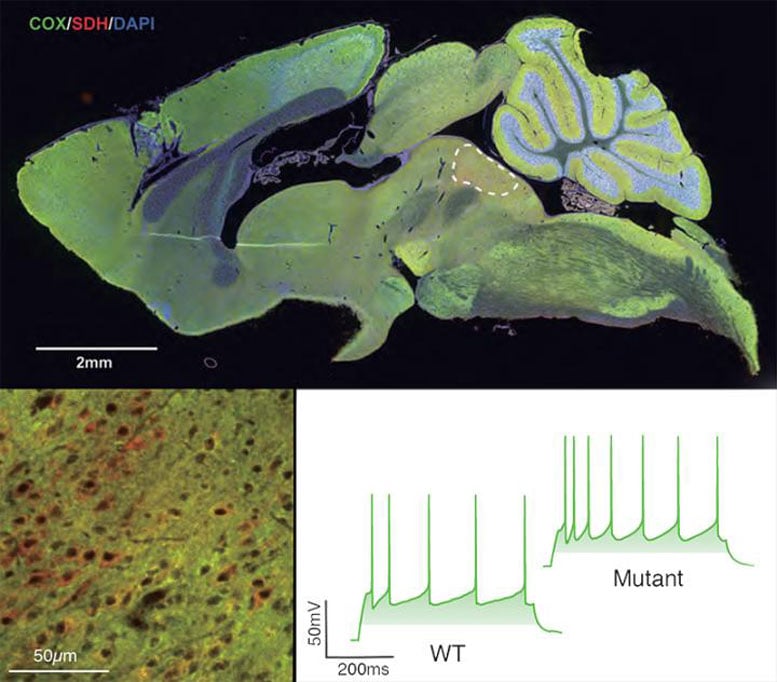
    This is immunohistochemical and electrophysiological analysis. (top) whole mouse brain, the dotted region is the dorsal raphe where COX-negative cells were more numerous in the mutants. (bottom left). Close-up of the dorsal raphe. COX-negative cells are red. (bottom right) Electrophysiological analysis showed that serotonergic neurons in the mutant dorsal raphe were more excitable than in wild-type mice. RIKEN National Science Institute

    The study started by identifying ANT1 mutations in patients with bipolar disorder. Kato and colleagues then looked at mice lacking the ANT1 gene in the brain only. Compared with non-mutant mice, the mitochondria in these knockout mice could not retain calcium and had leakier pores. The ANT1-mutant mice also showed lower impulsivity in behavior tests, and consistent with this, their brains showed elevated serotonin turnover. This hyper-serotonergic state is likely a result of a cascade of changes that starts with the loss of the ANT1 gene and the resulting dysfunctional mitochondria. Enhanced serotonergic activity may then further impair mitochondria in a vicious cycle.

    Serotonergic neurons were found to deteriorate in a brain area called the dorsal raphe, which is a region also affected in Parkinson’s disease–another condition that may have its roots in mitochondrial dysfunction. The ANT1 mutation does not cause bipolar disorder, says Kato, but is associated with elevated risk. The implication of this research is that emerging therapies for the underlying mitochondrial dysfunction could one day treat bipolar disorder more successfully than today’s variable serotonin-targeting drugs.

    Reference: “Ant1 mutant mice bridge the mitochondrial and serotonergic dysfunctions in bipolar disorder,” by Tomoaki M. Kato, Mie Kubota-Sakashita, Noriko Fujimori-Tonou, Fumihito Saitow, Satoshi Fuke, Akira Masuda, Shigeyoshi Itohara, Hidenori Suzuki and Tadafumi Kato, 11 June 2018, Molecular Psychiatry.
    DOI: 10.1038/s41380-018-0074-9

    Never miss a breakthrough: Join the SciTechDaily newsletter.
    Follow us on Google and Google News.

    Bipolar Disorder Mitochondria RIKEN
    Share. Facebook Twitter Pinterest LinkedIn Email Reddit

    Related Articles

    Meet the Microbes That Breathe Nitrate Instead of Oxygen – And They’re Everywhere

    How NAD Keeps Your Cells Energized and Slows Down Aging

    The Hidden Heroes of Your Cells: How Mitochondria Balance Energy and Survival

    Scientists Unearth Ancient Protein That Could Rewrite Evolution

    Can Life Be Engineered? Biochemists Take Key Steps Toward Synthetic Lifeforms

    Defective Mitochondria: New Research Uncovers Hidden Cause of Crohn’s Disease

    New Research Explains Why You Inherit Your Mom’s Energy

    Early Embryo DNA Replication Defies Expectations

    Deciphering Aging: New Lipid Research Reveals Secrets of Longevity and Chronic Diseases

    Leave A Reply Cancel Reply

    • Facebook
    • Twitter
    • Pinterest
    • YouTube

    Don't Miss a Discovery

    Subscribe for the Latest in Science & Tech!

    Trending News

    Scientists Recreate a Nuclear Fireball and Uncover Fallout’s Hidden Chemistry

    These Tiny Gut Particles Could Be Accelerating Aging Throughout the Body

    Doctors Changed One Thing and Weight Gain Stopped

    Magnetic Fields May Solve a Longstanding Binary Star Mystery

    The Probiotic Breakthrough for Natural Anxiety Relief and Better Mental Health

    Animal vs. Plant Protein: Scientists Found a Surprising Nutritional Difference

    According to Scientists, This Simple Dietary Change Is Linked to Lower Depression Scores

    Researchers Discover a Hidden Vitamin D Problem That Persists Year-Round

    Follow SciTechDaily
    • Facebook
    • Twitter
    • YouTube
    • Pinterest
    • Newsletter
    • RSS
    SciTech News
    • Biology News
    • Chemistry News
    • Earth News
    • Health News
    • Physics News
    • Science News
    • Space News
    • Technology News
    Recent Posts
    • Scientists Uncover Why Walking Gets Slower and More Exhausting As We Age
    • 24 Hours Without Sleep Changes Your Saliva in Measurable Ways
    • A Major Update Just Hit Cholesterol Guidelines – Here’s What Every Adult Needs To Know
    • Scientists Tracked 4,500 Animals During COVID – What They Discovered Was Surprising
    • Hidden Phase of Matter Finally Captured After Decades of Predictions
    Copyright © 1998 - 2026 SciTechDaily. All Rights Reserved.
    • Science News
    • About
    • Contact
    • Editorial Board
    • Privacy Policy
    • Terms of Use

    Type above and press Enter to search. Press Esc to cancel.