
Close Menu
    Facebook X (Twitter) Instagram
    SciTechDaily
    • Biology
    • Chemistry
    • Earth
    • Health
    • Physics
    • Science
    • Space
    • Technology
    Facebook X (Twitter) Pinterest YouTube RSS
    SciTechDaily
    Home»Space»Scientists Observe the Magnetic Field Remains of Supernova 1987A
    Space

    Scientists Observe the Magnetic Field Remains of Supernova 1987A

    By Chris Sasaki, Dunlap Institute for Astronomy & AstrophysicsJune 29, 2018No Comments4 Mins Read
    Facebook Twitter Pinterest Telegram LinkedIn WhatsApp Email Reddit
    Share
    Facebook Twitter LinkedIn Pinterest Telegram Email Reddit
    Astronomers Observe the Magnetic Field of Supernova 1987A
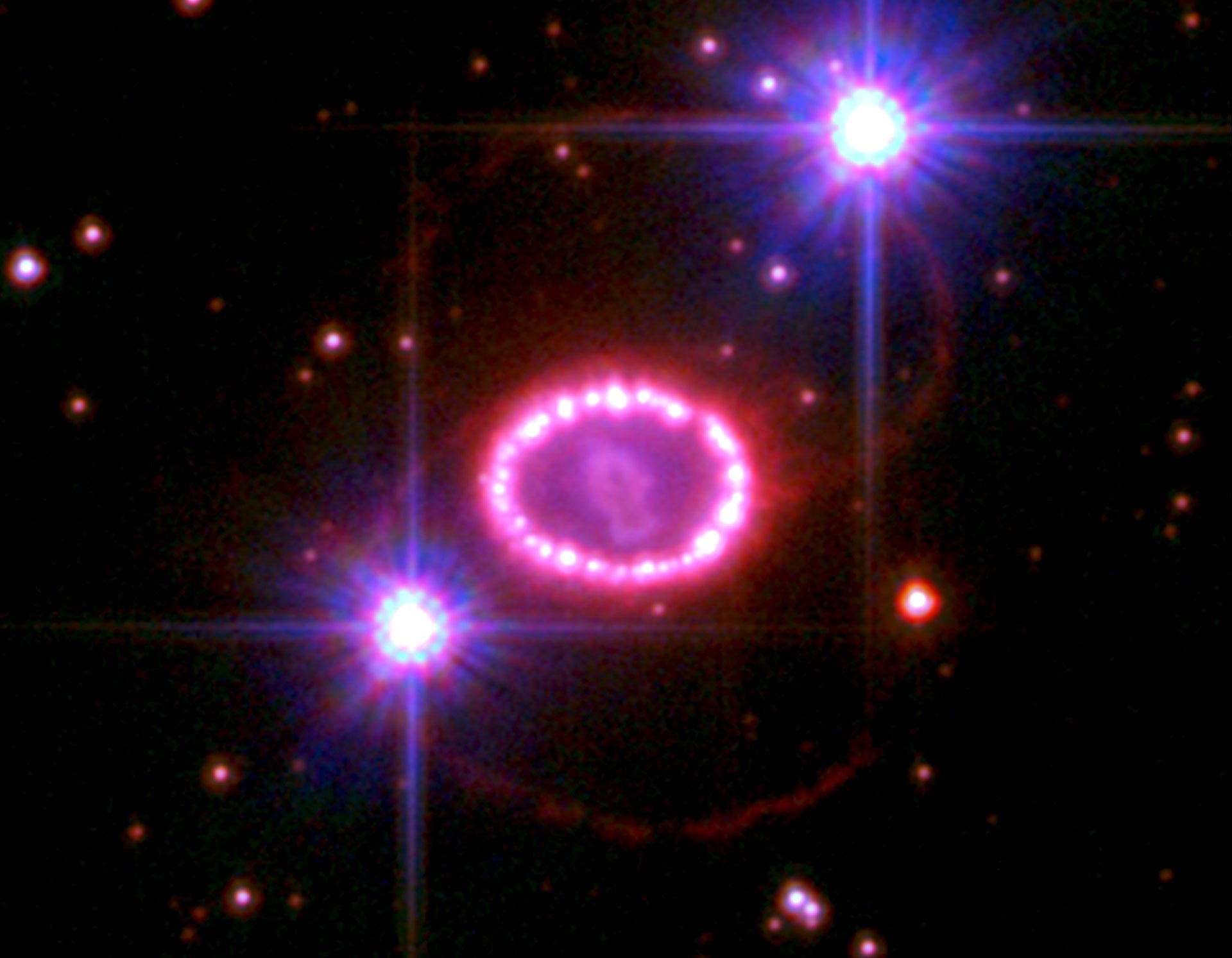
    This Hubble Space Telescope image of the remnant of Supernova 1987A shows a bright inner ring glowing as it interacts with material from the supernova blast. The ring is approximately one light-year in diameter. It is not clear what is causing the two larger, fainter rings. The two bright objects are stars in the Large Magellanic Cloud. The image was taken in 2010. Credit: NASA, ESA, R. Kirshner and P. Challis (Harvard-Smithsonian Center for Astrophysics)

    For the first time, astronomers have directly observed the magnetism in one of astronomy’s most studied objects: the remains of Supernova 1987A (SN 1987A), a dying star that appeared in our skies over thirty years ago.

    In addition to being an impressive observational achievement, the detection provides insight into the early stages of the evolution of supernova remnants and the cosmic magnetism within them.

    “The magnetism we’ve detected is around 50,000 times weaker than a fridge magnet,” says Prof. Bryan Gaensler. “And we’ve been able to measure this from a distance of around 1.6 million trillion kilometers.”

    “This is the earliest possible detection of the magnetic field formed after the explosion of a massive star,” says Dr. Giovanna Zanardo.
    Detection Of Linear Polarization In The Radio Remnant Of Supernova 1987a
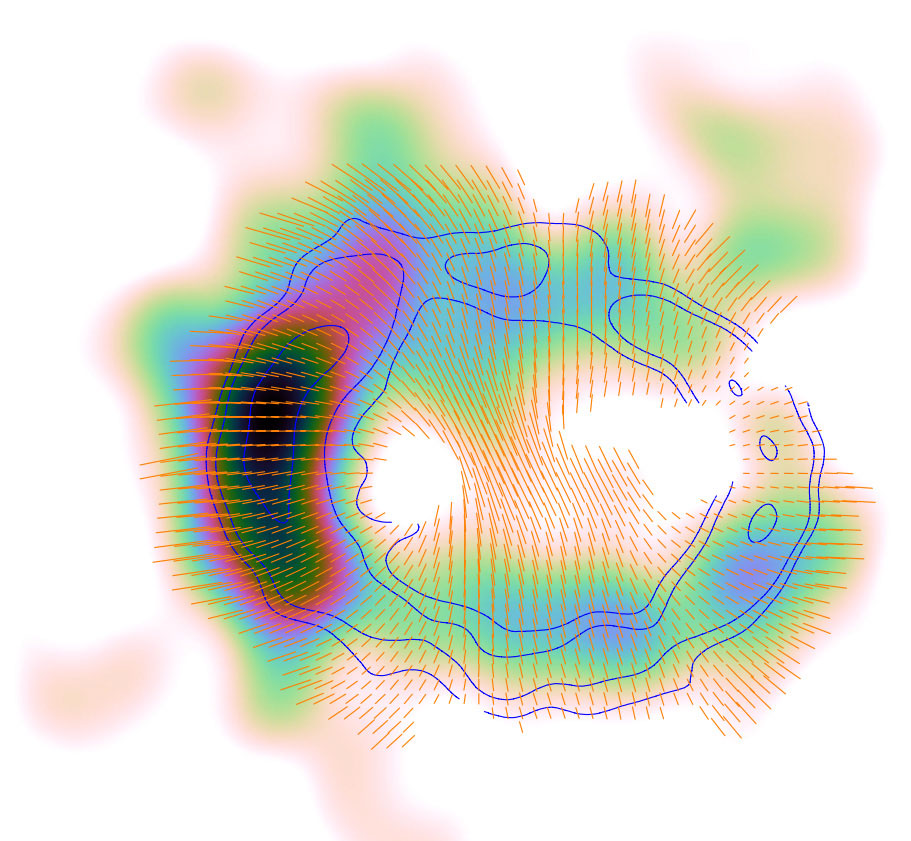
    A map of the SN 1987A remnant with short orange lines showing the orientation of the magnetic field. Credit: Giovanna Zanardo

    Gaensler is Director of the Dunlap Institute for Astronomy & Astrophysics at the University of Toronto, and a co-author on the paper announcing the discovery being published in the Astrophysical Journal Letters on June 29th. The lead author, Zanardo, and co-author Prof. Lister Staveley-Smith are both from the University of Western Australia’s node of the International Center for Radio Astronomy Research.

    SN 1987A was co-discovered by University of Toronto astronomer Ian Shelton in February 1987 from the then Southern Observatory of the University of Toronto in northern Chile. It is located in the Large Magellanic Cloud, a dwarf galaxy companion to the Milky Way Galaxy, at a distance of 168,000 light-years from Earth. It was the first naked-eye supernova to be observed since the astronomer Johannes Kepler witnessed a supernova over 400 years ago.

    In the thirty years since the supernova occurred, material expelled by the blast, as well as the shockwave from the star’s death throes, have been traveling outward through the gas and dust that surrounded the star before it exploded. Today, when we look at the remnant, we see rings of material set aglow by the supernova’s expanding debris and shockwave.

    Using the CSIRO Australia Telescope Compact Array at the Paul Wild Observatory, Gaensler and his colleagues observed the magnetic field by studying the radiation coming from the object. By analyzing the properties of this radiation, they were able to trace the magnetic field.

    “The picture shows what it would look like if you could sprinkle iron filings over the expanding cloud of debris, 170 thousand light years away,” says Gaensler.

    What they found was that the remnant’s magnetic field was not chaotic but already showed a degree of order. Astronomers have known that as supernova remnants get older, their magnetic fields are stretched and aligned into ordered patterns. So, the team’s observation showed that a supernova remnant can bring order to a magnetic field in a relatively short period of thirty years.

    The magnetic field lines of the Earth run north and south, causing a compass to point to the Earth’s poles. By comparison, the magnetic field lines associated with SN 1987A are like the spokes of a bicycle wheel aligned from the center out.

    “At such a young age,” says Zanardo, “everything in the stellar remnant is moving incredibly fast and changing rapidly, but the magnetic field looks nicely combed out all the way to the edge of the shell.”

    Gaensler and his colleagues will continue to observe the constantly evolving remnant. “As it continues to expand and evolve,” says Gaensler, “we will be watching the shape of the magnetic field to see how it changes as the shock wave and debris cloud run into new material.”

    Reference: “Detection of Linear Polarization in the Radio Remnant of Supernova 1987A” by Giovanna Zanardo, Lister Staveley-Smith, B. M. Gaensler, Remy Indebetouw, C.-Y. Ng, Mikako Matsuura and A. K. Tzioumis, 29 June 2018, The Astrophysical Journal Letters.
    DOI: 10.3847/2041-8213/aacc2a

    Never miss a breakthrough: Join the SciTechDaily newsletter.
    Follow us on Google and Google News.

    Astronomy Astrophysics Cosmology Dunlap Institute for Astronomy & Astrophysics Supernova
    Share. Facebook Twitter Pinterest LinkedIn Email Reddit

    Related Articles

    Five-Time Supernova Discovery May Solve a Century-Old Cosmic Mystery

    James Webb Telescope Spots the Most Distant Supernova Ever Seen

    Twin Supernovae Open Up New Possibilities for Precision Cosmology

    New Findings Will Help Light the Way to Understanding Dark Energy

    Astronomers Search for Trigger of Nearby Supernova

    New ScienceCasts Video: Evidence for Supernovas Near Earth

    Dark Energy Survey Reveals a Rare Superluminous Supernova

    12 Billion-Year Old Supernova Discovered by Astronomers

    Links Between Core Collapse Supernovae and Star Formation Established

    Leave A Reply Cancel Reply

    • Facebook
    • Twitter
    • Pinterest
    • YouTube

    Don't Miss a Discovery

    Subscribe for the Latest in Science & Tech!

    Trending News

    The Universe Is Expanding Too Fast and Scientists Can’t Explain Why

    “Like Liquid Metal”: Scientists Create Strange Shape-Shifting Material

    Early Warning Signals of Esophageal Cancer May Be Hiding in Plain Sight

    Common Blood Pressure Drug Shows Surprising Power Against Deadly Antibiotic-Resistant Superbug

    Scientists Uncover Dangerous Connection Between Serotonin and Heart Valve Disease

    Scientists Discover a “Protector” Protein That Could Help Reverse Hair Loss

    Bone-Strengthening Discovery Could Reverse Osteoporosis

    Scientists Uncover Hidden Trigger Behind Stem Cell Aging

    Follow SciTechDaily
    • Facebook
    • Twitter
    • YouTube
    • Pinterest
    • Newsletter
    • RSS
    SciTech News
    • Biology News
    • Chemistry News
    • Earth News
    • Health News
    • Physics News
    • Science News
    • Space News
    • Technology News
    Recent Posts
    • Quantum Physics’ Strangest Problem May Hold the Key to Time Itself
    • Scientists Create “Liquid Gears” That Spin Without Touching
    • The Simple Habit That Could Help Prevent Cancer
    • Forgotten Medicinal Plant Shows Promise in Fighting Dangerous Superbugs
    • Millions Take These IBS Drugs, But a New Study Finds Serious Risks
    Copyright © 1998 - 2026 SciTechDaily. All Rights Reserved.
    • Science News
    • About
    • Contact
    • Editorial Board
    • Privacy Policy
    • Terms of Use

    Type above and press Enter to search. Press Esc to cancel.