
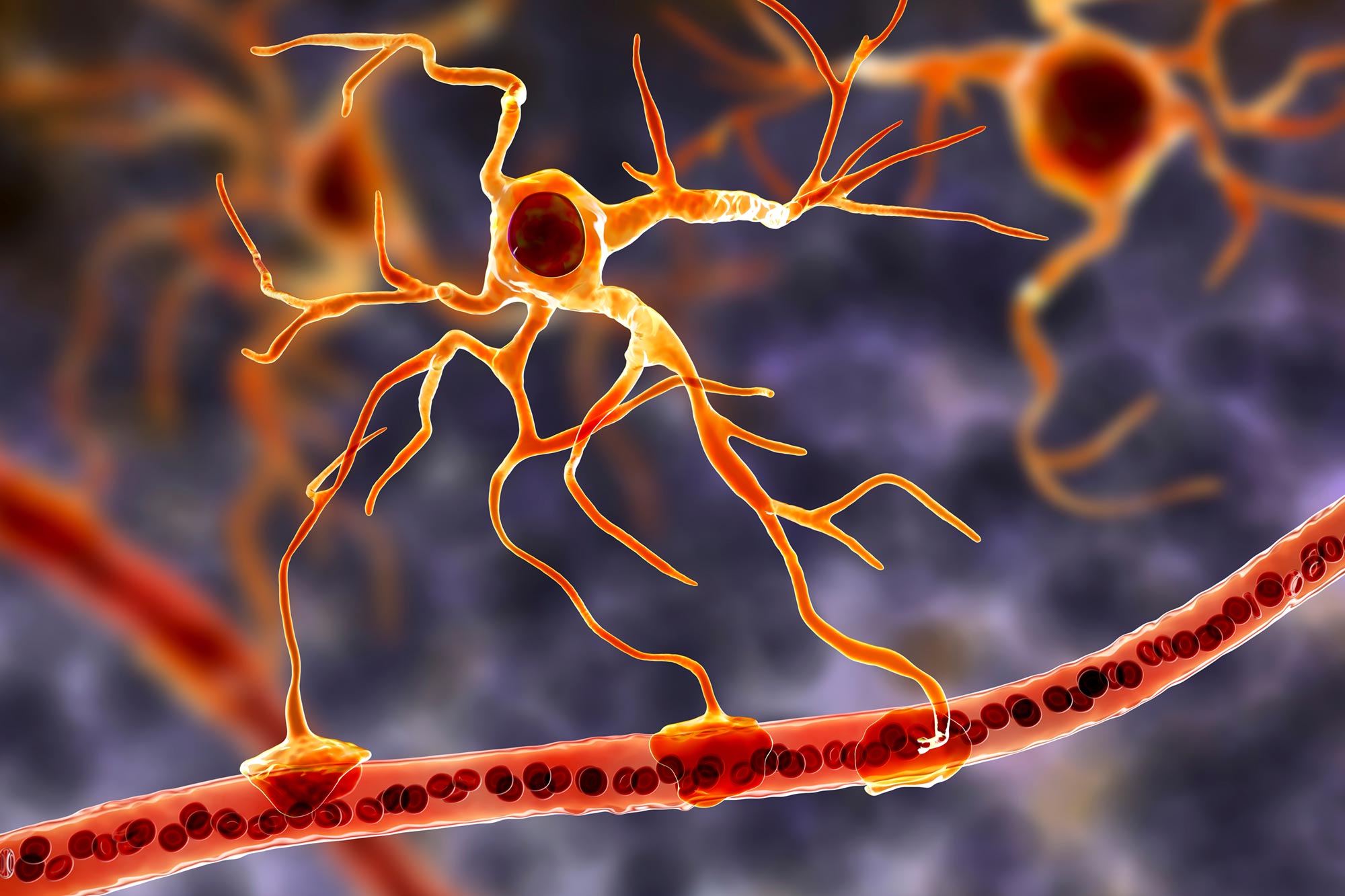
A new study reveals that astrocytes, once dismissed as mere support cells, play a central role in fear memory.
Imagine a star-shaped brain cell extending delicate branches that wrap around nearby neurons. This cell is called an astrocyte. For many years, scientists believed astrocytes mainly served as caretakers, helping hold neural networks together and supporting the connections that allow brain cells to communicate.
New research now challenges that long-standing view. A recent study reports that these widely distributed support cells play a role just as critical as neurons when it comes to forming and regulating fear memories.
“Astrocytes are interwoven among neurons in the brain, and it seemed unlikely they were there just for housekeeping. We wanted to understand what they’re actually doing – and how they’re shaping neural activity in the process,” said Lindsay Halladay, assistant professor at the University of Arizona Department of Neuroscience and one of the study’s senior authors.
Halladay’s laboratory partnered with researchers at the National Institutes of Health on the multi-institutional project, which was led by Andrew Holmes and Olena Bukalo of the Laboratory of Behavioral and Genomic Neuroscience.
The findings, published in Nature, focus on astrocytes located in the amygdala, a region often described as the brain’s fear center. The researchers found that these cells help the brain learn which experiences are threatening, assist in recalling those memories, and play an important role in extinguishing fear when it is no longer appropriate. The results challenge traditional ideas about how fear memories are stored and suggest new directions for treating conditions such as post-traumatic stress disorder.
“For the first time, we found that astrocytes encode and maintain neural fear signaling,” Halladay said.
Watching Fear Form in Real Time
To explore how fear learning unfolds, the team used a mouse model to study how fear memories form, how they are retrieved, and how neurons and astrocytes each contribute to the process.
With the help of fluorescent activity sensors, the researchers tracked astrocyte responses in real time during the creation and recall of fear memories. Astrocyte activity rose as memories were formed and retrieved, then declined as those memories were extinguished.
The scientists then adjusted the signals astrocytes send to nearby neurons. When they boosted or reduced those signals, the strength of fear memories changed in step. This showed that astrocytes are not merely supporting actors but directly influence how fear is encoded and expressed.
Altering astrocyte function also reshaped broader neural activity. When astrocyte signaling was disrupted, neurons were unable to generate typical fear-related patterns of activity. As a result, they struggled to pass along information about appropriate defensive responses to other brain regions that coordinate behavior. These results push back against neuron-centered models of fear by demonstrating that neurons alone do not account for how fear memories are produced.
The effects were not limited to the amygdala. Interfering with astrocytes also changed how fear-related signals traveled to the prefrontal cortex, a region essential for decision making. This indicates that astrocytes influence not only how fear memories are encoded in the amygdala, but also how those memories guide responses in complex situations.
Implications for Anxiety and PTSD
Halladay said that recognizing the role of astrocytes in retrieving fear memories could reshape treatments for disorders marked by persistent fear, including post-traumatic stress disorder, anxiety disorders, and phobias. If astrocytes help control whether fear memories are expressed or successfully extinguished, then therapies aimed at astrocyte-related pathways may one day complement approaches that focus primarily on neurons.
Her next step is to investigate astrocyte activity throughout the broader fear network in the brain. The amygdala works in coordination with other regions. The prefrontal cortex contributes to decision-making during threatening situations, while deeper structures such as the periaqueductal gray in the midbrain, carry out defensive actions like freezing or fleeing. Although the precise role of astrocytes in these areas remains uncertain, Halladay believes there is a strong possibility that they also shape neural function there.
“Understanding that larger circuit could help answer a simple question of why someone with an anxiety disorder might exhibit inappropriate fear responses to something that isn’t actually dangerous,” Halladay said.
Reference: “Astrocytes enable amygdala neural representations supporting memory” by Olena Bukalo, Ruairi O’Sullivan, Yuta Tanisumi, Adriana Mendez, Chase Weinholtz, Sydney Zimmerman, Victoria Offenberg, Olivia Carpenter, Hrishikesh Bhagwat, Sophie Mosley, John J. O’Malley, Kerri Lyons, Yulan Fang, Jess Goldschlager, Linnaea E. Ostroff, Mario A. Penzo, Hiroaki Wake, Lindsay R. Halladay and Andrew Holmes, 11 February 2026, Nature.
DOI: 10.1038/s41586-025-10068-0
Never miss a breakthrough: Join the SciTechDaily newsletter.
Follow us on Google and Google News.
5 Comments
Thanks for sharing such interesting biology about fear. Hopefully interactions are not conditioned into overpowering habits of fear (where it doesn’t belong), and the apparent competition for attention doesn’t t/d-ramatize the mundane. Thriving often seems to be a collection of ‘boring habits’ and not a constant need for conflict. Although a good challenge seems occasionally necessary in order to invite the spirit of life back to where it may have been excluded.
Any medicine ,I have memory loss &fear
Any medicine ,I have memory loss &fear
What is it
Subject: Comment on the Need for Expanded Research into Chronic Anxiety and Hyperarousal
Dear Researchers and Contributors,
I recently read the article on your website discussing current research findings related to bipolar disorder, depression, and schizophrenia. I appreciate the important work being conducted in these areas and the dedication of clinicians and researchers working to improve treatment outcomes for patients with severe psychiatric illnesses.
However, I would like to respectfully raise an important concern regarding the relative lack of emphasis on anxiety disorders—particularly chronic anxiety and persistent hyperarousal states.
Anxiety disorders are among the most common and disabling mental health conditions worldwide. While they may not always involve psychosis or hospitalization, they can profoundly affect daily functioning, cognitive performance, physical health, and quality of life. For individuals who experience long-term hyperarousal, the condition can persist for decades and can influence many aspects of the nervous system, including sleep, muscle tension, autonomic regulation, and stress response.
From a patient perspective, it sometimes feels as though anxiety disorders receive less research attention than other psychiatric conditions, despite the fact that they affect an extremely large portion of the population. Many available medications for anxiety were originally developed for other conditions, and treatment responses vary widely among patients.
Chronic hyperarousal states may be particularly very difficult to treat because they involve multiple interacting systems:
• the brain’s threat-detection circuits
• autonomic nervous system regulation
• long-term stress conditioning
• learning and behavioral patterns
• sleep and physiological stress recovery mechanisms.
When hyperarousal becomes deeply ingrained over many years, it may no longer resemble episodic anxiety. Instead, the nervous system may remain in a persistent “high-alert” mode that is very difficult to recalibrate through standard treatments.
For this reason, I believe there is an important opportunity for continued research focused specifically on:
• chronic hyperarousal mechanisms
• autonomic nervous system regulation
• new pharmacological targets for persistent anxiety states
• long-term neuroplasticity approaches to recalibrating threat perception.
Expanding scientific attention in these areas could greatly improve treatment options for the many individuals who live with chronic anxiety conditions that are not always well addressed by current therapies and medications.
I appreciate the work your institute is doing and hope that future research initiatives will continue to explore the very complex biology of anxiety disorders and hyperarousal states with the same level of attention given to other psychiatric conditions.
Thank you for your time and for your ongoing contributions to neurological and psychiatric research.
Respectfully,
James L. Washington