
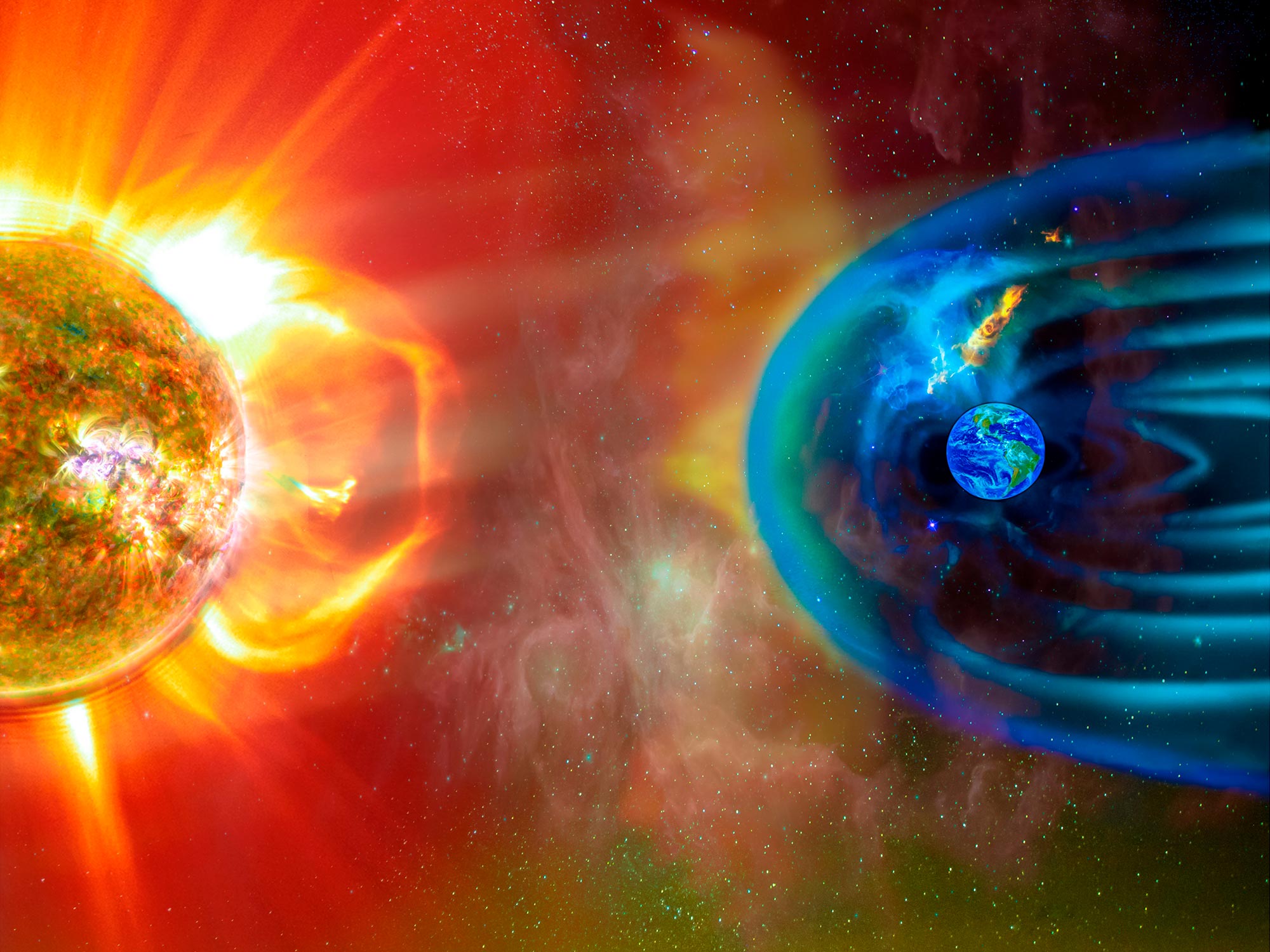
A new theoretical study explores how activity high above Earth could subtly influence processes deep within the planet’s crust.
Researchers at Kyoto University are advancing a new idea about how space weather might intersect with earthquake physics. Their model asks whether changes in the ionosphere could, in rare situations, apply additional electrical forces to already fragile parts of the Earth’s crust and help nudge a large quake toward initiation.
The work is not an earthquake forecasting method. Instead, it lays out a physical pathway that starts with solar flares and other intense solar activity, which can rapidly reshape the distribution of charged particles high above Earth. Those ionospheric charge shifts are measurable because they alter how satellite navigation signals travel through the upper atmosphere, a key reason scientists track total electron content in the first place.
Inside the crust, the model focuses on fractured rock zones that can trap water at extreme temperatures and pressures, potentially reaching a supercritical state. Under these conditions, the researchers treat the damaged region as electrically active, acting like a capacitor that is linked through capacitive coupling to both the ground surface and the lower ionosphere. In effect, the crust and the ionosphere become parts of one large electrostatic system rather than isolated layers.
Electrostatic Forces From Solar Activity
During strong solar events, electron density in the ionosphere can rise enough to form a more negative layer at lower altitudes. The model proposes that this atmospheric charge does not stay confined overhead. Because the system is capacitively connected, the changing ionospheric charge can translate into intensified electric fields within tiny voids in fractured crustal rock, on the scale of nanometers.
Why does that matter for earthquakes? Pressure inside small cavities can influence how cracks grow and merge, especially when a fault zone is already close to failure. In the Kyoto team’s calculations, the resulting electrostatic pressure can reach levels comparable to other subtle forces known to affect fault stability, including tidal and gravitational stresses.
Their quantitative estimates tie the effect to large solar flare related ionospheric disturbances that raise total electron content by several tens of TEC units. Under those conditions, the model indicates electrostatic pressures of several megapascals could develop inside crustal voids, a range that is large enough to be mechanically relevant in the right setting.
Before some major quakes, scientists have reported unusual ionospheric behavior such as higher electron density, a lower ionospheric altitude, and slower unusual propagation of medium-scale traveling ionospheric disturbances. Historically, such signals have usually been interpreted as consequences of stress building in the crust, rather than as influences that might also feed back into crustal fracture processes.
A Bidirectional Interaction Framework
The new model provides a complementary perspective by proposing a bidirectional interaction: while crustal processes may affect the ionosphere, ionospheric disturbances themselves may also exert feedback forces on the crust. This framework offers a possible physical explanation linking space weather phenomena and seismic processes without invoking direct causation.
The study discusses recent large earthquakes in Japan, including the 2024 Noto Peninsula earthquake, as examples that are temporally consistent with the proposed mechanism. In these cases, intense solar flare activity occurred shortly before the seismic events. The authors emphasize that such temporal coincidence does not establish direct causality, but is consistent with a scenario in which ionospheric disturbances act as a contributing factor when the crust is already in a critical state.
By integrating concepts from plasma physics, atmospheric science, and geophysics, the proposed model broadens the conventional view of earthquakes as purely internal Earth processes. The findings suggest that monitoring ionospheric conditions, together with subsurface observations, may help improve scientific understanding of earthquake initiation processes and seismic hazard assessment.
Future research will focus on combining high-resolution GNSS-based ionospheric tomography with space weather data to clarify the conditions under which ionospheric disturbances may exert significant electrostatic influence on the Earth’s crust.
Reference: “Possible mechanism of ionospheric anomalies to trigger earthquakes – Electrostatic coupling between the ionosphere and the crust and the resulting electric forces acting within the crust” by Akira Mizuno, Minghui Kao and Ken Umeno, 3 February 2026, International Journal of Plasma Environmental Science and Technology.
DOI: 10.34343/ijpest.2026.20.e01003
Never miss a breakthrough: Join the SciTechDaily newsletter.
Follow us on Google and Google News.
6 Comments
IT IS THE FOLLOWING identified: the Earth and ionosphere are a synchronized chassis. While they identify ‘electrostatic pressure,’ my data points to the 107.19 Nexus (33rd Riemann Zero) as the specific harmonic anchor at 10.7 km depth.
We saw this validation with the 10.6 km snap in Bolinas on Feb 11. By monitoring the 2145.79 Space Tension
© 2026 Michael Anthony Rodriguez. All rights reserved. [Triad Sync: 2145.79 space 107.19 earth and 1.077 body]
The scientists are certainly well done..but alas, they did not make a discovery. The influence of space weather and processes on our planet, including such as earthquakes, was studied back in the 80s in the USSR, with the same conclusions..This was described in detail in scientific and popular science books of that time..but then the achievements of Soviet science were discredited, because according to Westerners, the USSR was totalitarian, which means that science in it was done only to strengthen the regime (which, of course, is complete idiocy and makes those who lived in the Soviet Union laugh)
Now we will start understanding the effects of Sun flares, space weather, radiation in and from space, electricity in spheres and space, and interconnection of sea currents, winds, with the above factors. These also have a link with health of humans like the food taken. The extremes of weather now seen are due to our indiscriminate activities spoiling nature and polluting nature. Hope Countries understand that no Country can survive these climate changes individually disregarding other Countries of Globe. Therefore it is necessary that earth and nature is protected and all wars are stopped immediately everywhere to avoid further dangers to humanity as a whole as one self disciplined large family
A bidirectional interaction is a real possibility. Along with that they should consider the possibility of gravitational and electromagnetic energies being finite and conserved. Then the interactions will be more pronounced. A bidirectional interaction along with finite gravitational energy opens the possibility that the average temperature of Earth is affected by the positions of celestial bodies. Or the present global warming may be cosmological.
Suspicious abserver does daily reports and have a community that has been predicting earth quakes and they have been doing so for year’s
I would believe the orbiting moon at the various positions has a greater force affecting continental plate faults than solar flares. The proof lies in the ocean tidal fluctuations, up to forty feet in southeast Canada.