

A team of Italian scientists has uncovered why cacio e pepe often goes wrong, and how to get it right every time.
The beloved Italian pasta dish cacio e pepe is famous for two things: its rich, satisfying flavor and its notorious difficulty to prepare correctly. On the surface, the recipe seems straightforward, just three ingredients: pasta, Pecorino Romano cheese, and black pepper. However, anyone who has attempted to make it knows that achieving the ideal smooth, creamy sauce is easier said than done. All too often, the cheese seizes and clumps when mixed with hot pasta water, resulting in a lumpy, sticky texture instead of a silky emulsion.
In a study published in Physics of Fluids by AIP Publishing, researchers from the University of Barcelona, the Max Planck Institute for the Physics of Complex Systems, the University of Padova, and the Institute of Science and Technology Austria investigated the underlying physics of how cheese mixes with water. Their work pinpointed the precise mechanism that causes the sauce to curdle. Armed with these insights, the team formulated a scientifically sound, foolproof method for preparing cacio e pepe, ensuring that the final dish is as creamy and smooth as intended.
For these researchers, their work was about more than idle curiosity.
“We are Italians living abroad,” said author Ivan Di Terlizzi. “We often have dinner together and enjoy traditional cooking. Among the dishes we have cooked was cacio e pepe, and we thought this might be an interesting physical system to study and describe. And of course, there was the practical aim to avoid wasting good pecorino.”
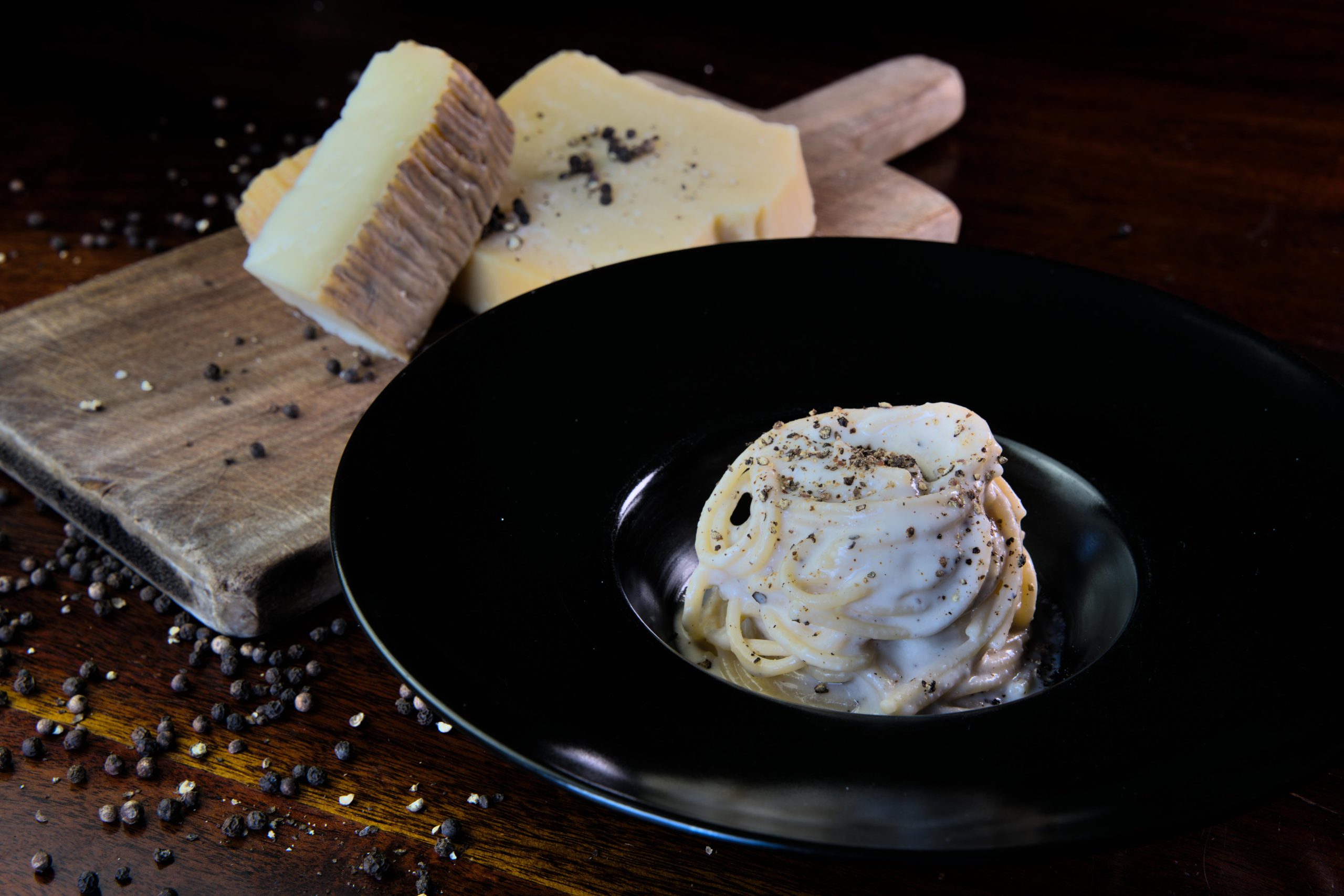
The team first focused on the starch in the pasta water as the key ingredient for a perfect sauce. Typically, fatty substances like cheese cannot mix with water, but a stabilizer like starch helps to bridge that gap. In their tests, the researchers found that a 2%-3% starch-to-cheese ratio produced the smoothest, most uniform sauce.
The Heat Factor: Why Temperature Matters
The other key element of a perfect cacio e pepe sauce is heat — or rather, a lack of it. Too much heat denatures the proteins inside the cheese, causing them to stick together and leading to the dreaded clumps. Instead, the authors advise letting the water cool before mixing in the cheese and bringing the sauce up to temperature as slowly as possible.
For those looking to make cacio e pepe at home, the team provided a scientific recipe for making a perfect sauce, based on their experiments and results. The first step is creating some starchy water, and for this, they recommended using powdered starch like potato or corn starch, rather than relying on an unknown amount of starch in pasta water.
“Because starch is such an important ingredient, and the amount of starch can sharply determine where you end up, what we suggest is to use an amount of starch which is precisely measured,” said Di Terlizzi. “And this can only be done if you have the right amount of powdered starch in proportion to the amount of cheese that you’re using.”
Once the starch is added to the water, the authors’ instructions say to blend it with the cheese for a uniform consistency, before adding the sauce back into the pan and slowly heating it up to serving temperature. Then, the final steps are to mix in the pepper and pasta, and eat.
For future work, the researchers have an entire pantry full of ideas.
“There’s a recipe called pasta alla gricia, which is cacio e pepe plus guanciale, cured pork cheek,” said author Daniel Maria Busiello. “This recipe seems to be easier to perform, and we don’t know exactly why. This is one idea we might explore in the future.”
Reference: “Phase behavior of Cacio e Pepe sauce” by G. Bartolucci, D. M. Busiello, M. Ciarchi, A. Corticelli, I. Di Terlizzi, F. Olmeda, D. Revignas and V. M. Schimmenti, 29 April 2025, Physics of Fluids.
DOI: 10.1063/5.0255841
Never miss a breakthrough: Join the SciTechDaily newsletter.
Follow us on Google and Google News.