
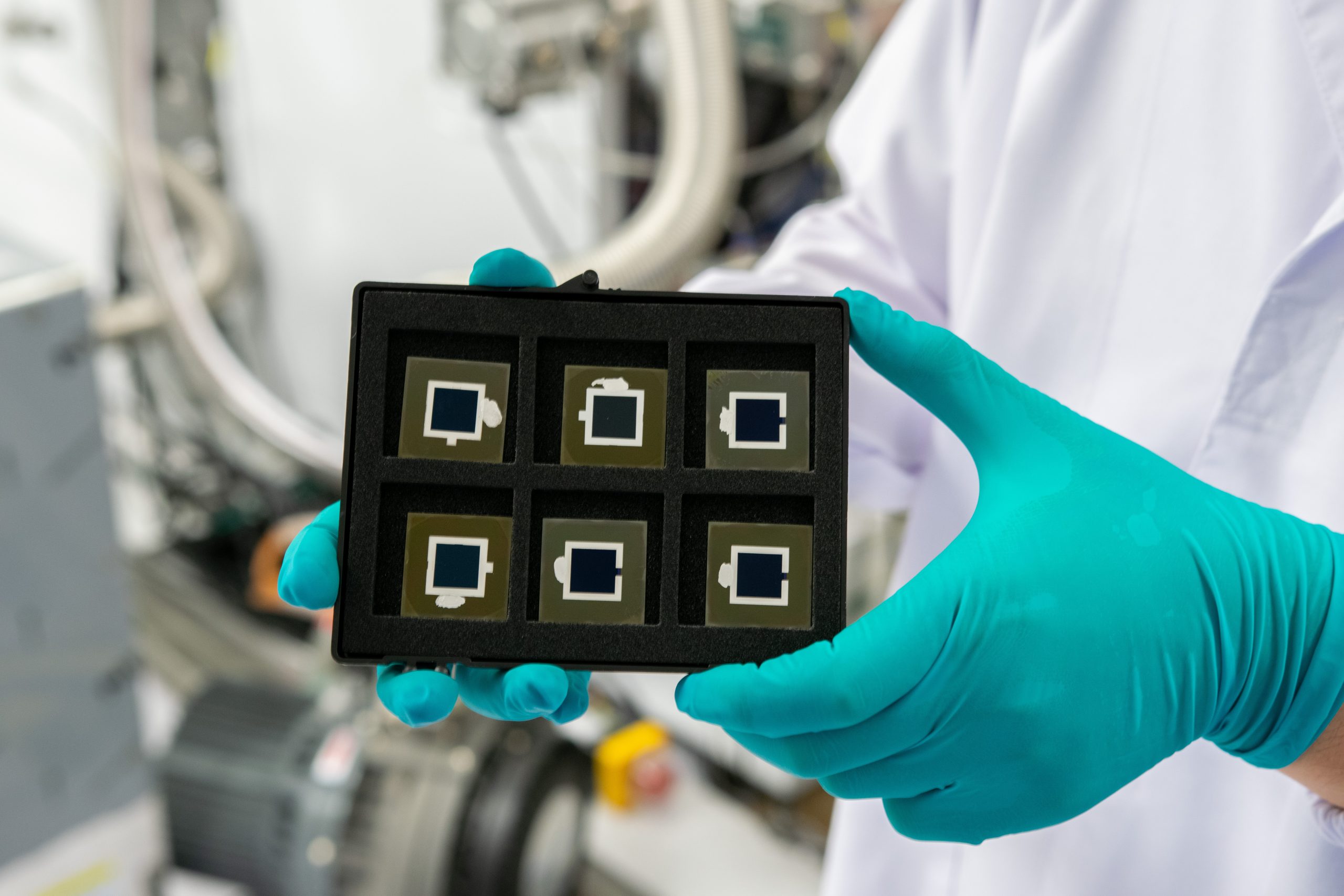
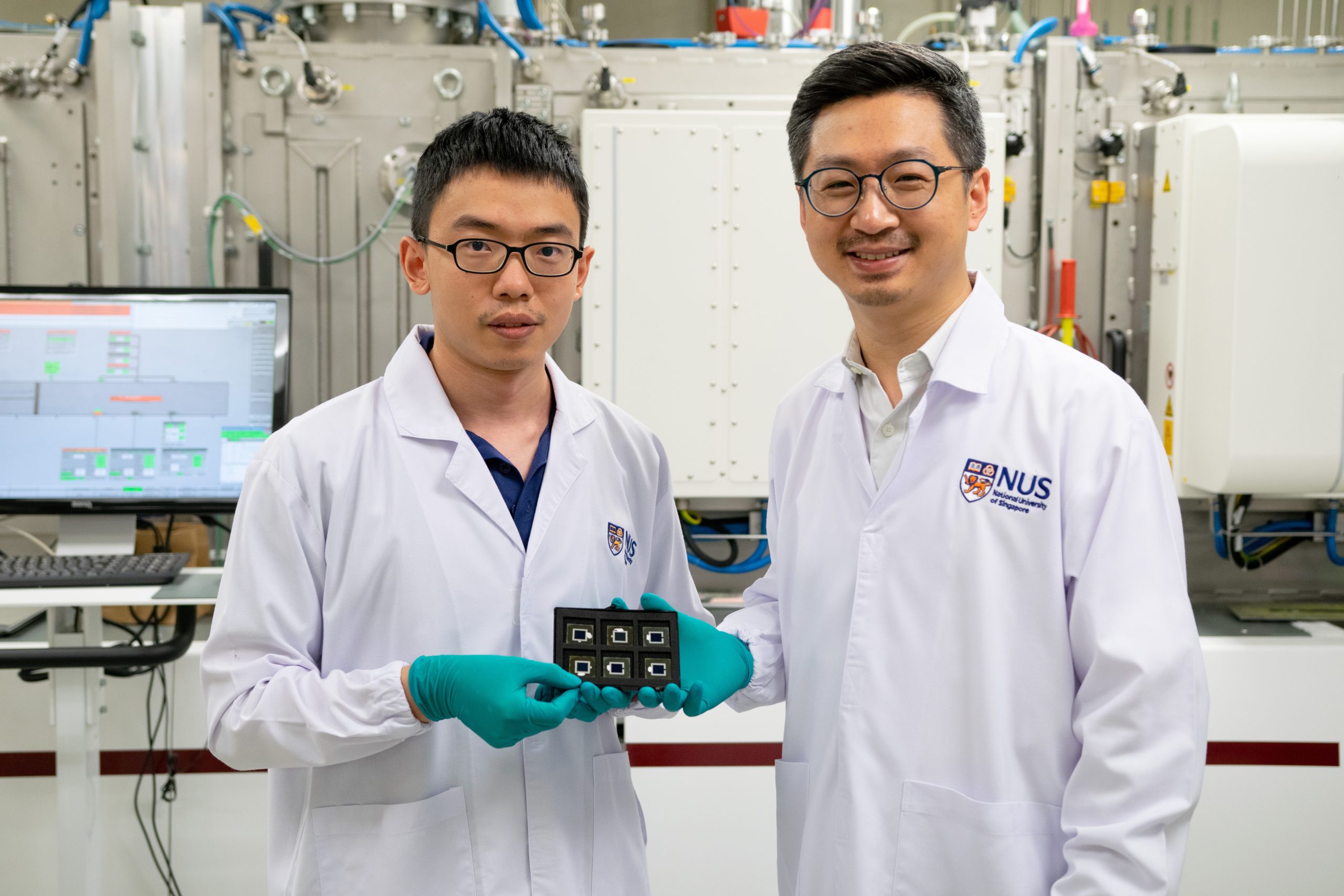
Researchers at the National University of Singapore (NUS) have developed a novel triple-junction perovskite/Si tandem solar cell that can achieve a certified world-record power conversion efficiency of 27.1 percent across a solar energy absorption area of 1 sq cm. This achievement marks the highest performance for a triple-junction perovskite/silicon tandem solar cell to date. The breakthrough was made possible by developing a novel cyanate-integrated perovskite solar cell, known for its stability and high energy efficiency.
Solar cells can be fabricated in more than two layers and assembled to form multi-junction solar cells to increase efficiency. Each layer is made of different photovoltaic materials and absorbs solar energy within a different range. However, current multi-junction solar cell technologies pose many issues, such as energy loss which leads to low voltage and instability of the device during operation.
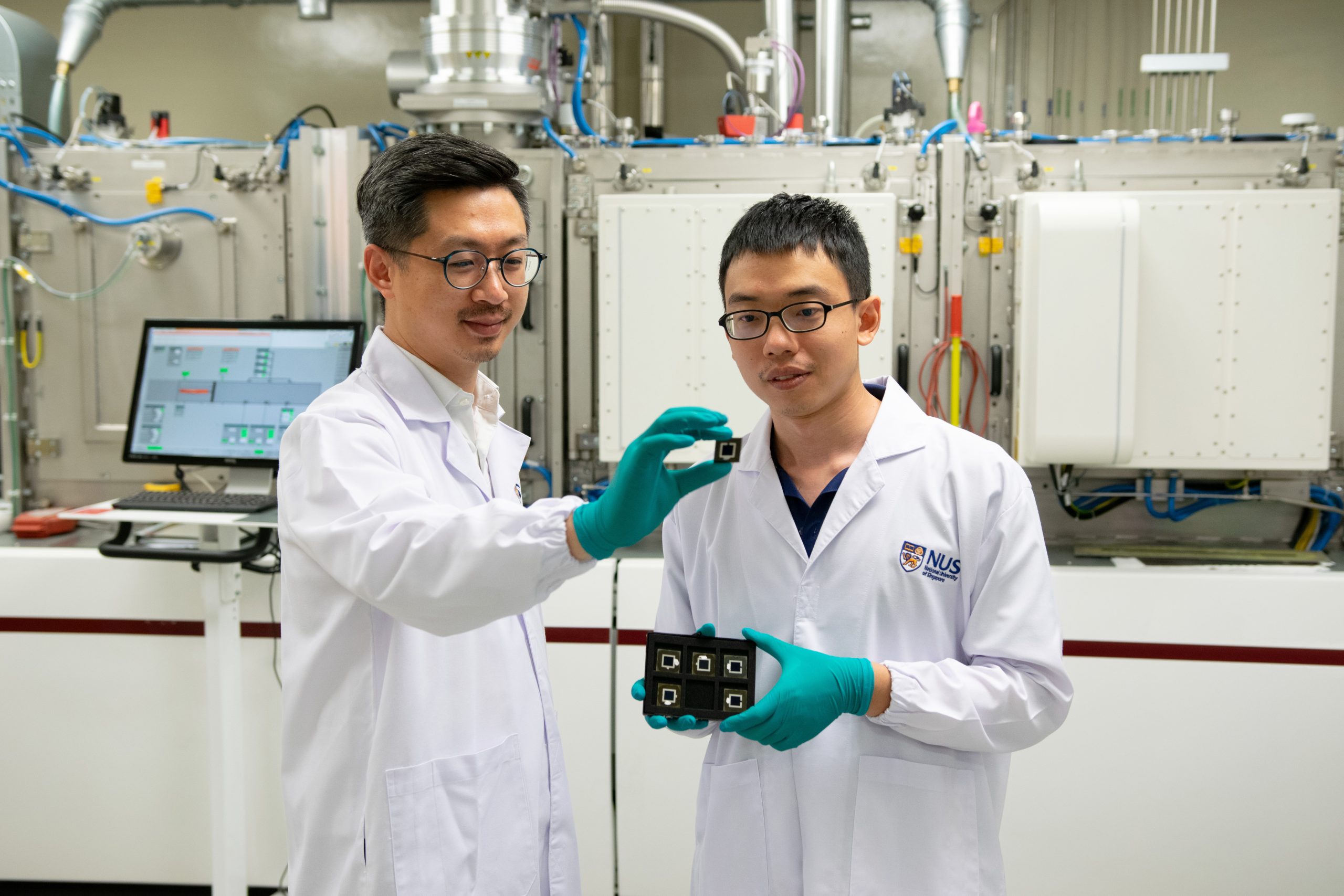
To overcome these challenges, Assistant Professor Hou Yi led a team of scientists from NUS College of Design and Engineering (CDE) and Solar Energy Research Institute of Singapore (SERIS) to demonstrate, for the first time, the successful integration of cyanate into a perovskite solar cell to develop a cutting-edge triple-junction perovskite/Si tandem solar cell that surpasses the performance of other similar multi-junction solar cells. Asst Prof Hou is a Presidential Young Professor at the Department of Chemical and Biomolecular Engineering under CDE as well as a Group Leader at SERIS, a university-level research institute in NUS.
“Remarkably, after 15 years of ongoing research in the field of perovskite-based solar cells, this work constitutes the first experimental evidence for the inclusion of cyanate into perovskites to boost the stability of its structure and improve power conversion efficiency,” said Asst Prof Hou.
The experimental process that led to this ground-breaking discovery was published in the journal Nature.
Fabricating energy-efficient solar cell technology
The interactions between the components of the perovskite structure determine the energy range that it can reach. Adjusting the proportion of these components or finding a direct substitute can help modify the perovskite’s energy range. However, prior research has yet to produce a perovskite recipe with an ultrawide energy range and high efficiency.
In this recently published work, the NUS team experimented on cyanate, a novel pseudohalide, as a substitute for bromide – an ion from the halide group that is commonly used in perovskites. Dr Liu Shunchang, Research Fellow in Asst Prof Hou’s team, employed various analytical methods to confirm the successful integration of cyanate into the perovskite structure, and fabricated a cyanate-integrated perovskite solar cell.
Further analysis of the new perovskite’s atomic structure provided – for the first time – experimental evidence that incorporating cyanate helped to stabilize its structure and form key interactions within the perovskite, demonstrating how it is a viable substitute for halides in perovskite-based solar cells.
When assessing performance, the NUS scientists found that perovskite solar cells incorporated with cyanate can achieve a higher voltage of 1.422 volts compared to 1.357 volts for conventional perovskite solar cells, with a significant reduction in energy loss.
The researchers also tested the newly engineered perovskite solar cell by continuously operating it at maximum power for 300 hours under controlled conditions. After the test period, the solar cell remained stable and functioned above 96 percent capacity.
Encouraged by the impressive performance of the cyanate-integrated perovskite solar cells, the NUS team took their ground-breaking discovery to the next step by using it to assemble a triple-junction perovskite/Si tandem solar cell. The researchers stacked a perovskite solar cell and a silicon solar cell to create a dual-junction half-cell, providing an ideal base for the attachment of the cyanate-integrated perovskite solar cell.
Once assembled, the researchers demonstrated that despite the complexity of the triple-junction perovskite/Si tandem solar cell structure, it remained stable and attained a certified world-record efficiency of 27.1 percent from an accredited independent photovoltaic calibration laboratory.
“Collectively, these advancements offer ground-breaking insights into mitigating energy loss in perovskite solar cells and set a new course for the further development of perovskite-based triple junction solar technology,” said Asst Prof Hou.
Next steps
The theoretical efficiency of triple-junction perovskite/Si tandem solar cells exceeds 50 percent, presenting significant potential for further enhancements, especially in applications where installation space is limited.
Going forward, the NUS team aims to upscale this technology to larger modules without compromising efficiency and stability. Future research will focus on innovations at the interfaces and composition of perovskite – these are key areas identified by the team to further advance this technology.
Reference: “Triple-junction solar cells with cyanate in ultrawide bandgap perovskites” by Shunchang Liu, Yue Lu, Cao Yu, Jia Li, Ran Luo, Renjun Guo, Haoming Liang, Xiangkun Jia, Xiao Guo, Yu-Duan Wang, Qilin Zhou, Xi Wang, Shaofei Yang, Manling Sui, Peter Müller-Buschbaum and Yi Hou, 4 March 2024, Nature.
DOI: 10.1038/s41586-024-07226-1
Never miss a breakthrough: Join the SciTechDaily newsletter.
Follow us on Google and Google News.
1 Comment
Until it’s on the shelves at Digikey or Mouser, it never happened.