
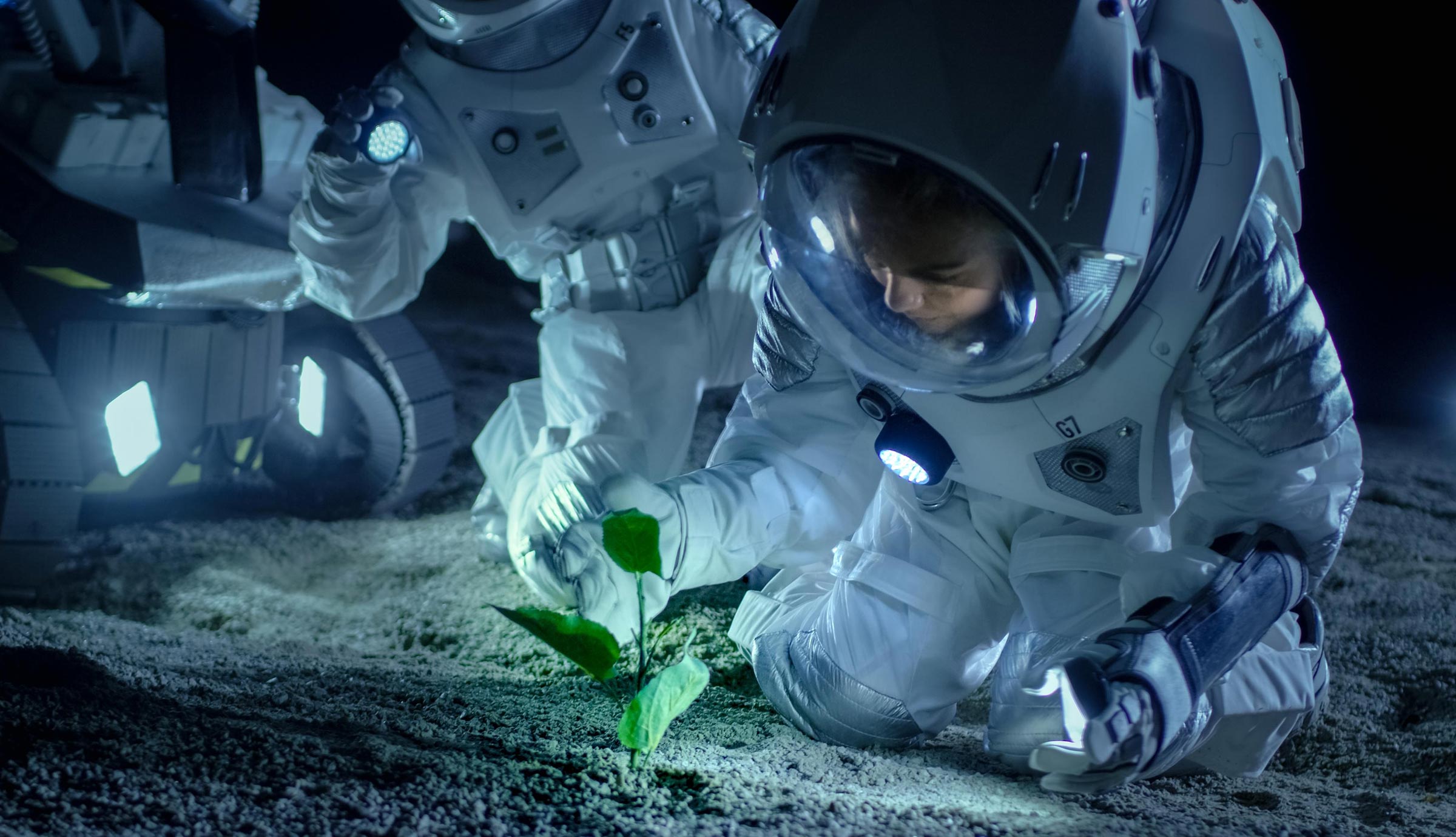
A new solar-powered tech extracts water from Moon soil and turns astronaut CO₂ into oxygen and fuel.
Scientists have created a new technology that could significantly improve the chances of long-term human survival on the Moon. Detailed in a study published July 16 in the journal Joule, the research team successfully extracted water from lunar soil and used it to transform carbon dioxide into breathable oxygen and chemical components for fuel. This breakthrough could play a key role in future space missions by reducing the need to carry large quantities of water and fuel from Earth.
“We never fully imagined the ‘magic’ that the lunar soil possessed,” said Lu Wang of the Chinese University of Hong Kong, Shenzhen. “The biggest surprise for us was the tangible success of this integrated approach. The one-step integration of lunar H2O extraction and photothermal CO2 catalysis could enhance energy utilization efficiency and decrease the cost and complexity of infrastructure development.”
The concept of using the Moon as a launchpad for deeper space exploration has been discussed by space agencies for many years. But the biggest hurdle has always been supplying enough essential materials, particularly water, to support astronauts stationed there. According to the study, transporting just one gallon of water into space costs approximately $83,000. Given that an astronaut typically requires around four gallons of water daily, the logistics quickly become both expensive and impractical.

Soil samples analyzed from the Chang’E-5 mission provide evidence of water on the lunar surface, which the authors suggest could allow human explorers to harness the Moon’s natural resources to meet their needs while avoiding the costs and logistical challenges of transporting those resources. However, previously developed strategies for extracting water from lunar soil involved multiple energy-intensive steps and didn’t break down CO2 for fuel and other essential uses.
A Dual-Purpose Lunar Technology
To advance this research, Wang and colleagues developed a technology that would both extract water from lunar soil and directly use it to convert the CO2 exhaled by astronauts into carbon monoxide (CO) and hydrogen gas, which could then be used to make fuels and oxygen for the astronauts to breathe. The technology accomplishes this feat through a novel photothermal strategy, which converts light from the Sun into heat.
The scientists tested the technology using lunar soil samples gathered during the Chang’E mission as well as simulated lunar samples and a batch reactor filled with CO2 gas that used a light-concentrating system to drive the photothermal process. The team used ilmenite, a heavy black mineral and one of several reported water reservoirs in lunar soil, to measure photothermal activity and analyze the mechanisms of the process.
Despite the technology’s success in the lab, the extreme lunar environment still poses challenges that will complicate its usage on the Moon, according to the authors, including drastic temperature fluctuations, intense radiation, and low gravity. Additionally, lunar soil in its natural environment does not have a uniform composition, which leads to it having inconsistent properties, while CO2 from astronauts’ exhalations might not be enough to offer a basis for all the water, fuel, and oxygen they need. Technological limitations also continue to present a barrier, with current catalytic performance still insufficient to fully support human life in environments beyond Earth, said Wang.
“Overcoming these technical hurdles and significant associated costs in development, deployment, and operation will be crucial to realizing sustainable lunar water utilization and space exploration,” the authors write.
Reference: “Inherent lunar water enabled photothermal CO2 catalysis” by Junchuan Sun, Wanguo Gao, Xue Ding, Zhe Lu, Huaiguang Li, Mingjian Zhang, Wenguang Tu, Zhongxin Chen, Yong Zhou, Wei Yao, Wenlei Wu, Yingfang Yao, Lu Wang, Mengfei Yang, Weihua Wang and Zhigang Zou, 16 July 2025, Joule.
DOI: 10.1016/j.joule.2025.102006
This research was supported by funding from the National Key R&D Program of China, the National Natural Science Foundation of China, The Program for Guangdong Introducing Innovative and Entrepreneurial Teams, the Special Fund for the Sci-tech Innovation Strategy of Guangdong Province, the Guangdong Basic Research Center of Excellence for Aggregate Science, The Shenzhen Natural Science Foundation, The Shenzhen Key Laboratory of Eco-materials and Renewable Energy, the NSF of Jiangsu Province, and the University Development Fund.
Never miss a breakthrough: Join the SciTechDaily newsletter.
Follow us on Google and Google News.
7 Comments
probably one of most important articles of all time in human history….
thank you, kind regards
rubbish, all this has already been discovered in the US Moon missions back in 1960’s and 1970’s. My science book for kids described this already back then.
This is NOT by any means a new innovation nor new information, but already know fact from the US Moon mission from the 1960’s and 1970’s. Even my science book for kids described this back then.
Calling lunar grit “soil” is like calling plaster of Paris “flour”. Soil is much more than just dirt.
Taking the steps to move through space from planet to planet we need to keep building life modules , gain ground base operations to gain workable space , the gravity might differ but a spandex type suits that fit tight causing pressure to the body to mimic the pressure on earth would be helpful create and build then go move forward to sustainable travel . It is like having to get building materials to space and then have a construction crew of workers building platforms of modules .
” Wang and colleagues developed a technology that would both extract water from lunar soil and directly use it to convert the CO2 exhaled by astronauts into carbon monoxide (CO) and hydrogen gas,” Another approach for making town-gas to keep us warm in winter whilst getting rid of globally-warming CO2. See space-travel does give us useful technologies for use on Earth.
As for the Moon. A nice launching-pad for missiles to knock off populations one doesn’t like. Good job Israel has no Biblical grounds for claiming the Moon as home……………….
You could say The Moon is a Harsh Mistress 😉