
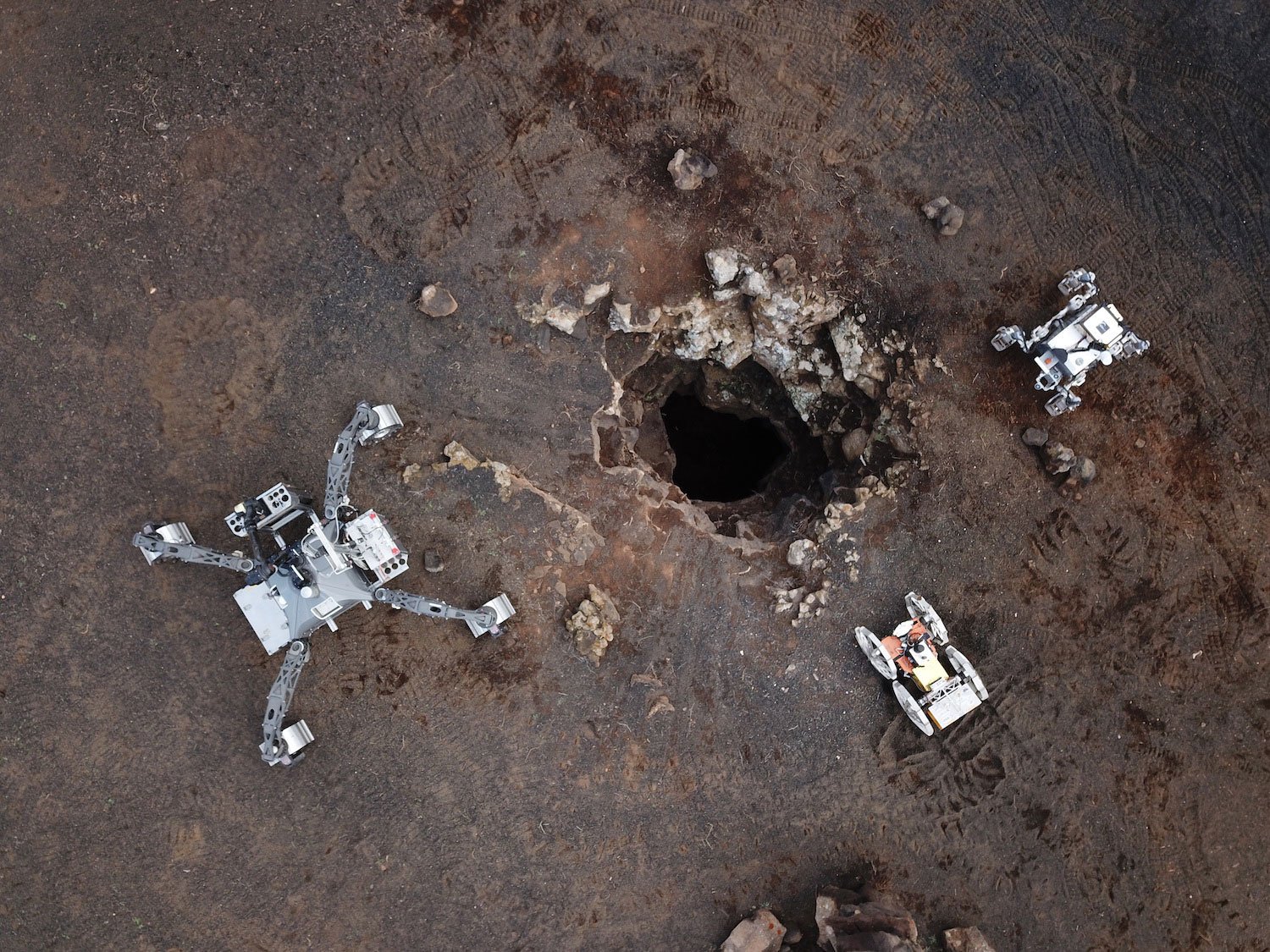
A research team from the Space Robotics Laboratory at the University of Malaga, involved in the project, is testing and validating three robots on the volcanic island of Lanzarote, Spain.
Protecting astronauts and their equipment once they leave Earth’s magnetic cocoon is one of the central challenges of sustained lunar and Martian exploration.
The lunar surface in particular is an unforgiving place: without an atmosphere or magnetosphere, it is continuously bombarded by powerful solar and cosmic radiation, and endures some of the most intense temperature swings in the Solar System—from blistering highs of about 121 °C in sunlight to frigid lows near –146 °C in darkness.
In permanently shadowed polar regions, temperatures can plummet to around –240 °C. On top of that, a steady rain of micrometeorites erodes and sandblasts the surface. Any long-term human presence must therefore find shelter from radiation, thermal stress, and hypervelocity dust impacts rather than try to withstand them directly on the surface.
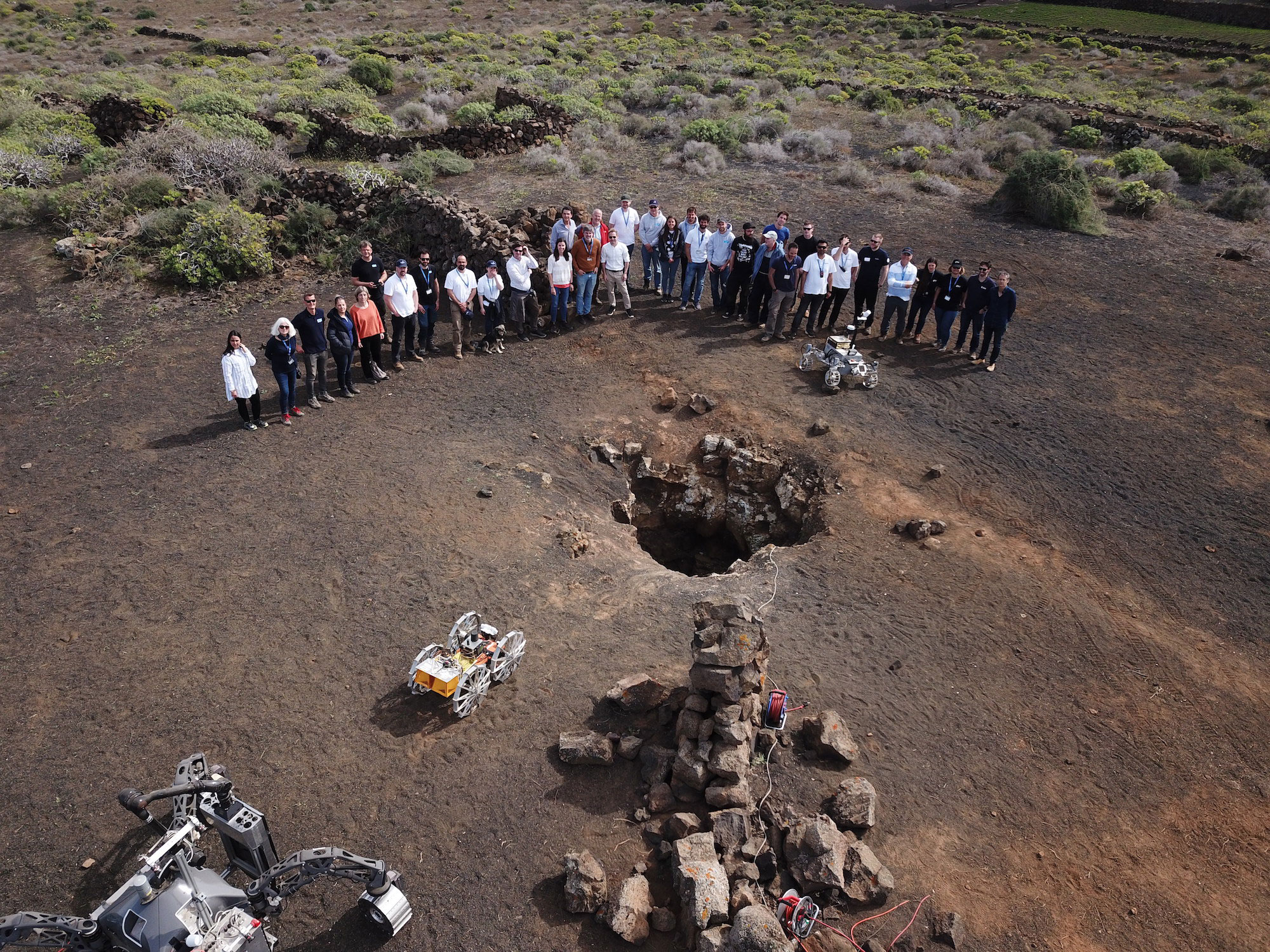
Ancient volcanic activity on the Moon and Mars has left behind lava tubes that are now seen as promising locations for future base camps, offering natural protection beneath the surface. Skylights, collapsed sections of tube ceilings, and long sinuous rilles identified in orbital imagery hint at extensive subsurface voids, but images alone cannot reveal which tubes are intact or suitable for habitats, making direct robotic exploration essential despite the harsh conditions and restricted access.
A European Vision for Subsurface Exploration
Now, a European consortium, which includes the Space Robotics Laboratory at the University of Malaga, has designed an innovative lava tunnel exploration mission concept. This concept has just been published in the scientific journal Science Robotics. It comprises a team of three heterogeneous robots that collaborate autonomously to explore and map these extreme environments efficiently, and they are being tested in caves of Lanzarote (Spain) with a view to the Moon.
This mission concept is divided into four phases: Cooperative mapping of the area surrounding the entrance to the lava tunnel (phase 1); deployment of a sensorized payload cube ejected down into the cave to collect initial data (phase 2); rappelling of a scout rover through the entrance (phase 3); and exploration and detailed 3D mapping of the interior (phase 4).
Testing in the Caves of Lanzarote
In February 2023, the research team took their three-robot system to a lava cave on the volcanic island of Lanzarote for a full-scale field trial. The campaign was organized by a consortium led by the German Research Center for Artificial Intelligence (DFKI), with the participation of the University of Malaga and the Spanish company GMV, and it showed that the robots could carry out the planned four-phase mission in a realistic setting.
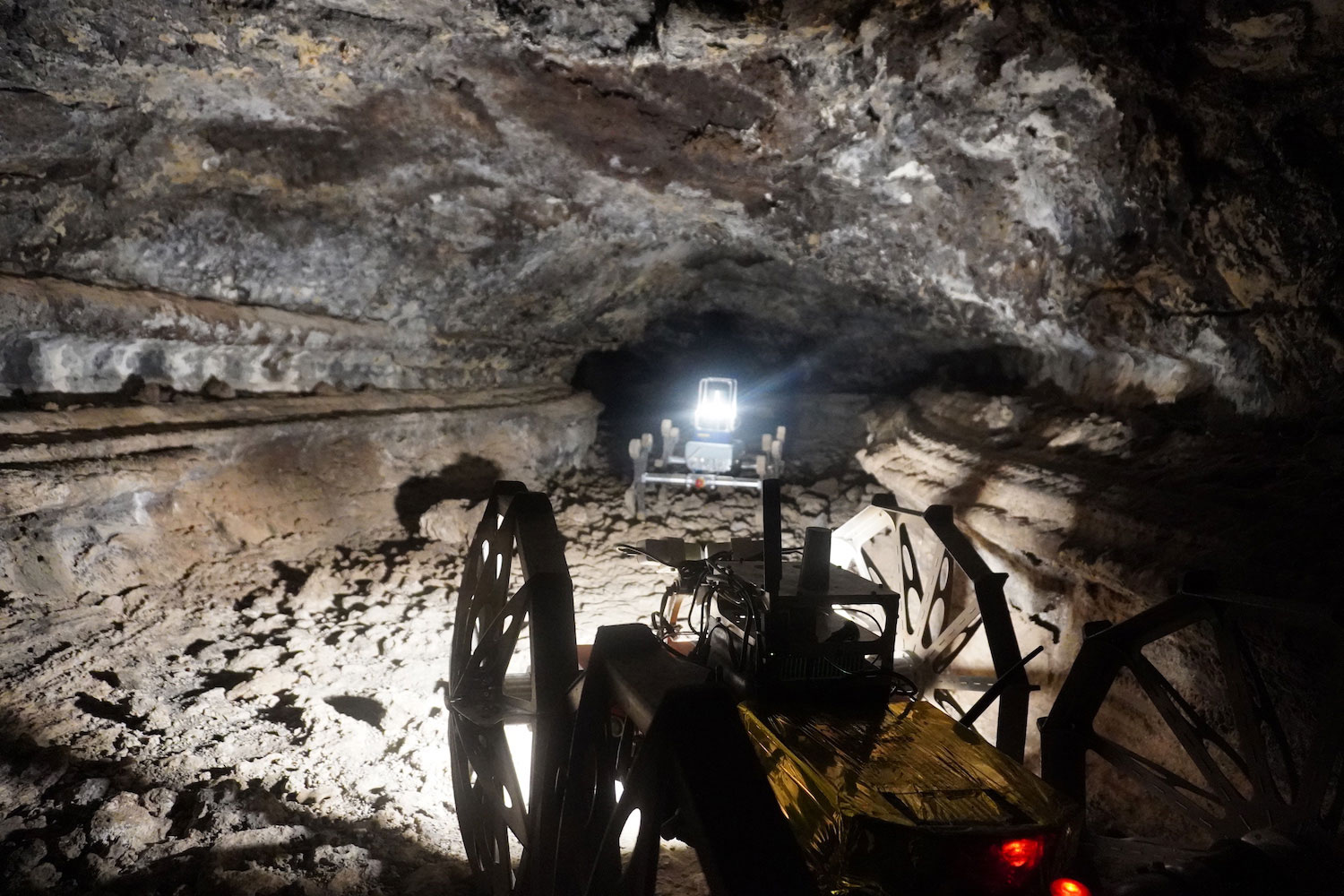
SherpaTT and LUVMI-X worked together to map the entrance and generate a detailed digital elevation model, the sensorized payload cube with high-speed cameras was deployed to simulate a lunar-style free fall and reconstruct the skylight in 3D, and the Coyote III rover was successfully lowered into the cave, where it traversed harsh terrain while gathering point clouds and other 3D data.
Although weather and logistical constraints prevented the team from repeating every phase as often as they had intended, the results still showed that the overall mission concept is technically sound and that a coordinated group of heterogeneous robots can effectively explore and map a lava tube.
The study indicates that this kind of collaborative robotic system could play a key role in future missions to the Moon or Mars by assessing lava caves as potential protected base sites, and it gives important momentum to the development of autonomous robotic technologies for planetary exploration.
Reference: “Cooperative robotic exploration of a planetary skylight surface and lava cave” by Raúl Domínguez, Carlos Pérez-del-Pulgar, Gonzalo J. Paz-Delgado, Fabio Polisano, Jonathan Babel, Thierry Germa, Iulia Dragomir, Valérie Ciarletti, Anne-Claire Berthet, Leon Cedric Danter and Frank Kirchner, 13 August 2025, Science Robotics.
DOI: 10.1126/scirobotics.adj9699
Never miss a breakthrough: Join the SciTechDaily newsletter.
Follow us on Google and Google News.