
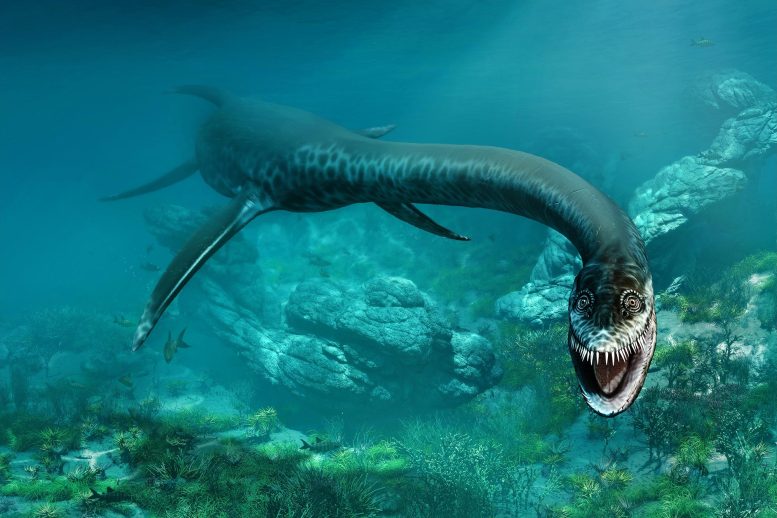
A New Study Reveals How Plesiosaurs Swam Underwater
Plesiosaurs, who lived around 210 million years ago, adapted to living underwater in an unusual way: their front and hind legs evolved to become four uniform, wing-like flippers over time. Dr. Anna Krahl examined how they utilized them to travel through the water in her thesis, which was supervised at Ruhr-Universität Bochum and the University of Bonn.
She was able to demonstrate that twisting the flippers was crucial for forward motion in part by using the finite element approach, which is often employed in engineering. Using bones, muscle models, and reconstructions of the muscles, she was able to recreate the movement sequence. Her findings were recently published in the journal PeerJ.
Plesiosaurs are members of the Sauropterygia, often known as paddle lizards, a group of saurians that re-adapted to live in the water. They developed in the late Triassic, around 210 million years ago, coexisted with dinosaurs, and died out at the end of the Cretaceous era.
Plesiosaurs are distinguished by their often exceedingly long necks and tiny heads; the elasmosaurs even have the longest necks of any vertebrates. On the other hand, there were also enormous predatory types with short necks and enormous skulls. The neck is linked to a teardrop-shaped, hydrodynamically well-suited body with a markedly shortened tail in all plesiosaurs.
Researchers Have Puzzled for 120 Years How Plesiosaurs Swam
The second feature that makes plesiosaurs so unusual is their four uniform wing-like flippers.
“Having the front legs transformed into wing-like flippers is relatively common in evolution, for instance in sea turtles. Never again, however, did the hind legs evolve into an almost identical-looking airfoil-like wing,” explains Anna Krahl, whose doctoral thesis was supervised by Professor P. Martin Sander (Bonn) and Professor Ulrich Witzel (Bochum).
Sea turtles and penguins, for example, have webbed feet. For more than 120 years, researchers in vertebrate paleontology have puzzled over how plesiosaurs might have swum with these four wings. Did they row like freshwater turtles or ducks? Did they fly underwater like sea turtles and penguins? Or did they combine underwater flight and rowing like modern-day sea lions or the pig-nosed turtle? It is also unclear whether the front and rear flippers were flapped in unison, in opposition, or out of phase.
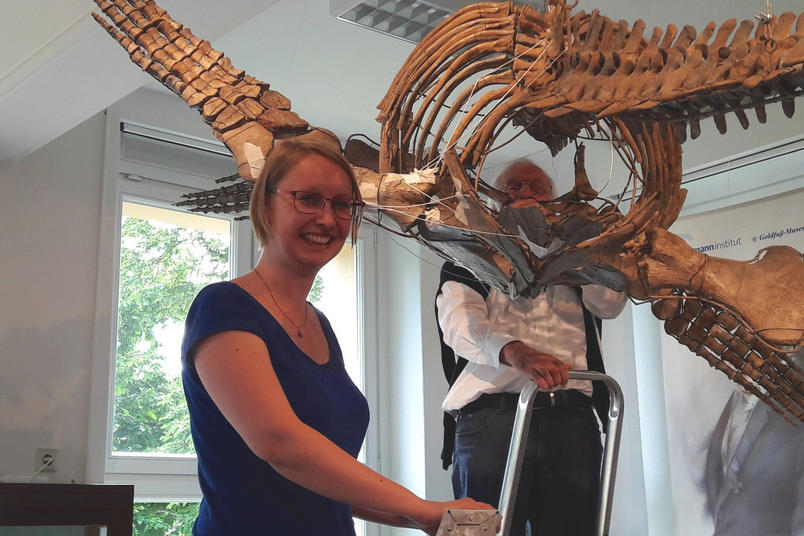
Anna Krahl has been studying the body structure of plesiosaurs for several years. She examined the bones of the shoulder and pelvic girdle, the front and hind flippers, and the shoulder joint surfaces of the plesiosaur Cryptoclidus eurymerus from the Middle Jurassic period (about 160 million years ago) on a complete skeleton displayed in the Goldfuß Museum of the University of Bonn. Plesiosaurs have stiffened elbow, knee, hand, and ankle joints, but functioning shoulder, hip, and finger joints.
“Analysis comparing them to modern-day sea turtles, and based on what is known about their swimming process, indicated that plesiosaurs were probably not able to rotate their flippers as much as would be necessary for rowing,” concludes Krahl, summarizing one of her preliminary papers. Rowing is primarily a back-and-forth motion that uses water resistance to move forward.
The preferred direction of flipper movement in plesiosaurs, on the other hand, was up-and-down, as used by underwater fliers to generate propulsion.
The question remained how plesiosaurs could ultimately twist their flippers to place them in a hydrodynamically favorable position and produce lift without rotating the upper arm and thigh around the longitudinal axis.
“This could work by means of twisting the flippers around their long axis,” says Anna Krahl. “Other vertebrates, such as the leatherback turtle, have also been shown to use this movement to generate propulsion through lift.”
Twisting, for example, involves bending the first finger far downward and the last finger far upward. The remaining fingers bridge these extreme positions so that the flipper tip is almost vertical without requiring any real rotation in the shoulder or wrist.
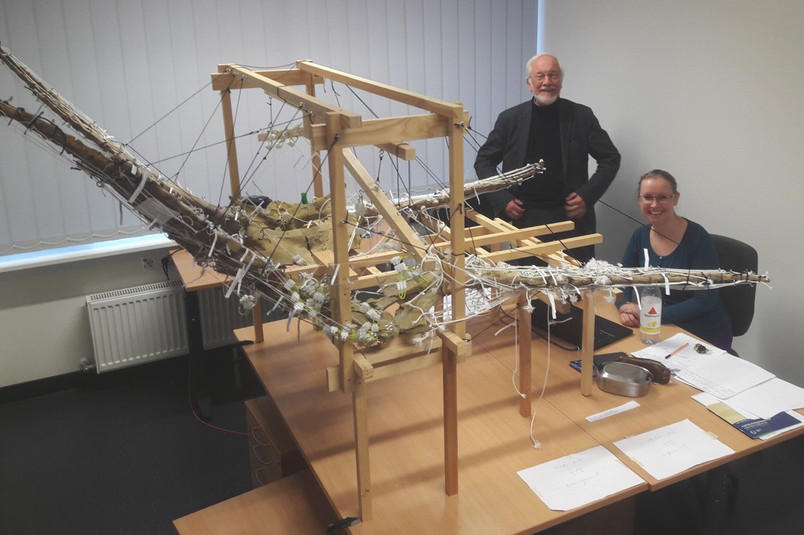
A reconstruction of the muscles of the fore- and hind flippers for Cryptoclidus using reptiles alive today showed that plesiosaurs could actively enable such flipper twisting. In addition to classical models, the researchers also made computer tomographies of the humerus and femur of Cryptoclidus and used them to create virtual 3D models.
“These digital models were the basis for calculating the forces using a method we borrowed from engineering: the finite element method, or FE,” explains Anna Krahl.
All the muscles and their angles of attachment on the humerus and femur were virtually reproduced in an FE computer program that can simulate physiological functional loads, for example on construction components but also on prostheses. Based on muscle force assumptions from a similar study on sea turtles, the team was able to calculate and visualize the loading on each bone.
Twisting of the Flippers Can Be Proven Indirectly
During a movement cycle, the limb bones are loaded by compression, tension, bending, and torsion. “The FE analyses showed that the humerus and femur in the flippers are functionally loaded mainly by compression and to a much lesser extent by tensile stress,” Anna Krahl explains.
“This means that the plesiosaur built its bones by using as little material as necessary.” This natural state can only be maintained if the muscles that twist the flippers and the muscles that wrap around the bone are included. “We can therefore indirectly prove that plesiosaurs twisted their flippers in order to swim efficiently,” Anna Krahl sums up.
The team was also able to calculate forces for the individual muscles that generated the upstroke and downstroke. For instance, it transpired that the downstroke of both pairs of flippers was more powerful than the upstroke. This is comparable to our sea turtles today and different from today’s penguins, which move forward the same distance with the upstroke as with the downstroke.
“Plesiosaurs adapted to life in water in a very different way than whales, for example,” notes Anna Krahl, who now works at the Eberhard Karls University in Tübingen, Germany. “This unique path of evolution exemplifies the importance of paleontological research because it’s the only way we can appreciate the full range of what evolution can bring about.”
Reference: “Determination of muscle strength and function in plesiosaur limbs: finite element structural analyses of Cryptoclidus eurymerus humerus and femur” by Anna Krahl, Andreas Lipphaus, P. Martin Sander and Ulrich Witzel, 3 June 2022, PeerJ.
DOI: 10.7717/peerj.13342
Never miss a breakthrough: Join the SciTechDaily newsletter.
Follow us on Google and Google News.
3 Comments
Awesome work!
“The neck is linked to a teardrop-shaped, hydrodynamically well-suited body with a markedly shortened [?] in all plesiosaurs.”
What is the missing word?
Fixed, thanks for the notice.