
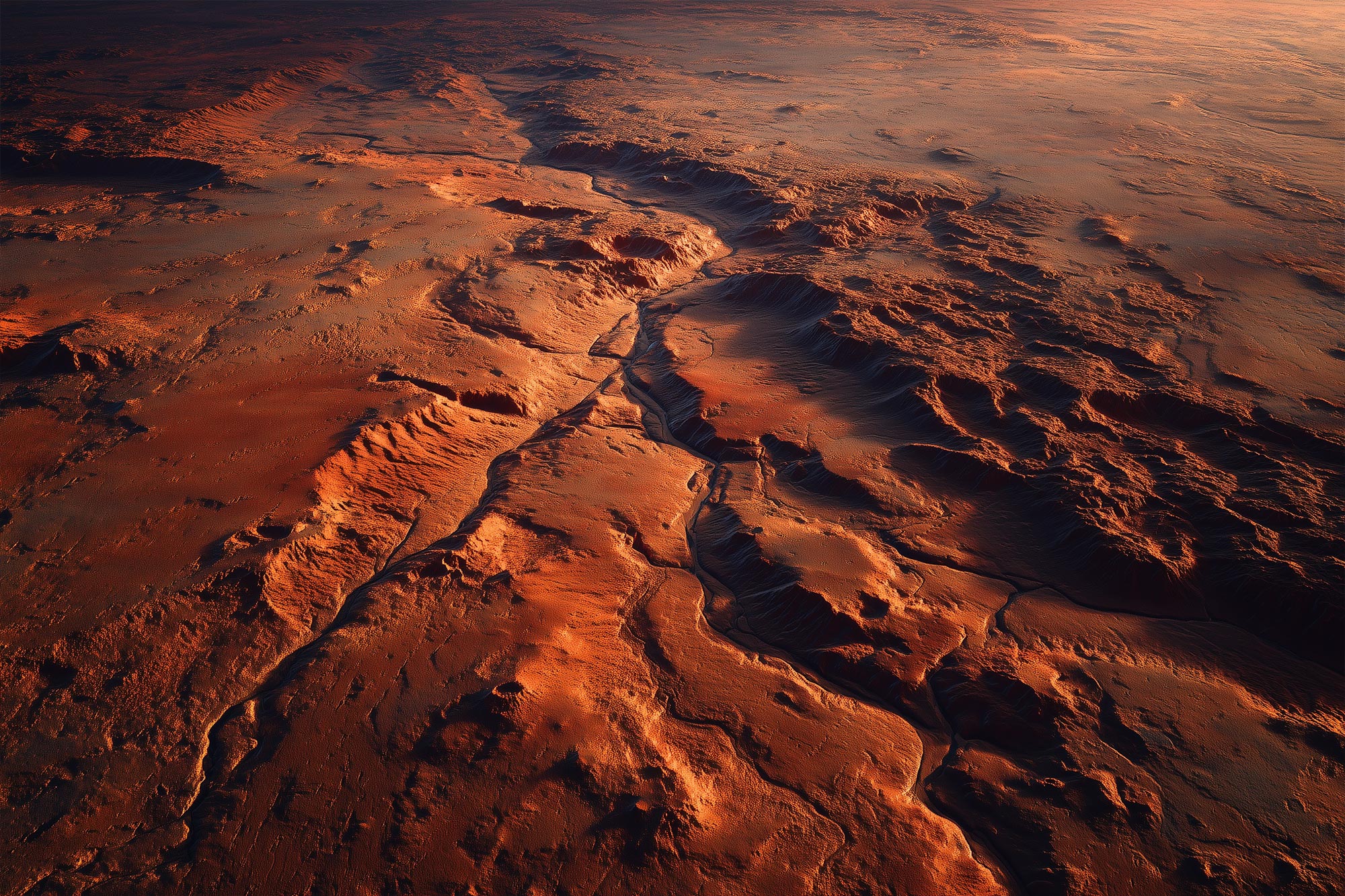
Near-surface water ice could supply essential resources for future human exploration on the Red Planet.
Before sending people on the long trip to another world, mission planners must determine a safe and practical landing location. Recent work by a researcher at the University of Mississippi may help identify a promising spot on Mars.
Erica Luzzi, a planetary geologist and postdoctoral researcher at the Mississippi Mineral Resources Institute, led a study that uncovered signs of water ice lying just beneath the Martian surface. The results, published in the Journal of Geophysical Research: Planets, suggest a valuable resource that future astronauts could rely on.
“If we’re going to send humans to Mars, you need H2O and not just for drinking, but for propellant and all manner of applications,” Luzzi said. She completed the research as a part of her postdoctoral studies at the Bay Area Environmental Research Institute within the NASA Ames Research Center.
“And finding it close to the surface is helpful because we can easily extract it and use it. This is called in situ resource utilization, and it’s an important practice for any space exploration.”
Evidence of Shallow Ice in Amazonis Planitia
By examining high-resolution images from orbit, Luzzi’s team identified features that point to ice sitting less than 1 meter below the ground in Amazonis Planitia, a broad region in Mars’ mid-latitudes. This area is already being evaluated as a potential landing zone for future human crews.
“The mid-latitudes offer the perfect compromise – they get enough sunlight for power, but they’re still cold enough to preserve ice near the surface,” Luzzi said. “That makes them ideal for future landing sites.”
Using satellite images from HiRISE, the highest resolution camera ever sent to another planet, the researchers identified ice-exposing craters, polygonal terrain, and other morphologies that typically suggest ice near the surface.
Finding water ice means that human explorers would be able to use resources on the planet to provide drinking water, fuel, oxygen, and other forms of life support.
“For the moon, it would take us one week, more or less, to go back and forth to Earth for resupply,” said Giacomo Nodjoumi, postdoctoral researcher at the Space Science Data Center of the Italian Space Agency and a co-author of the study. “But for Mars, it would take months. So, we have to be prepared for not having resupply from Earth for extended periods of time.
“The most important resources are oxygen to breathe and water to drink. That’s what makes our candidate landing site really promising.”
Ice can also preserve indicators of life, both past and present, the researchers said.
“This also has astrobiological implications,” Luzzi said. “On Earth, ice can preserve biomarkers of past life, and it can also host microbial populations. So, it could tell us if Mars was ever habitable.”
Next Steps for Confirming Martian Ice
To get samples of the ice, humans would have to send a robot or an exploration mission.
“The next step would be radar analyses to better understand the depth and patchiness of the ice,” the Ole Miss researcher said. “The lag deposit, material on top of the ice, might vary, which affects whether the ice is preserved.
“Understanding that will help us decide where a robotic precursor should land.”
A rover or human expedition is also necessary to determine whether the ice formations at these locations are purely water ice, or if they contain other materials.
“We will never be sure of something if we don’t have a rover, a lander or a human to take real measurements,” Nodjoumi said. “We have strong evidence to suggest that this is water ice, but until we go there and measure it, we won’t be 100% sure.”
Humans are still a long way from exploring the Red Planet on their own two feet, but the researchers’ work shows where those first footsteps might land.
Reference: “Geomorphological Evidence of Near-Surface Ice at Candidate Landing Sites in Northern Amazonis Planitia, Mars” by Erica Luzzi, Jennifer L. Heldmann, Kaj E. Williams, Giacomo Nodjoumi, Ariel Deutsch and Alexander Sehlke, 3 May 2025, Journal of Geophysical Research: Planets.
DOI: 10.1029/2024JE008724
Never miss a breakthrough: Join the SciTechDaily newsletter.
Follow us on Google and Google News.