
Close Menu
    Facebook X (Twitter) Instagram
    SciTechDaily
    • Biology
    • Chemistry
    • Earth
    • Health
    • Physics
    • Science
    • Space
    • Technology
    Facebook X (Twitter) Pinterest YouTube RSS
    SciTechDaily
    Home»Space»Alien Rock From Mars Reveals Ancient Volcanic Secrets
    Space

    Alien Rock From Mars Reveals Ancient Volcanic Secrets

    By Higher Education PressJuly 17, 20251 Comment3 Mins Read
    Facebook Twitter Pinterest Telegram LinkedIn WhatsApp Email Reddit
    Share
    Facebook Twitter LinkedIn Pinterest Telegram Email Reddit
    Olympus Mons Mars Volcano
    A newly identified Martian meteorite, NWA 16254, is reshaping our understanding of Mars’ volcanic and mantle evolution. With a rare chemical signature and dual-stage crystallization history, this meteorite offers fresh evidence of deep mantle processes and slow crustal cooling under reducing conditions. Credit: Shutterstock

    A rare Martian meteorite has revealed complex volcanic processes and mantle heterogeneity on Mars, offering new clues to the planet’s magmatic evolution and thermal history.

    In a groundbreaking discovery published in the inaugural issue of Planet, scientists at Chengdu University of Technology revealed how a newly identified Martian rock formed. This specimen—Northwest Africa (NWA) 16254—belongs to the gabbroic shergottite group and stands out as the first of its kind to show significant geochemical depletion. By studying its composition, the team has opened a new window onto Mars’s volcanic history and the way its mantle and crust have interacted over time.

    Under the leadership of Dr. Jun-Feng Chen from the Research Center for Planetary Science, researchers used detailed mineral maps and chemical analyses to trace a two-stage cooling and crystallization sequence. At depths where pressure reached between 4.3 and 9.3 kbar, magnesium-rich pyroxene crystals took shape first, marking the rock’s earliest growth phase.

    As the molten material rose to shallower levels (less than 4 kbar), it cooled more slowly, allowing iron-rich pyroxene rims and plagioclase to form. The resulting coarse-grained texture preserves a record of repeated melt extraction from an aged, depleted mantle source. These findings provide a key piece of the puzzle for reconstructing the planet’s magmatic evolution.
    NWA 16254 Sample Graphic
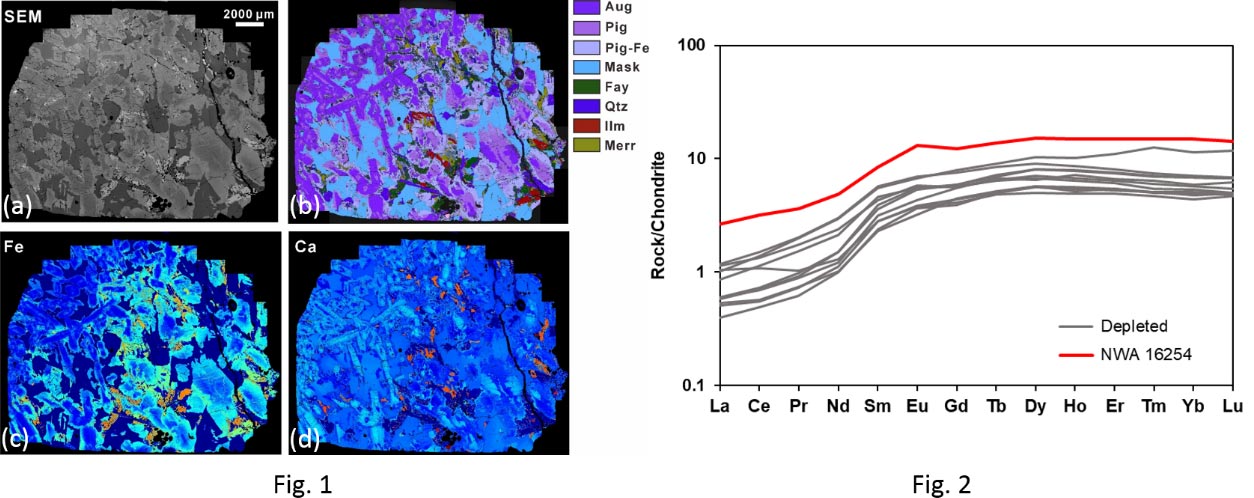
    Image of the entire NWA 16254 sample studied in this work. (a) A backscattered electron (BSE) image obtained by TIMA. (b) Mineralogical mapping via TIMA. (c) Distribution map of the iron content obtained via TIMA. (d) Distribution map of the calcium content obtained via TIMA. Aug = augite, Pig = pigeonite, Pig-Fe = Fe-rich pigeonite; Mask = maskelynite, Fay = fayalite, Qtz = quartz; Ilm = ilmenite. Fig. 2 Chondrite-normalized rare earth element patterns of whole-rock for NWA 16254 meteorite and other depleted shergottites. The gray lines represent data from Udry et al. (2020). Credit: Chen, J.-F., Tian, X., & Cao, F.

    A Unique Geochemical Signature

    The meteorite’s geochemical depletion, marked by light rare earth element (LREE) depleted (Fig. 2) and low oxygen fugacity (fO2​=IW−1.0), aligns it with the rare QUE 94201 meteorite, hinting at a shared magma source. Its gabbroic texture, indicative of slow cooling in crustal chambers, distinguishes it as a unique archive of subsurface magmatism.

    These findings challenge existing models of Martian volcanic evolution, as NWA 16254’s consistently low fO2​, corroborated by Ti3+-bearing ilmenite assemblages, implies sustained reducing conditions during crystallization. This underscores the heterogeneity of Mars’ mantle and raises questions about the planet’s redox evolution over billions of years. Future geochronological studies could resolve whether this meteorite represents ancient mantle melting (~2.4 billion years ago) or younger magmatic activity, offering clues to Mars’ thermal history.

    The study leverages state-of-the-art techniques, including TESCAN Integrated Mineral Analyzer (TIMA) mapping and laser ablation-inductively coupled plasma-mass spectrometry (LA-ICP-MS), to trace mineral zoning and trace element distributions. These methods revealed decoupled geochemical behaviors in pyroxene cores and rims—a phenomenon critical for reconstructing magma chamber dynamics. For researchers, NWA 16254’s well-preserved geochemical signatures present a prime target for isotopic analyses, potentially unlocking timelines of Martian mantle depletion and refining models of planetary differentiation.

    Reference: “Petrography and geochemistry of a newly discovered Martian gabbroic shergottite NWA 16254” by Chen Jun-Feng, Tian Xinyi and Cao Fengke, 13 May 2025, Planet.
    DOI: 10.15302/planet.2025.25002

    Never miss a breakthrough: Join the SciTechDaily newsletter.
    Follow us on Google and Google News.

    Astrobiology Geochemistry Mars Planetary Science
    Share. Facebook Twitter Pinterest LinkedIn Email Reddit

    Related Articles

    Mars Isn’t Just Red – It’s Electrically Alive, Scientists Reveal

    Harvard Scientists Grow Algae in Mars-Like Conditions, Paving Way for Space Habitats

    Scientists Discover Mysterious Earth-Like Patterns in Martian Soil

    Is Life Lurking Beneath Mars? New Seismic Study Says It’s Possible

    Clues to Martian Life? Organic Material Discovered in a Martian Meteorite

    Giant Impact Explains Unusual Amount of Noble Metals on Mars

    Biologists Reveal How Long Microorganisms Can Live on Mars

    Scientists Discover Evidence of Methane in Martian Meteorites

    Martian Meteorite Reveals the Possibility of Life on Mars

    1 Comment

    1. Rob on July 17, 2025 11:56 pm

      Magmatic history at around 2.4 billion years on Mars and at 2.35 billion years on the Moon and the Great Oxygen Crisis on Earth at 2.3-2.4 billion years ago. Anyone detecting in this coincidence the Hidden Finger of God?

      Reply
    Leave A Reply Cancel Reply

    • Facebook
    • Twitter
    • Pinterest
    • YouTube

    Don't Miss a Discovery

    Subscribe for the Latest in Science & Tech!

    Trending News

    Scientists Warn That This Common Pet Fish Can Wreck Entire Ecosystems

    Scientists Make Breakthrough in Turning Plastic Trash Into Clean Fuel Using Sunlight

    This Popular Supplement May Interfere With Cancer Treatment, Scientists Warn

    Scientists Finally Solved One of Water’s Biggest Mysteries

    Could This New Weight-Loss Pill Disrupt the Entire Market? Here’s What You Should Know About Orforglipron

    Earth’s Crust Is Tearing Open in Africa, and It Could Form a New Ocean

    Breakthrough Bowel Cancer Trial Leaves Patients Cancer-Free for Nearly 3 Years

    Natural Compound Shows Powerful Potential Against Rheumatoid Arthritis

    Follow SciTechDaily
    • Facebook
    • Twitter
    • YouTube
    • Pinterest
    • Newsletter
    • RSS
    SciTech News
    • Biology News
    • Chemistry News
    • Earth News
    • Health News
    • Physics News
    • Science News
    • Space News
    • Technology News
    Recent Posts
    • Why Your Dreams Feel So Real Sometimes and So Strange Other Times
    • Scientists Debunk 100-Year-Old Belief About Brain Cells, Rewriting Textbooks
    • This Simple Home Device May Boost Brain Power in Adults Over 40
    • Ancient Roman Ship Coating Reveals Secrets Hidden for 2,200 Years
    • Enormous Prehistoric Insects Puzzle Scientists
    Copyright © 1998 - 2026 SciTechDaily. All Rights Reserved.
    • Science News
    • About
    • Contact
    • Editorial Board
    • Privacy Policy
    • Terms of Use

    Type above and press Enter to search. Press Esc to cancel.