
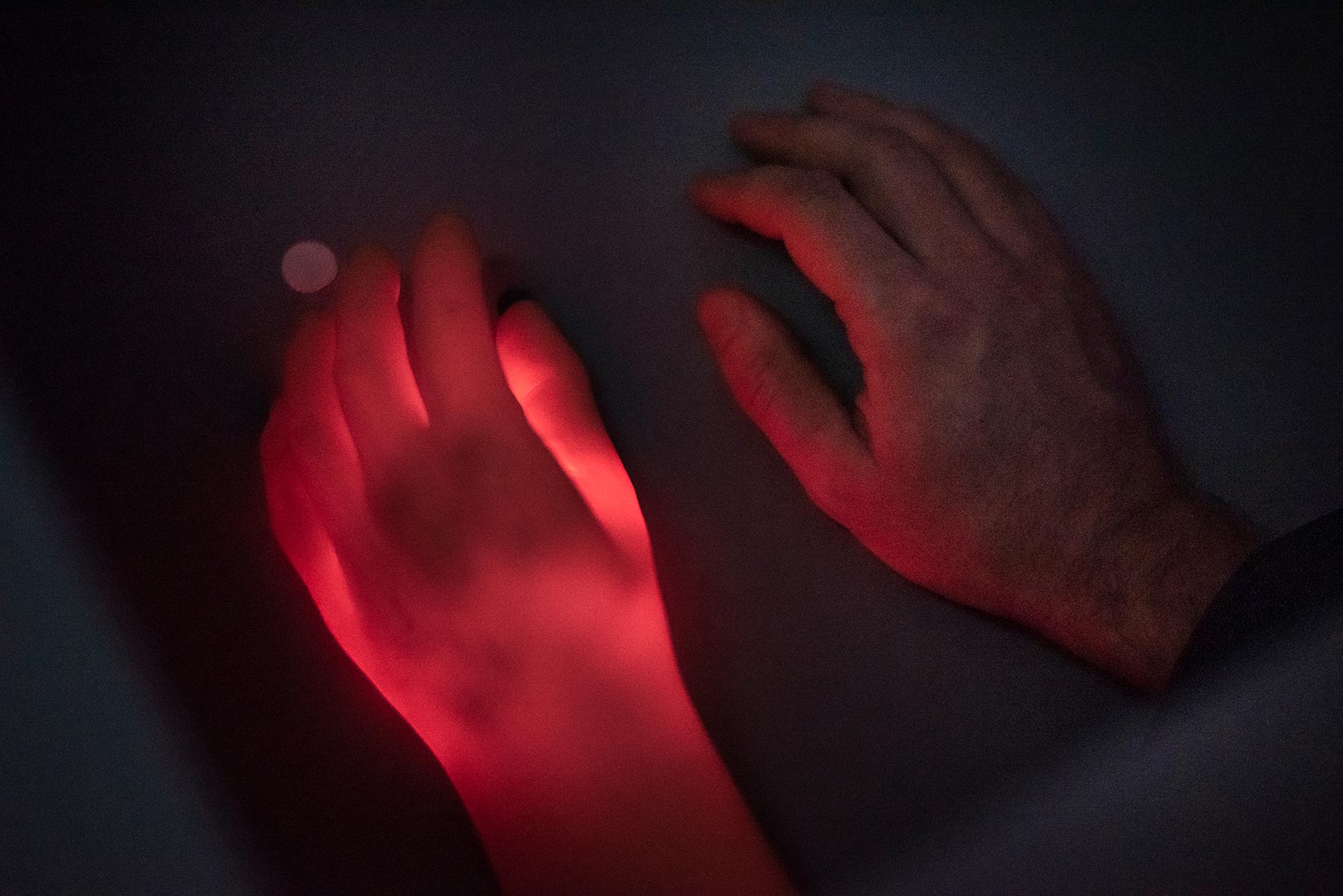
Could an illusion help relieve pain? Researchers in Germany tested the “rubber hand illusion,” a bizarre trick where people start believing a fake hand is part of their body. Instead of using touch to trigger the illusion, they applied heat and red light, discovering that this strange sensory deception reduced pain perception.
The experiment suggests that our brains can be tricked into experiencing less pain when visual and sensory information is manipulated. This could one day lead to new treatments for chronic pain conditions, proving that sometimes, seeing really is believing.
The Mind-Bending Rubber Hand Illusion
When people can’t see their own hand and instead focus on a rubber one placed in front of them, their brain can sometimes be tricked into accepting the fake hand as part of their body. While it may sound like a party trick, this illusion, known as the rubber hand illusion, could have real clinical benefits. Researchers at the Clinic for Psychosomatic Medicine and Psychotherapy at LWL University Hospital in Bochum, Germany, have found that the illusion can reduce the intensity of heat-related pain. Their findings were published in the April 2025 issue of PAIN Reports.
Heat Creates Illusion
Traditionally, the rubber hand illusion is triggered by touching both the real and fake hands simultaneously, like brushing them at the same time. However, in this study, the researchers used a different method: heat and red light.
First, they determined the heat pain threshold for each of the 34 right-handed participants. Then, each person placed their left hand behind a screen, out of view, resting it on a heated device called a thermode. In place of the visible hand, a lifelike rubber hand was positioned in front of them, illuminated from below with red light.
While the hidden hand was exposed to controlled levels of heat, participants used their right hand to move a slider and continuously rate the pain they were feeling. This setup allowed researchers to test whether the illusion could reduce pain perception without any tactile stimulation, just through visual and thermal cues.
The Illusion Reduces Pain
The researchers carried out several test runs in which they heated the thermode to several temperature levels just below the respective pain threshold, exactly at the pain threshold and just resp. significantly above it. The rubber hand was simultaneously illuminated with red light. “The heat stimulus on the left hand with simultaneous red illumination of the rubber hand evoked the illusion,” explains study supervisor Professor Martin Diers, Head of the Research Section Clinical and Experimental Behavioral Medicine.
A survey of the test participants confirmed these findings after each series of experiments. In the control condition, the researchers conducted the experiment with a rubber hand rotated by 180 degrees.
The Intensity of Pain Decreases
“We showed that the perceived pain intensity was reduced in the rubber hand illusion condition compared to the control condition,” says Martin Diers. “We assume that the mechanism behind the rubber hand illusion is the multisensory integration of visual, tactile (here nociceptive) and proprioceptive information. The findings suggest that when people perceive the rubber hand as part of their own body, this reduces their perception of pain.” Another factor could be the phenomenon of visual analgesia, which has also been shown in other studies: A pain stimulus is perceived as less intense if the person can see the relevant part of the body while it is occurring. “However, we still don’t fully understand the neural basis for this phenomenon,” admits Diers.
Future Applications in Pain Treatment
In future, the findings could possibly be used in the treatment of pain. One conceivable field of use would be the treatment of complex regional pain syndrome, for example, in which patients typically experience pain and swelling in the hand.
Reference: “Time course of the rubber hand illusion–induced analgesia” by Benjamin Mosch, Xaver Fuchs, Theresia Tu and Martin Diers, 11 March 2025, PAIN Reports.
DOI: 10.1097/PR9.0000000000001252
Never miss a breakthrough: Join the SciTechDaily newsletter.
Follow us on Google and Google News.