

Vineyard waste may hold the key to replacing plastic packaging.
The demand for biodegradable packaging has reached a critical point.
Today, most packaging is designed for single use and made from plastic derived from nonrenewable resources such as crude oil. These materials can take hundreds of years to break down once they enter the environment. Despite widespread recycling efforts, only about 9% of plastic is actually recycled. As a result, massive accumulations of plastic waste have formed in the ocean, including the area known as the “Great Pacific Garbage Patch.”
Even more troubling is the spread of microplastics and nanoplastics throughout the environment. Studies have shown that plastic gradually fragments into microscopic particles that can be inhaled or swallowed by both animals and people. These particles have been detected nearly everywhere scientists have looked, including inside the human body — according to recent research studies. Adding to the concern, researchers still know very little about the long-term health effects of exposure to microplastics.
A Researcher Focused on Reducing Plastic Waste
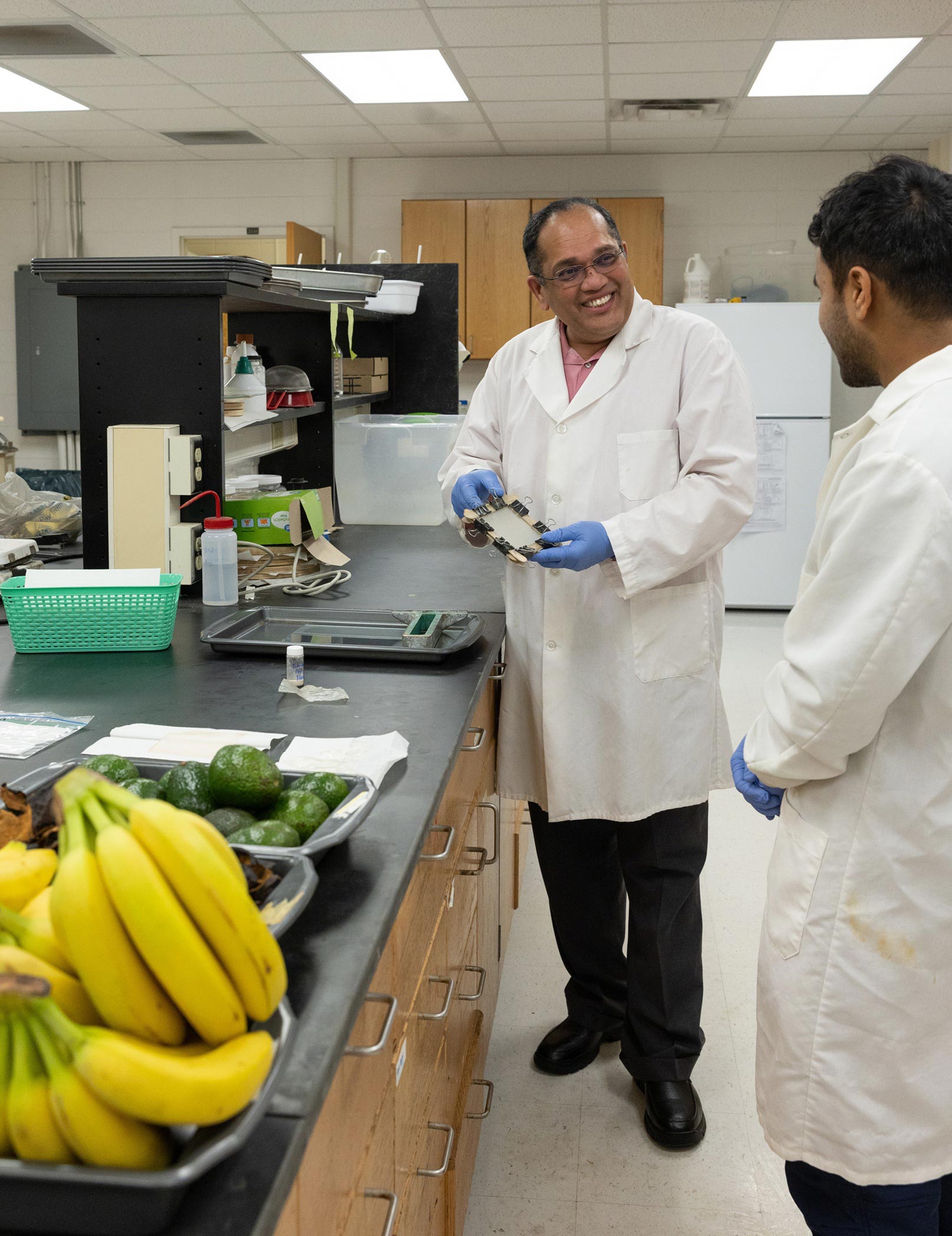
Srinivas Janaswamy is an associate professor in South Dakota State University’s Department of Dairy and Food Science. His work centers on creating higher-value products from biowaste and agricultural leftovers. A central aim of his research is to find practical solutions to the growing plastic waste problem.
Plastic bags, especially those used at retail stores, are among the largest contributors to plastic pollution in the United States. While some bags are recycled, many are used only once and frequently end up as litter in natural environments.
To help address this issue, Janaswamy has been working toward designing a plastic-like bag that can safely break down after disposal.
“That is my dream,” Janaswamy said.
Cellulose: Nature’s Most Abundant Building Block
At the heart of Janaswamy’s approach is cellulose. This natural biopolymer is the most abundant organic compound on the planet and is found mainly in the cell walls of plants. The structure of cellulose, built from long chains of glucose molecules held together by strong hydrogen bonds, provides plants with strength and rigidity. Other biopolymers, including mannan, xylose, hemicellulose and lignin, also contribute to plant structure.
Cellulose has been used by humans for centuries. Cotton, which makes up most of the world’s clothing, is largely composed of cellulose. Wood is another major source of this material.
In earlier studies, Janaswamy successfully extracted cellulose from a wide range of agricultural materials, including avocado peels, soyhulls, alfalfa, switchgrass, spent coffee grounds, corncob and banana peels. The recovered cellulose was then used to create thin films that resemble conventional plastic wrap in both appearance and texture.
“By extracting cellulose from agricultural products, value-added products can be created,” Janaswamy said.
Each type of film produced from these sources showed different properties. Some were clearer, while others were tougher. A new collaboration, however, opened the door to what may be Janaswamy’s most promising material yet.
Grapevine Canes Offer a New Opportunity
Janaswamy had recently presented “Ag Biomass – A Holy Grail to Clean up the Plastic Mess” at SDSU’s Celebration of Faculty Excellence when he was approached by Anne Fennell, a Distinguished Professor in the Department of Agronomy, Horticulture and Plant Science and a colleague in the College of Agriculture, Food and Environmental Sciences.
Fennell, an expert in grapevine research, recognized a new opportunity after hearing Janaswamy speak. She knew that grapevine canes — the woody stems that support grape growth — contain high levels of cellulose. She also knew that these canes are produced in large quantities and have limited uses once grapes are harvested.
“Every year we prune the majority of yearly biomass off the vine,” Fennell said. “The pruned canes are either mowed over, composted and reapplied to the soil, or burned in some areas. Research in Australia showed that prunings could be removed from the field in alternate years without effecting soil health. My thought was why not use this for value added films. Several of the materials that Janaswamy previously used had a high-water content, in contrast the winter pruning yields a cellulose-dense material with low water content, making them an abundant ideal material to work with.”
Her suggestion led to a collaboration, and Janaswamy soon began extracting cellulose, which visually resembles cotton, from grapevine canes. The films produced from this material exceeded expectations.
Strong, Transparent Films That Break Down Quickly
A recent study published in the academic journal Sustainable Food Technology reported that films made from grapevine canes are both transparent and mechanically strong. When placed in soil, they fully biodegraded within 17 days, leaving no harmful residue.
“High transmittance in packaging films enhances product visibility, making them more attractive to consumers and facilitating easy quality inspection without the need for unsealing,” Janaswamy said. “These films demonstrate outstanding potential for food packaging applications.”
The grapevine canes used in the research were collected from SDSU’s research vineyard. The research team included doctoral candidates Sandeep Paudel and Sumi Regmi, along with Sajal Bhattarai, an SDSU graduate and a doctoral candidate at Purdue University. The team followed an established process that involved drying and grinding the canes, extracting the cellulose, dissolving the residue, and casting it onto glass plates to form films.
Testing showed that the grapevine-based films were stronger than traditional plastic bags when measured by tensile strength.
“Using underutilized grapevine prunings as a cellulose source for packaging films enhances waste management in the field and addresses the global issue of plastic pollution,” Janaswamy said. “Developing eco-friendly films from grapevine cellulose represents a practical approach to sustainability, helping to conserve the environment and its resources and contributing to the circular bioeconomy.”
This research brings Janaswamy closer to his long-term goal of creating a plastic-like bag that can quickly and safely decompose once it enters the environment.
Reference: “Valorization of grapevine agricultural waste into transparent and high-strength biodegradable films for sustainable packaging” by Sandeep Paudel, Sumi Regmi, Sajal Bhattarai, Anne Fennell and Srinivas Janaswamy, 20 June 2025, Sustainable Food Technology.
DOI: 10.1039/D5FB00211G
Funding for this research was provided by the U.S. Department of Agriculture’s National Institute of Food and Agriculture and the National Science Foundation. This original story was authored by Addison DeHaven, South Dakota State University.
Never miss a breakthrough: Join the SciTechDaily newsletter.
Follow us on Google and Google News.
1 Comment
thanks for this