

Researchers present first complete control map for KRAS, laying out a fresh blueprint for targeting ‘undruggable’ proteins.
Researchers at the Centre for Genomic Regulation in Barcelona, Spain, and the Wellcome Sanger Institute near Cambridge, UK, have comprehensively identified the allosteric control sites found in the protein KRAS. These are highly sought-after targets for drug development, representing secret vulnerabilities that can be exploited to control the effects of one of the most important causes of cancer. The study presents the first complete control map for any protein and was published on December 18 in the journal Nature.
KRAS: A Key Target in Cancer Treatment
KRAS is one of the most frequently mutated genes in cancers of many types. It is found in 1 in 10 human cancers, with higher prevalence in deadly types such as pancreatic or lung cancers. It has been called the ‘Death Star’ protein because of its spherical shape and lack of a good site to target with drugs. For this reason, KRAS has been historically considered ‘undruggable’ since it was first discovered in 1982.
Allosteric Sites: The Key to Controlling KRAS
The only effective strategy to control KRAS has been by targeting its allostery communication system. These are molecular signals that work through a remote-control lock and key mechanism. To control a protein, you need a key (a chemical compound or drug) that can open a lock (active site). Proteins can also be influenced by a secondary lock (allosteric site) which lies elsewhere on its surface. When a molecule binds to an allosteric site, it causes a change in the protein’s shape, which can alter the protein’s activity or its ability to bind to other molecules, for example by changing the internal structure of its main lock.
Challenges in Allosteric Drug Development
Allosteric sites are often preferred for drug development as they offer greater specificity, reducing the likelihood of side effects. They can also change a protein’s activity more subtly, offering potential for fine-tuning its function. Drugs that target allosteric sites are generally safer and more effective compared to drugs targeting active sites.
However, allosteric sites are highly elusive. Despite four decades of research, tens of thousands of scientific publications, and more than three hundred published structures of KRAS, only two drugs have been approved for clinical use — sotorasib and adagrasib. The drugs work by attaching to a pocket adjacent to the active site, inducing an allosteric conformational change in the protein that prevents it from being activated.
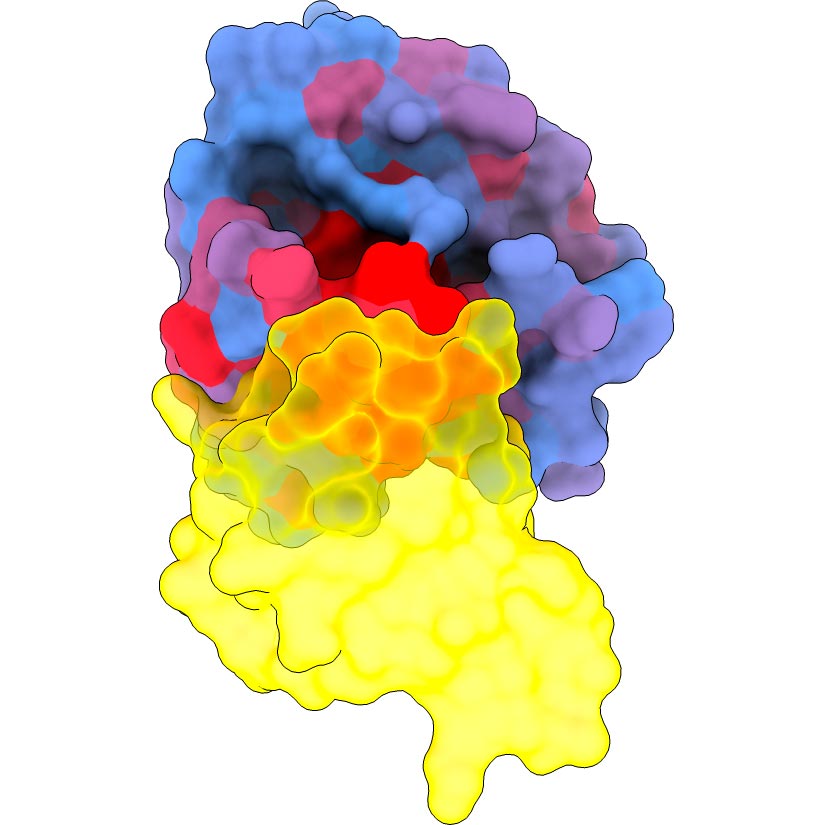
Video showing different angles the human protein KRAS (blue) interacting with RAF1 (yellow), one of its main partners. The blue-to-red color gradient indicates increasing potential for allosteric effects. The video highlights new and existing pockets that have the potential to control the function of KRAS through allosteric inhibition. Credit: Weng, Faure and Escobedo/Centro de Regulación Genómica
“It took decades to produce a working drug against KRAS partly because we lacked tools to identify allosteric sites at scale, meaning we were looking for therapeutic target sites in the dark. In this study, we demonstrate a new approach that can map allosteric sites systematically for entire proteins. For the purposes of drug discovery, it’s like turning the lights on and laying bare the many ways we can control a protein,” explains Dr. André Faure, staff scientist at the Centre for Genomic Regulation and co-author of the study.
Promising Drug Targets on KRAS Protein
The authors of the study mapped the allosteric sites by using a technique called deep mutational scanning. It involved creating over 26,000 variations of the KRAS protein, changing only one or two building blocks (amino acids) at a time. The team checked how these different KRAS variations bind to six other proteins, including those critical for KRAS to cause cancer. The researchers used AI software to analyse the data, detect allostery and identify the location of known and new therapeutic target sites.
“The unique selling point of our method is its scalability. In this work alone we made more than 22,000 biophysical measurements, a similar number as the total ever made for all proteins before we started harnessing the remarkable strides in DNA sequencing and synthesis methodologies. This is an enormous acceleration and demonstrates the power and potential of the approach,” explains Chenchun Weng, first author of the study and postdoctoral researcher at the Centre for Genomic Regulation.
The technique revealed that KRAS has many more strong allosteric sites than expected. Mutations in these sites inhibited the protein’s binding to all three of its main partners, suggesting that broadly inhibiting the activity of KRAS is possible. A subset of these sites are particularly interesting as they are located in four different pockets easily accessible on the surface of the protein, and represent promising targets for future drugs.
The authors of the study highlight one in particular – ‘pocket 3’ – as particularly interesting. This pocket is located far away from the active site of KRAS and so has previously received very little attention from pharmaceutical companies.
The researchers also found that small alterations in KRAS can drastically change its behavior with its partners, making the protein prefer one over another. This has important implications because it could lead to new strategies that control the aberrant activity of KRAS without hampering its normal function in non-cancerous tissues. Sparing normal versions of KRAS means fewer side effects, and safer, more effective treatments. Researchers could also use this knowledge to dig further into the biology of KRAS and explain how the protein behaves in various scenarios, which could be key to determining its role in different cancer types.
New Blueprint to Drug the ‘Undruggable’
The study provides the first-ever complete map of allosteric sites for any complete protein in any species. The research shows that with the right tools and techniques, like the ones they used to map KRAS, new vulnerabilities can be uncovered for many different medically-important proteins that have historically been considered ‘undruggable’.
“The big challenge in medicine isn’t knowing which proteins are causing diseases but not knowing how to control them. Our study represents a new strategy to target these proteins and speed up the development of drugs to control their activity. The nature of targeting allosteric sites means that the resulting drugs are likely to be safer, more effective treatments than the ones we have right now,” concludes ICREA Research Professor Dr. Ben Lehner, senior author of the study from the Centre for Genomic Regulation and the Wellcome Sanger Institute.
Reference: “The energetic and allosteric landscape for KRAS inhibition” by Chenchun Weng, Andre J. Faure, Albert Escobedo and Ben Lehner, 18 December 2023, Nature.
DOI: 10.1038/s41586-023-06954-0
Never miss a breakthrough: Join the SciTechDaily newsletter.
Follow us on Google and Google News.
2 Comments
My injuries on my body keep matching up with the galaxy in the activity
Wish you well.