
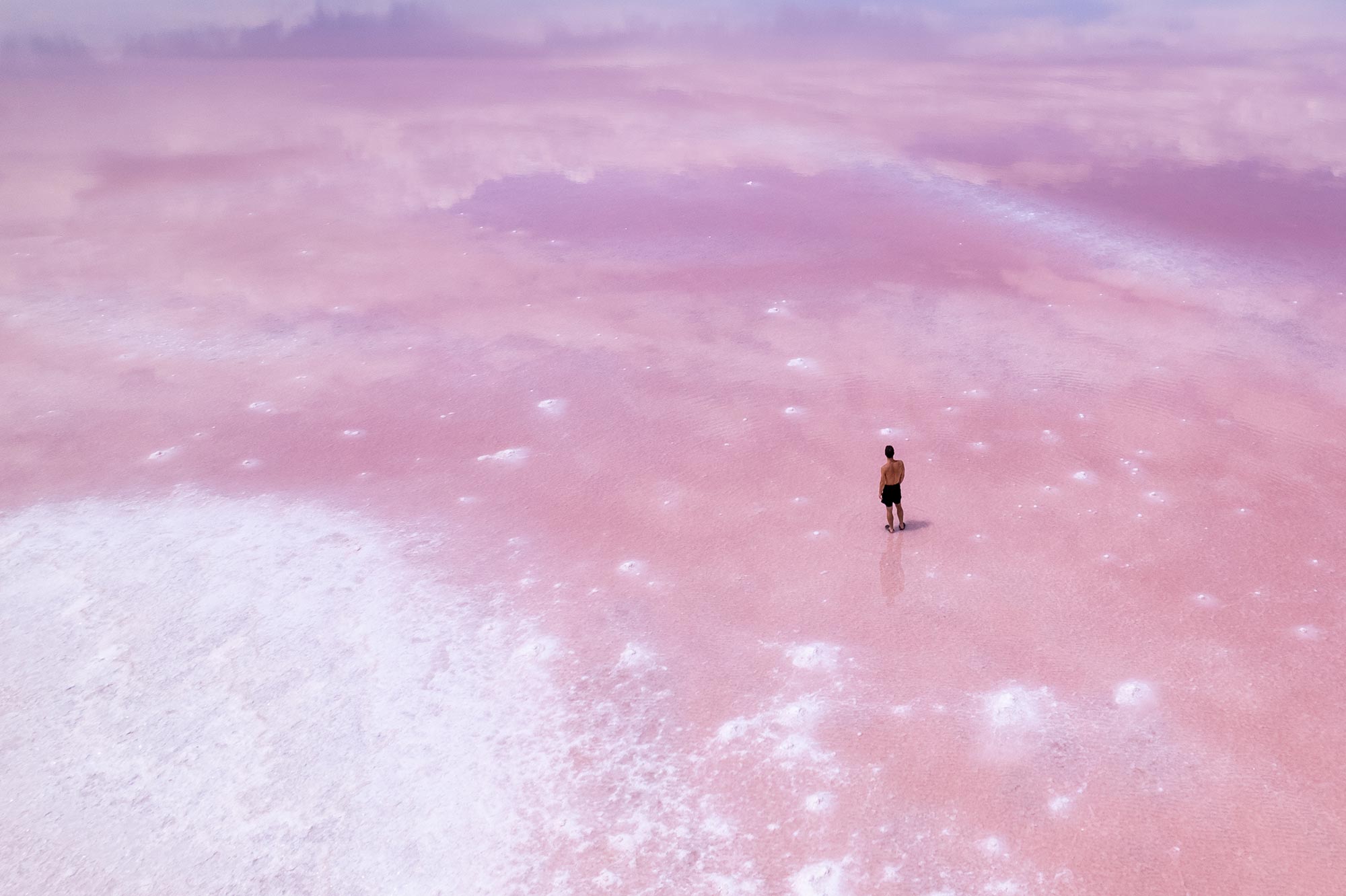
University of Utah geologists study reed-covered mounds that mark locations where ancient groundwater emerges at the surface.
As water levels in the Great Salt Lake continue to drop, a new and unusual feature has emerged, giving Utah scientists another chance to investigate the lake’s many mysteries.
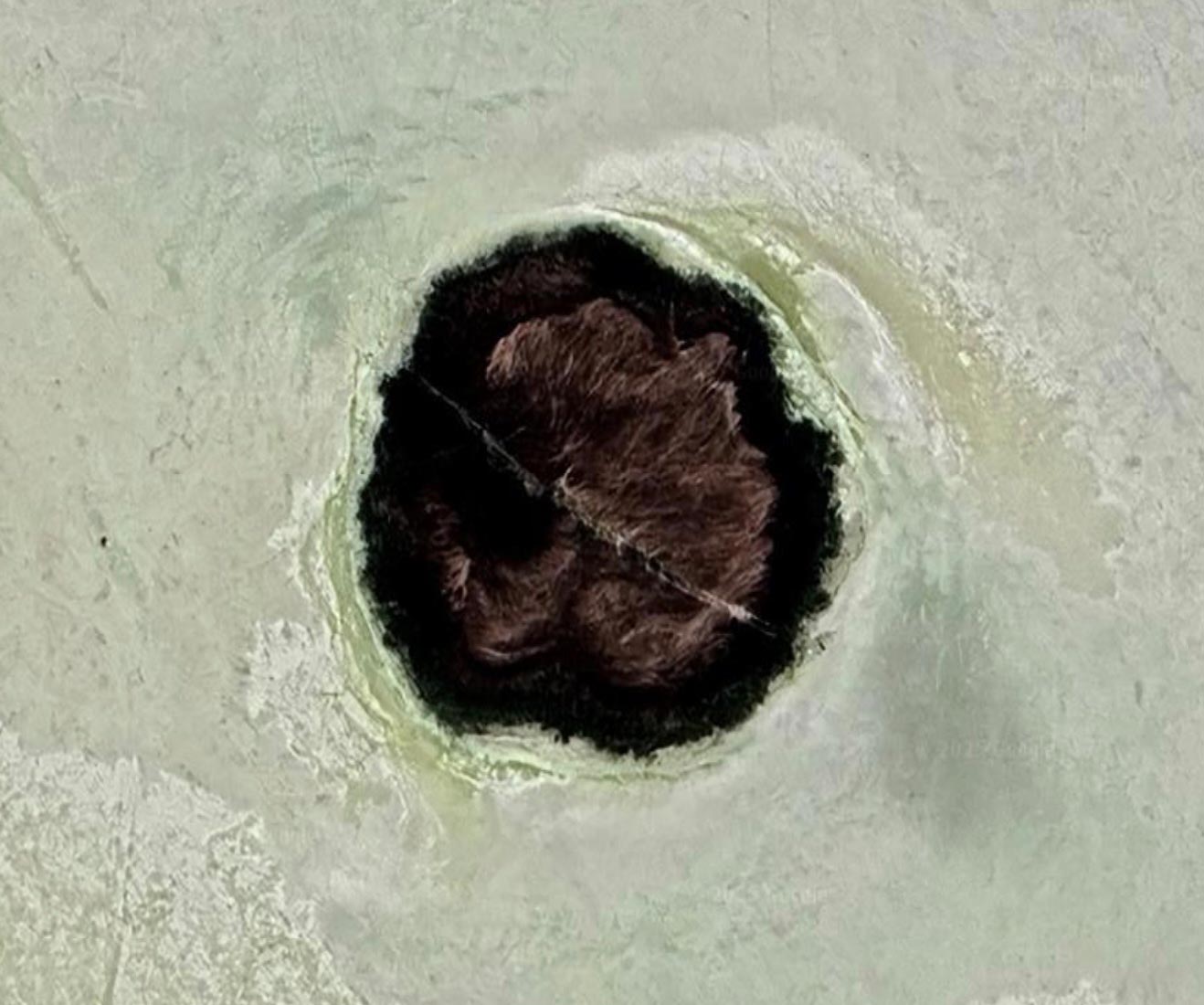
In recent years, clusters of phragmites-covered mounds have appeared on the exposed playa along the lake’s southeastern edge. For some time, these formations puzzled researchers. Now, using a network of piezometers and aerial electromagnetic surveys, University of Utah geoscientists are uncovering what is happening beneath the lakebed to create these dense reed-filled patches.
Bill Johnson, a professor in the Department of Geology & Geophysics, believes the circular mounds form where pressurized groundwater from below finds its way to the surface, feeding the lake and its surrounding wetlands.
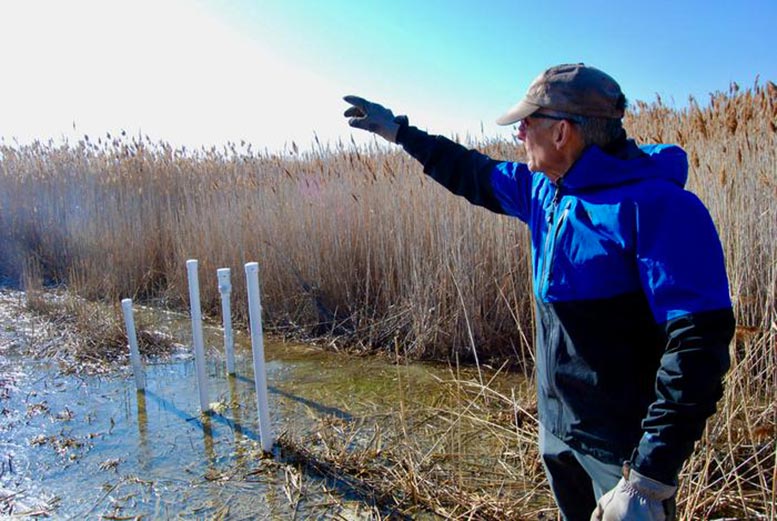
“Water in the lake has spent a significant time underground on its way to the lake. But where that happened, we don’t know,” Johnson explained during a visit to one such site, known as Round Spot 9. “Did that happen somewhere in the uplands where the water spent time in the ground and emerged in the stream before going to the lake? Or was it transmitted directly to the lake?”
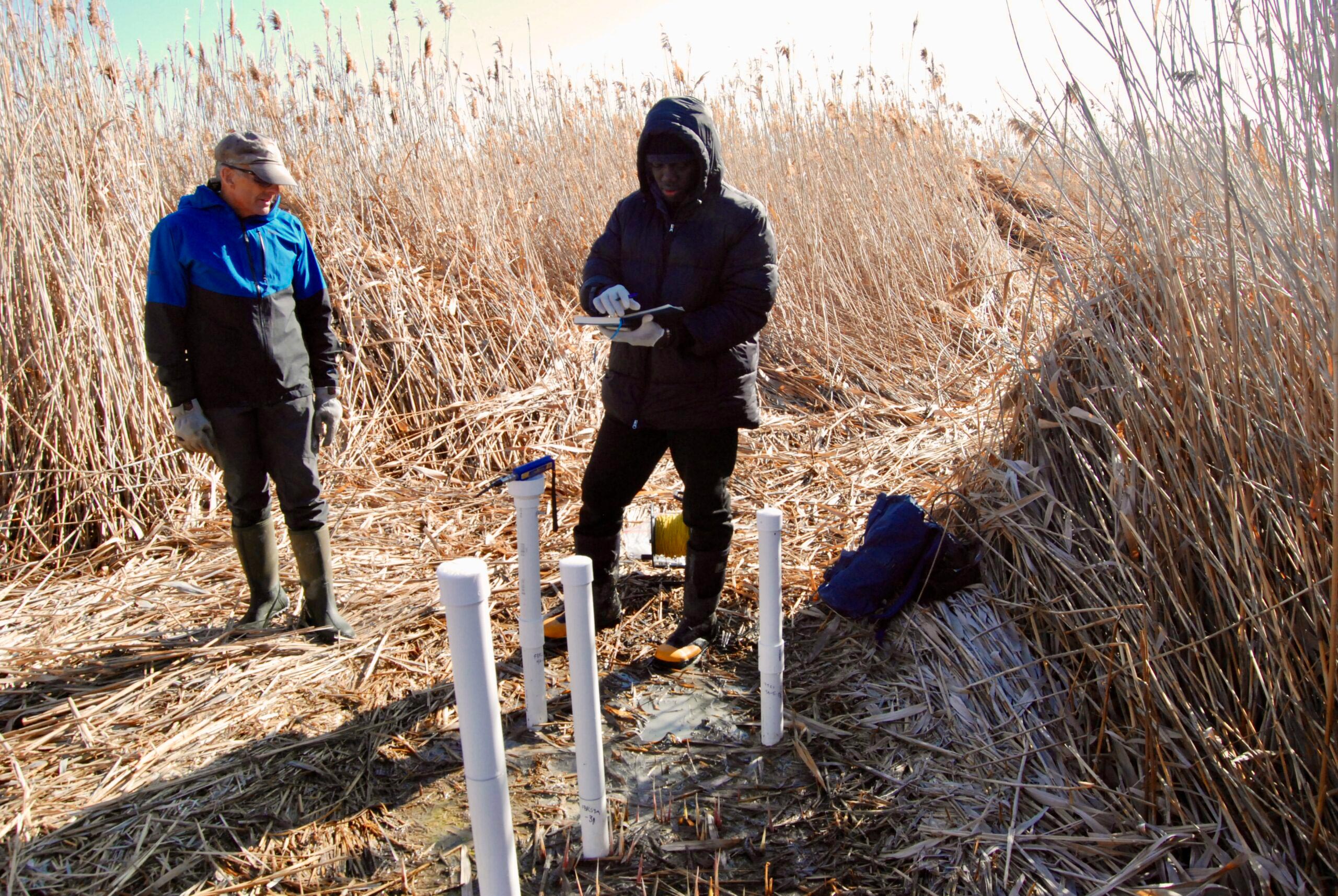
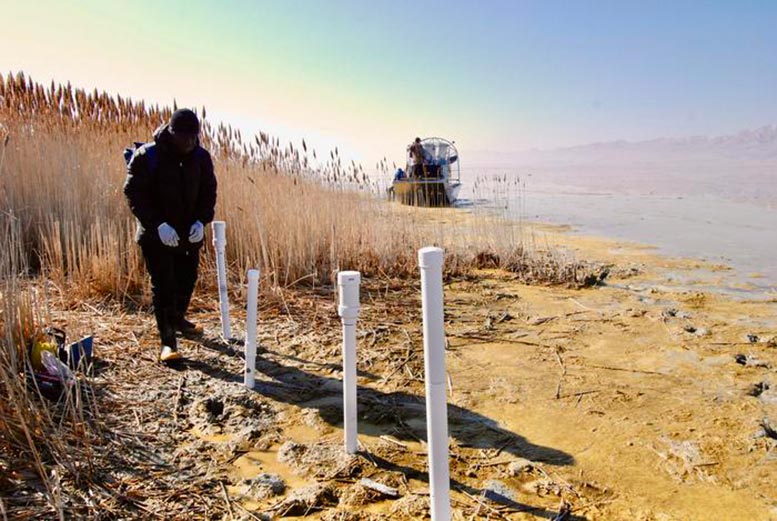
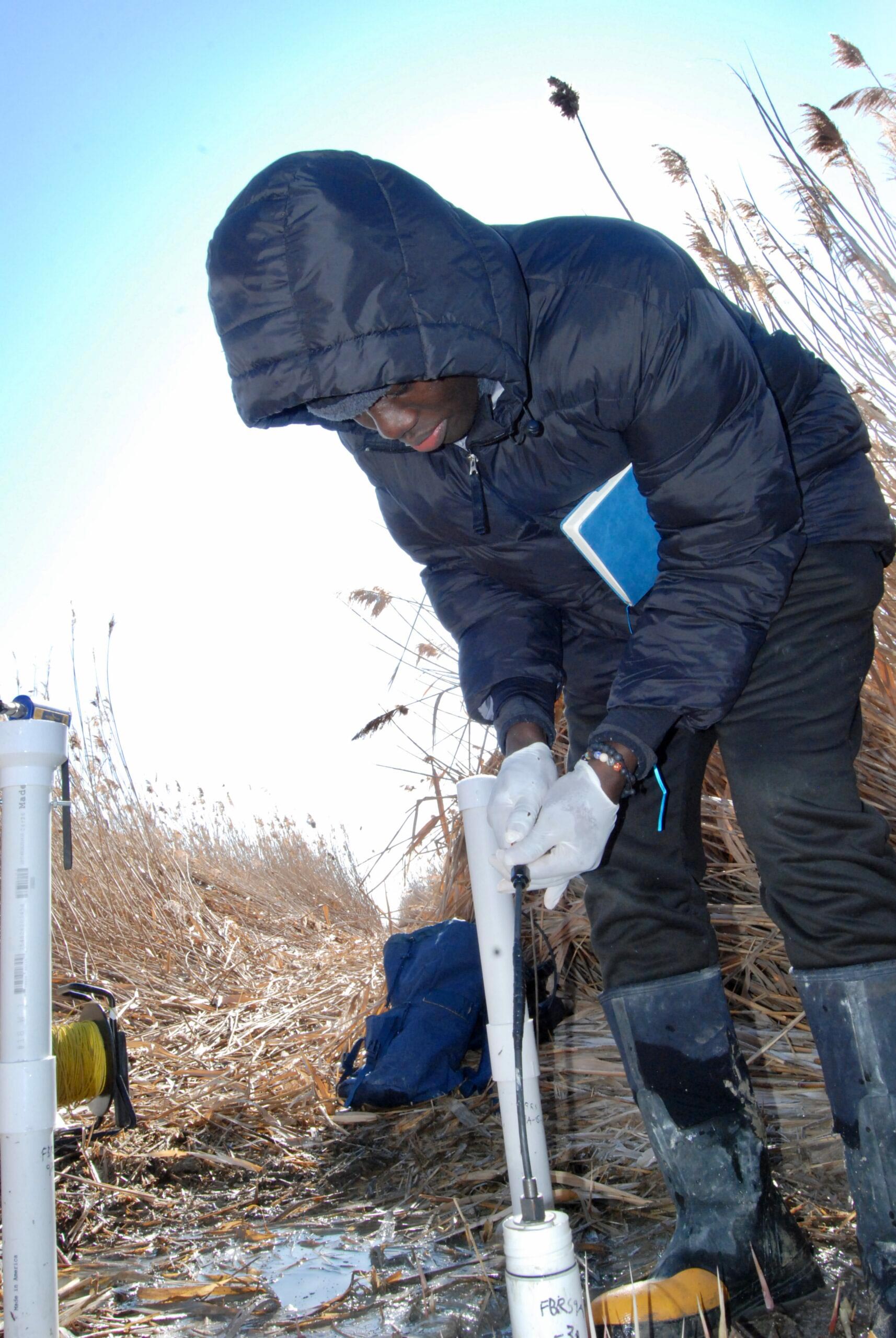
On that day, Johnson and graduate student Ebenezer Adomako-Mensah were inspecting piezometers installed the previous year, designed to measure underground water pressures at multiple depths and positions around the mound.
Mapping the lakebed’s subsurface
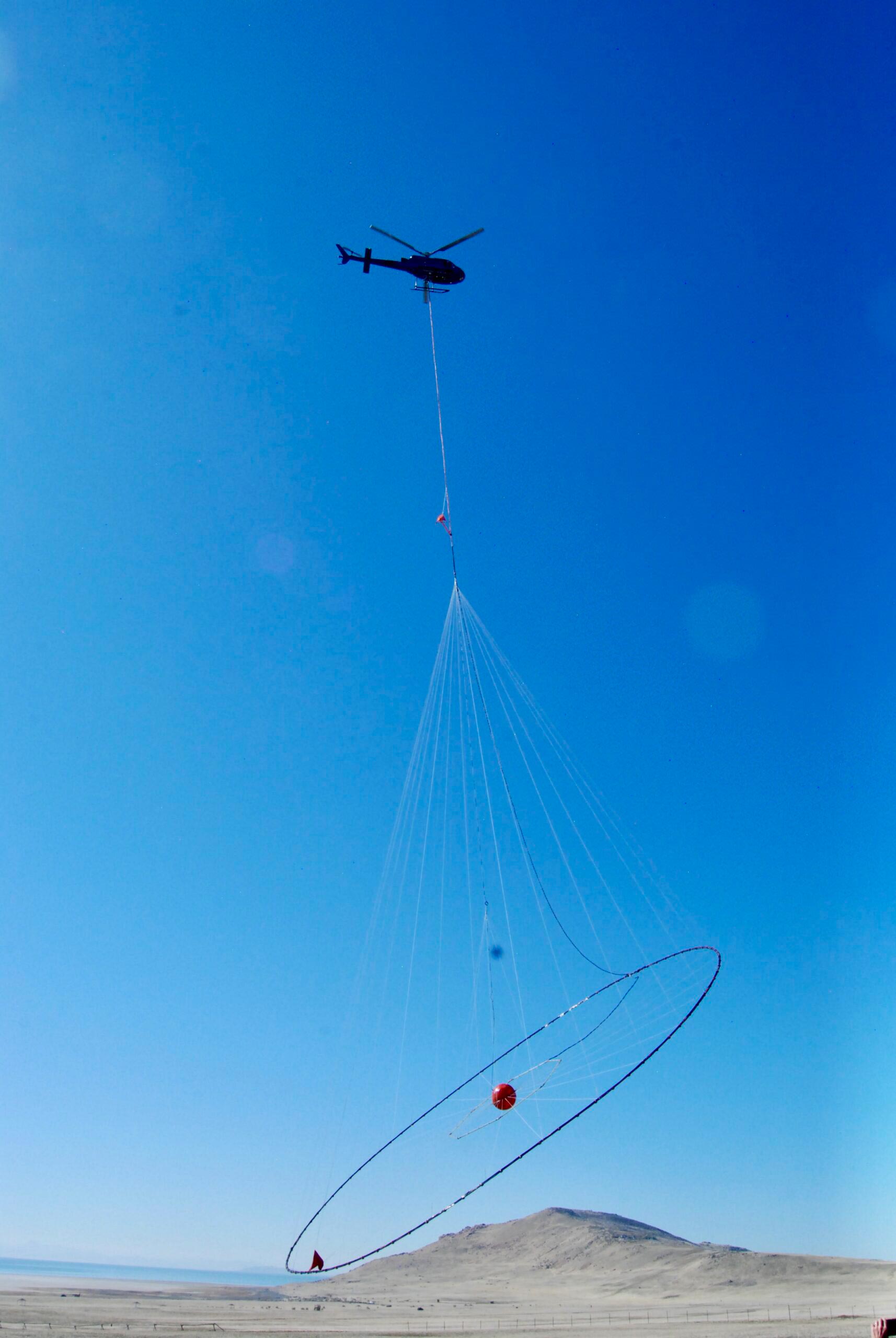
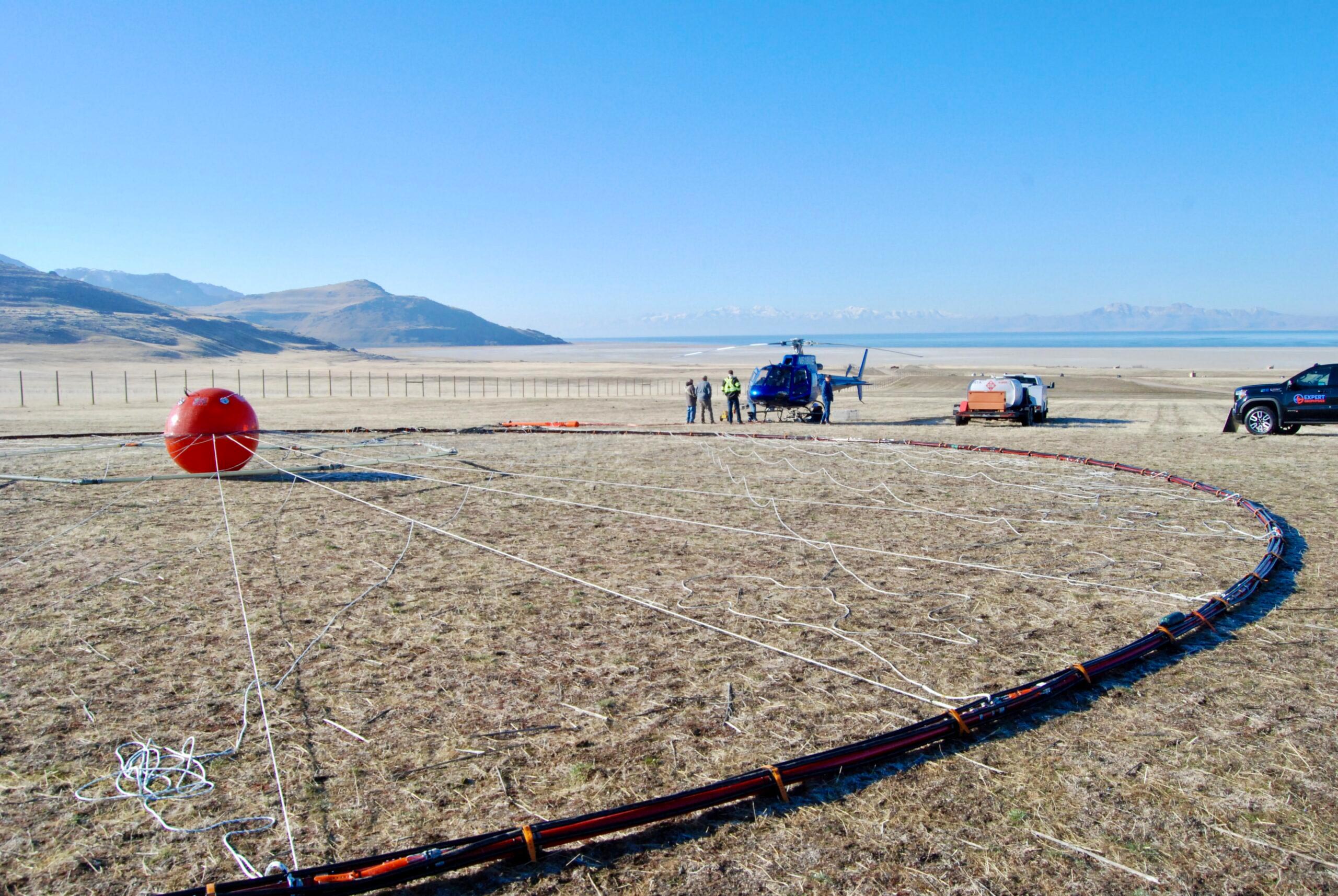
In February 2025, Johnson brought in the Canadian company Expert Geophysics to perform airborne electromagnetic surveys over Farmington Bay. Using a large circular sensor suspended beneath a helicopter, the pilot flew a grid across the bay to gather data that could pinpoint hidden freshwater beneath the lakebed.
The system works by sending an electrical current through the loop, producing a frequency that penetrates deep into the ground. A receiver housed inside a spherical unit at the center of the loop captures the returning electromagnetic signals.
“It’ll give you a spectrum, basically, of magnetic fields, and we’ll use that data to create a 3D image of what’s under the earth,” explained Jeff Sanderson, crew leader at Expert Geophysics.
With the lake’s low levels persisting, the exposed lakebed has become an increasing source of windblown dust, which can impact nearby urban areas. Research by University of Utah atmospheric scientists indicates that when submerged, disturbed lakebed crusts—which hold sediment in place—can recover. Johnson hopes to determine whether groundwater could be used to restore these crusts and reduce dust emissions.
“It looks like it’s from a water resource that could be useful in the future, but we need to understand it and not overexploit it to the detriment of the wetlands,” Johnson said. He has served on the Great Salt Lake Strike Team, a joint effort between the university and state agencies aimed at finding solutions to the lake’s decline.
Following the surveys, Johnson secured initial funding from the Utah Department of Natural Resources to further investigate and characterize the subsurface freshwater. The team includes senior geology faculty members Kip Solomon, Mike Thorne, and Michael Zhdanov. Their work involves mapping the size and location of the resource and determining its properties.
Solomon’s lab is applying isotope analysis to find the age of the groundwater and its recharge elevation, identifying where it originated in the mountains. Thorne is building on-ground resistivity profiles, while Zhdanov and Michael Jorgensen are using the airborne survey results to create a detailed 3D subsurface model.
“We hope to map out the boundary between fresh water and salt water, and find the location of freshwater springs that are discharging groundwater into the lake,” said Solomon, who recently presented results at the Geochemical Society’s 2025 Goldschmidt conference in the Czech Republic.
For Johnson, the investigation began years earlier while traveling the lake’s North Arm in an airboat. He noticed a large circular disturbance—twice the size of the boat—where water and gas were churning to the surface, hinting at pressurized groundwater entering the lake. When he dropped a 30-foot depth gauge into the swirl, it never reached the bottom of the shallow lake.
“I always wondered what the heck that was, because it seemed like groundwater was coming to the system at a huge rate,” he recalled. Later, he and others spotted mounds on Google Earth images of the Farmington Bay playa, sparking the current line of research.
Where does the groundwater come from?
Previously, it was believed that direct groundwater discharge accounts for just 3% of the lake’s water budget, but recently gathered data using chemical mass balance methods indicate it may be as much as 12% and new insights are emerging.
For starters, Johnson’s team has found that fresh water at depth in several spots far offshore.
“We didn’t expect that. We expected that fresh water would be coming into the system at the periphery, farther away from the lake,” he said, “and yet there it is, all the way underneath the causeway in Farmington Bay.”
Johnson’s team has located freshwater almost everywhere they looked in tight sediments 30 feet below the surface. The new geophysical data indicate these sediments are up to 10,000 feet deep.
“We don’t know if it’s freshwater that deep, but it is certainly going to be fresh a long way down, and it could be fresh all the way down,” Johnson said. “The last thing I want to do is get this hyped as a water resource, but it’s very clear, and it’s under pressure. And in my mind, it could help mitigate any dust generation on the exposed playa.”
The focus of Johnson’s research homes in on one of at least 18 mounds detected off the lake’s southeast shore, most of them choked with thickets of phragmites, the water-hogging invasive reed cluttering the lakeshore.
A vast underground plumbing system
On Round Spot 9 in Farmington Bay, Johnson’s team has installed three sets of four piezometers at various distances from the edge of the 250-foot-diameter island. The four instruments are placed at varying depths, 7, 11, 30, and 60 feet, connected to the surface via white PVC pipes.
Accompanied by grad students like Adomako-Mensah, Johnson has regularly visited the site this year by mountain bike or airboat to recover data that is already telling an interesting story.
Near-surface water is the purest measured at the center of the mound and gets progressively more saline as you move closer to the edge, while deep water is fresh at all locations. In other words, the groundwater is not reaching the surface on the periphery of the island, but mostly at the center. Why?
“Those show that the fresh water in the center is pressured the deeper you go; the more hydraulic head it has. It really wants to come up,” Johnson said. “And that’s true also in the perimeter, but it’s freshwater at depth there. It’s not coming up because it’s capped.”
Johnson believes there are hundreds of these groundwater-fed oases scattered across Great Salt Lake’s exposed playa, suggesting the presence of a vast underground reservoir connected to the surface by a plumbing system that is only now getting close study, thanks in part to the lake’s decline.
With his colleagues’ help, the geologist hopes to discover where the water came from, when it fell as snow and most critically, how much is there.
“The last thing we wanted to do is for this to be characterized as a water resource we should be tapping,” he said. “It’s much more fragile than that, and we need to understand it better.”
Meeting: Geochemical Society’s 2025 Goldschmidt Conference
Funding: Utah Department of Natural Resources
Never miss a breakthrough: Join the SciTechDaily newsletter.
Follow us on Google and Google News.
4 Comments
Like always I hope someday all this stuff will tell us how important trees are and how large of a water storage. capacitor treesis roots and leafs along with the accumulated duff and soil make the water reservoir it is and how treesturn marine salt laden moisture into fresh water that is ionized not like the water produced from fossils and forest fires
This is works of God all great and Joseph Smith and Book of Mormon. It happens in mysterious ways.
Scientists love mysteries! God has provided more mysteries than any scientist can ever ask for.
I have reviewed the pressurized freshwater located beneath the expansive Salt Lake and noted your extensive research utilizing time domain electromagnetic airborne surveys, piezometers, groundwater inventories, and hydrochemical analyses. Excellent work! While I understand you may already have plans in place, I suggest tracing the origins of the deep aquifers beneath the Salt Lake. It would be beneficial to analyze the correlation of boundary anomalies from the electromagnetic data alongside isotope hydrology, employing both global and local meteoric water lines. Additionally, verifying the age and residence time of the groundwater could provide insights into the natural processes that led to its accumulation in that area.